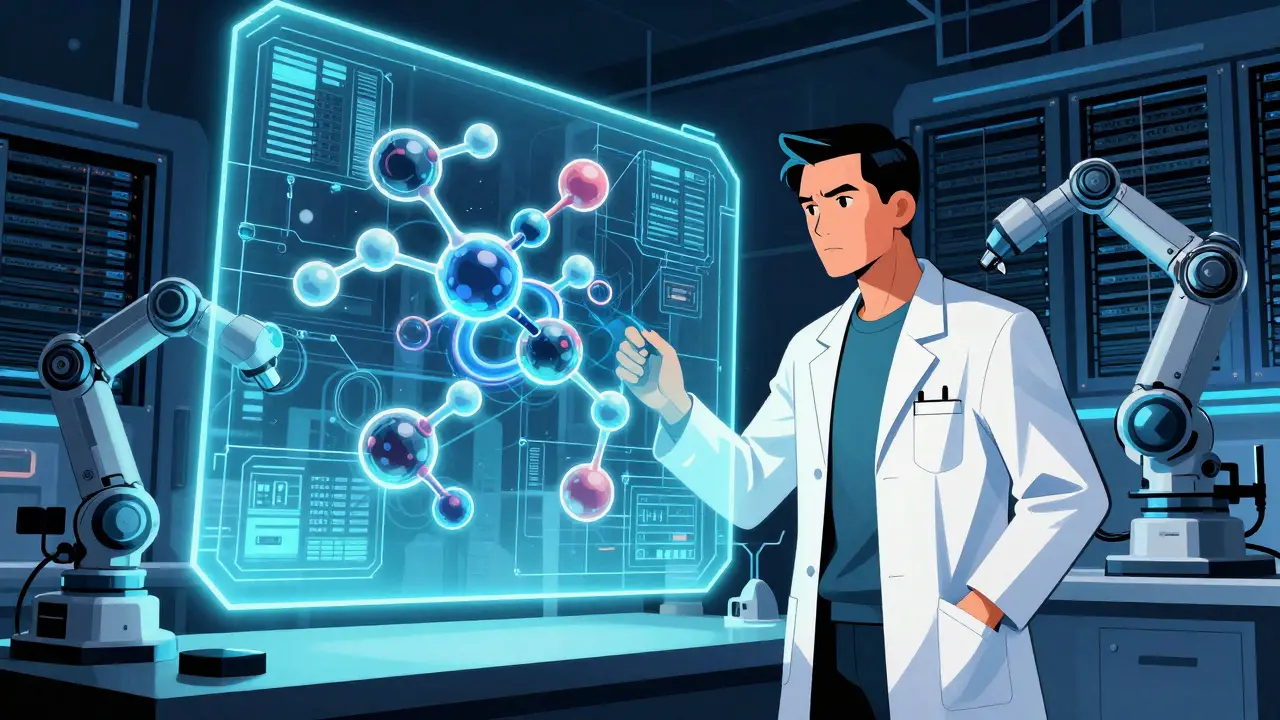
Imagine designing a new life-saving drug in minutes instead of years. That is the promise of Generative AI in biotechnology. For decades, bringing a single drug to market cost approximately $2.6 billion and took 10 to 15 years. Today, that timeline is shrinking. But there is a catch. The technology works beautifully on screens, yet it often hits a wall when researchers try to build those molecules in real labs. The missing link? Your lab notebook.
The Chemical Space Problem
To understand why we need AI, you have to grasp the scale of the problem. Chemists estimate there are roughly 10^60 possible drug-like molecules. To put that in perspective, that number is larger than the number of atoms in the known universe. Humans cannot search this space manually. We rely on intuition and trial and error, which is slow and expensive.
Generative AI changes the game by navigating this vast chemical space efficiently. Instead of screening existing libraries, these models create novel molecular structures from scratch. They do not just pick from a menu; they cook up new recipes based on specific ingredients you request, such as binding affinity or low toxicity. This approach addresses the core bottleneck of traditional drug discovery: finding the needle in an infinitely large haystack.
How Molecule Generation Works
The field has evolved rapidly since 2020. Early attempts used Variational Autoencoders (VAEs) and Generative Adversarial Networks (GANs). While groundbreaking at the time, they often produced invalid chemical structures. Today, diffusion models and transformer architectures dominate the landscape.
Here is how modern systems operate:
- Data Input: Models train on curated datasets containing 1 to 10 million molecular structures, often represented in SMILES format or as graphs.
- Generation Process: Algorithms like PRODIGY (PROjected DIffusion for controlled Graph Generation) use diffusion processes to generate molecules. Unlike older methods, PRODIGY allows precise control over constraints, such as exact atom counts and bond types.
- Validation: Outputs are checked against metrics like Quantitative Estimate of Drug-likeness (QED). A score above 0.6 indicates a viable candidate. Systems also check synthesizability and binding affinity.
Performance benchmarks show significant gains. Modern generative AI systems can design molecules with specified properties 10 times faster than previous methods. Generation times have dropped from hours to mere minutes per candidate. However, validity remains a challenge. Diffusion models like GCDM (Geometry-Complete Diffusion Models) achieve 94.2% validity on standard datasets, compared to 87.6% for GAN-based methods. Still, that means nearly 6% of generated molecules are chemically impossible.
| Architecture | Validity Rate | Novelty Score | Key Limitation |
|---|---|---|---|
| VAE / GAN | 77-87% | Baseline | Invalid structures, limited diversity |
| Diffusion Models (GCDM) | 92-94% | +30% vs Baseline | High compute requirements |
| Graph-Based (JTVAE) | 93% | High | Resource intensive, slower inference |

The Synthesis Gap: Why Screens Lie
This is where things get tricky. You might generate a perfect molecule on your screen, but can you actually build it? This disconnect is known as the "synthesis gap." According to a 2023 analysis in Nature Reviews Drug Discovery, only 30-40% of AI-generated molecules prove synthesizable in laboratory conditions.
Why does this happen? Most current models operate in a 2D chemical space fantasy. Biology happens in 3D. As Professor Regina Barzilay of MIT noted in May 2024, current models lack robust spatial reasoning capabilities. They predict flat structures that may fold into unstable shapes or react unpredictably when exposed to reagents.
User feedback reflects this frustration. In a July 2024 discussion on Reddit’s r/bioinformatics community, one organic chemist shared, "I've had 3 out of 5 AI-designed molecules fail at the synthesis stage due to unanticipated reactivity." While 68% of researchers reported positive experiences with hit identification speed, the failure rate at the bench remains a major pain point. The most successful teams adopt a "closed-loop" approach, iterating between in-silico predictions, docking simulations, and routine medicinal chemistry filters before attempting synthesis.
Integrating with Electronic Lab Notebooks (ELNs)
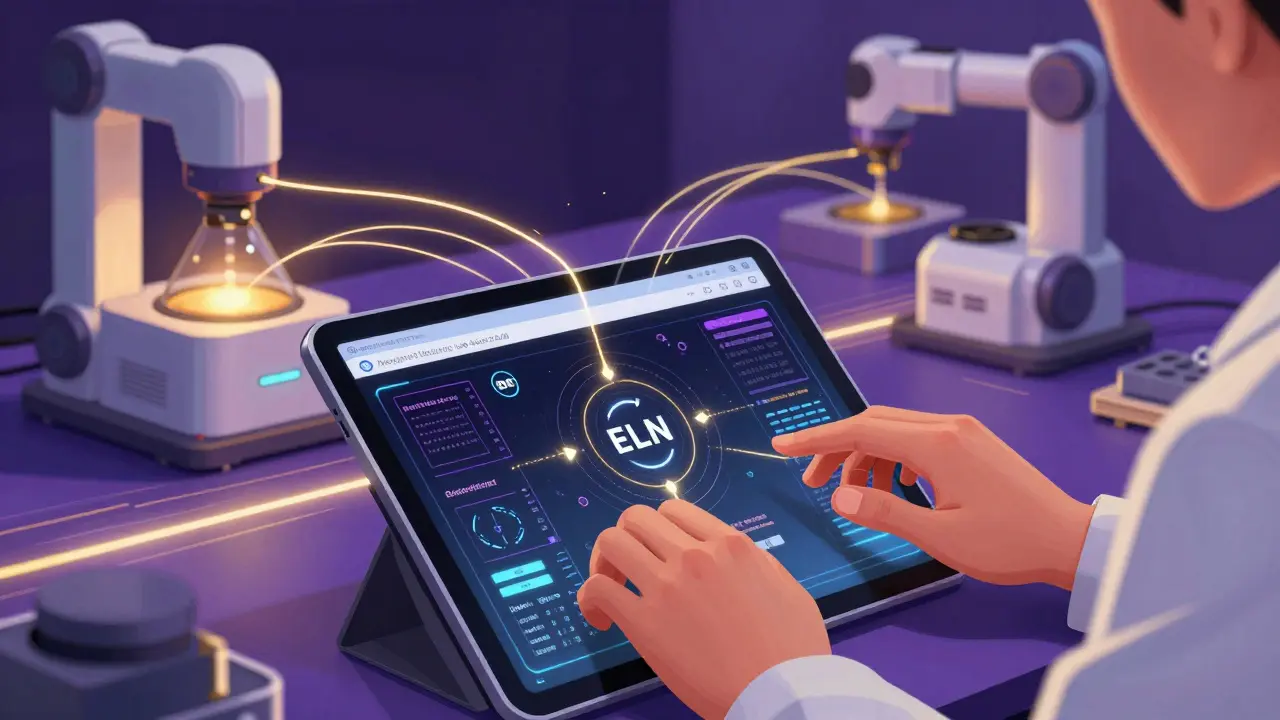
If generative AI is the engine, the Electronic Lab Notebook (ELN) is the steering wheel. An ELN is a digital platform where scientists record experiments, data, and results. Historically, ELNs were static repositories. Now, they are becoming active participants in the discovery process.
As of late 2024, only 15% of major ELN platforms offer native generative AI capabilities. Leaders like Benchling (acquired by Thermo Fisher Scientific for $3.5 billion in 2022) and LabArchives are beginning to incorporate AI features. However, integration remains nascent. McKinsey’s June 2024 survey found that 78% of pharmaceutical companies cite integration with existing laboratory workflows as their largest adoption barrier.
Here is what effective integration looks like:
- Automated Logging: When an AI model generates a candidate molecule, its structure, predicted properties, and training parameters are automatically logged into the ELN.
- Synthesis Planning: The ELN connects to retrosynthesis tools to suggest how to build the molecule, flagging potential stability issues early.
- Feedback Loops: Experimental results from the lab are fed back into the AI model via the ELN, allowing the system to learn from failures and improve future generations.
Without this tight coupling, AI becomes an isolated toy. Researchers waste time manually copying data between Python scripts and their notebooks, introducing errors and losing context. The goal is an "AI-native" laboratory environment, like Pfizer’s Cambridge facility, where automated synthesis robots receive direct input from generative AI models, reducing the design-make-test cycle from weeks to 72 hours.
Practical Implementation Challenges
Getting started is not plug-and-play. The learning curve is steep. Computational chemists typically need 6 to 12 months to become proficient with advanced generative frameworks. Here are the key hurdles:
- Compute Costs: Training diffusion models requires significant hardware. Standard setups involve 4 to 8 NVIDIA A100 GPUs running for 3 to 7 days on datasets of 1-10 million molecules.
- Data Scarcity: For niche therapeutic areas, high-quality structural data may be limited to 5,000-10,000 molecules. This requires transfer learning approaches, adding 2-3 weeks to implementation timelines.
- Regulatory Hurdles: The FDA released draft guidance in February 2024 acknowledging AI-generated molecules but requiring "enhanced validation data packages." This adds approximately 3-6 months to preclinical timelines as regulators demand rigorous proof of safety and efficacy.
Open-source tools like REINVENT (GitHub, 1,842 stars as of January 2025) offer transparency and community support, with active forums seeing 200+ monthly contributions. Commercial platforms provide polished interfaces but often lack the deep customization needed for complex research. Vendor support response times average 24-48 hours, which can stall critical projects.
Market Landscape and Future Outlook
The market is heating up. The generative AI drug discovery sector was valued at $1.34 billion in 2023 and is projected to reach $12.97 billion by 2030, growing at a 38.5% CAGR. Major players include Insilico Medicine, Recursion Pharmaceuticals, and BenevolentAI (acquired by Cognizant for $1.4 billion in October 2024).
Adoption varies by organization size. 87% of top 20 pharmaceutical companies have active generative AI initiatives, compared to only 32% of biotech startups. Startups often lack the computational resources and data infrastructure required to deploy these models effectively.
Looking ahead, the focus is shifting toward 3D structure generation and closing the synthesis gap. Current models achieve only 65% accuracy in predicting binding poses. By 2028, analysts predict 40% of novel drug candidates will originate from AI-driven design processes. However, clinical success is the ultimate test. As of January 2025, only three AI-designed molecules have entered clinical trials: Insilico’s ISM001-055 for fibrosis, Exscientia’s DSP-1181 for oncology, and an undisclosed candidate from Generate Biomedicines.
What is the role of generative AI in molecule generation?
Generative AI creates novel molecular structures by navigating the vast chemical space (estimated at 10^60 possibilities) more efficiently than human intuition. It designs molecules with specific desired properties, such as binding affinity or low toxicity, significantly accelerating the early stages of drug discovery.
Why is integration with electronic lab notebooks important?
Integration ensures that AI-generated candidates are properly documented, validated, and iterated upon within the experimental workflow. It closes the loop between computational prediction and laboratory synthesis, reducing manual data entry errors and enabling continuous learning from experimental outcomes.
What is the "synthesis gap" in AI drug discovery?
The synthesis gap refers to the discrepancy between computationally generated molecules and their ability to be synthesized in a lab. Currently, only 30-40% of AI-generated molecules are synthesizable due to challenges in predicting 3D stability and reactivity, as most models operate in 2D space.
Which AI architectures are best for molecule generation?
Diffusion models, such as GCDM and PRODIGY, currently lead the field with validity rates exceeding 90%. They outperform older VAE and GAN architectures in generating valid and novel structures, though they require higher computational resources.
How long does it take to implement generative AI in a biotech lab?
Implementation typically takes 6-12 months for teams to become proficient. This includes data preparation, model selection, and setting up validation pipelines. Additional time is needed for transfer learning if niche therapeutic data is scarce.