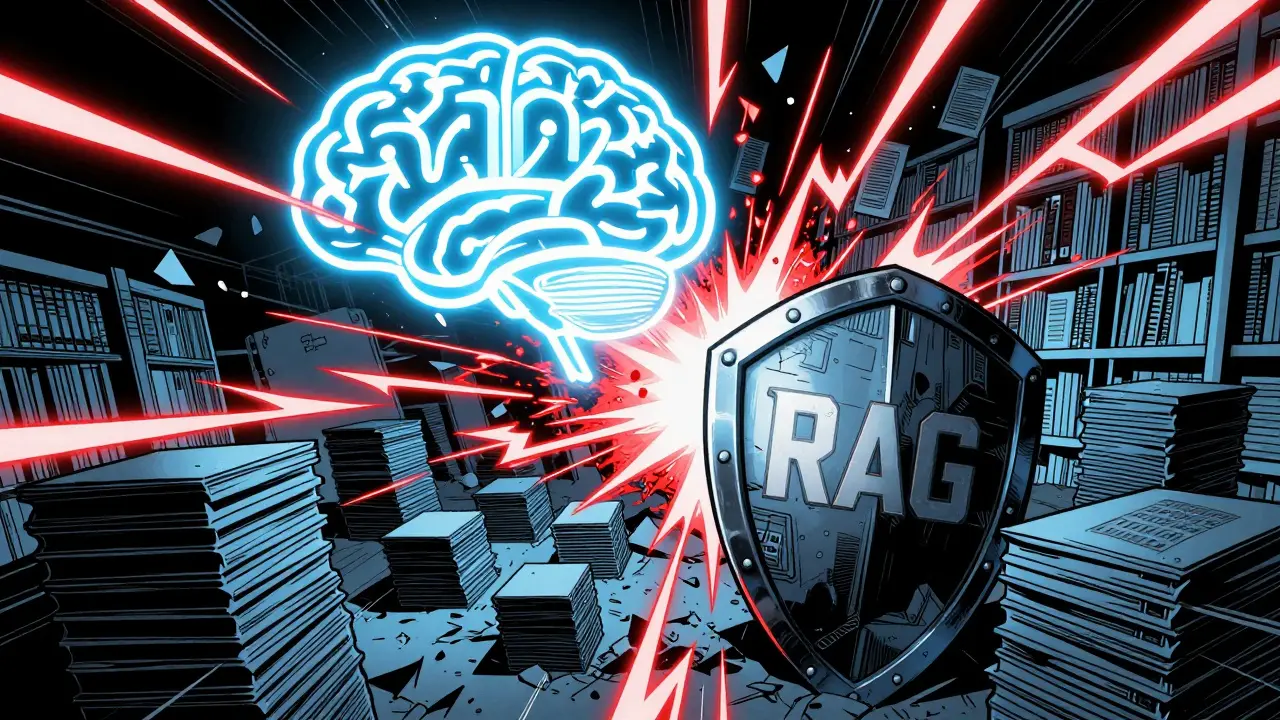
Large language models are powerful, but they have a fatal flaw: they hallucinate. They make up facts with confidence because their knowledge is frozen at the time of training. If you need an AI to answer questions about your company’s latest policy, a recent medical breakthrough, or a legal case from last week, a standard model will guess. That’s where Retrieval-Augmented Generation (RAG) comes in.
RAG fixes this by giving the model access to external data before it answers. It doesn’t just guess; it looks up the right document first. But not all RAG setups are created equal. A basic setup often fails when queries get complex. To get the high accuracy rates enterprises demand-often seeing improvements of 35-60% over base models-you need specific architectural patterns. Let’s look at the patterns that actually work.
The Core Problem: Why Basic RAG Fails
Most developers start with "Naive RAG." You chunk your documents, store them in a vector database, and send the user’s query directly to the search engine. It sounds simple, but it breaks down quickly. The main issue is that human questions don’t always match the text in your documents perfectly. If a user asks, "What is the refund policy for damaged goods?" but your manual says, "Returns for defective items must be processed within 14 days," a simple semantic search might miss the connection. The words aren’t identical, so the vector similarity score drops.
This mismatch leads to irrelevant context being fed into the prompt. When the Large Language Model receives bad context, it either ignores it (wasting tokens) or worse, tries to blend it with its own training data, creating a hybrid error. According to research from MIT Technology Review, naive implementations can reduce accuracy by 15-20% on poorly structured queries. To fix this, we need smarter retrieval strategies.
Pattern 1: Hybrid Search for Precision
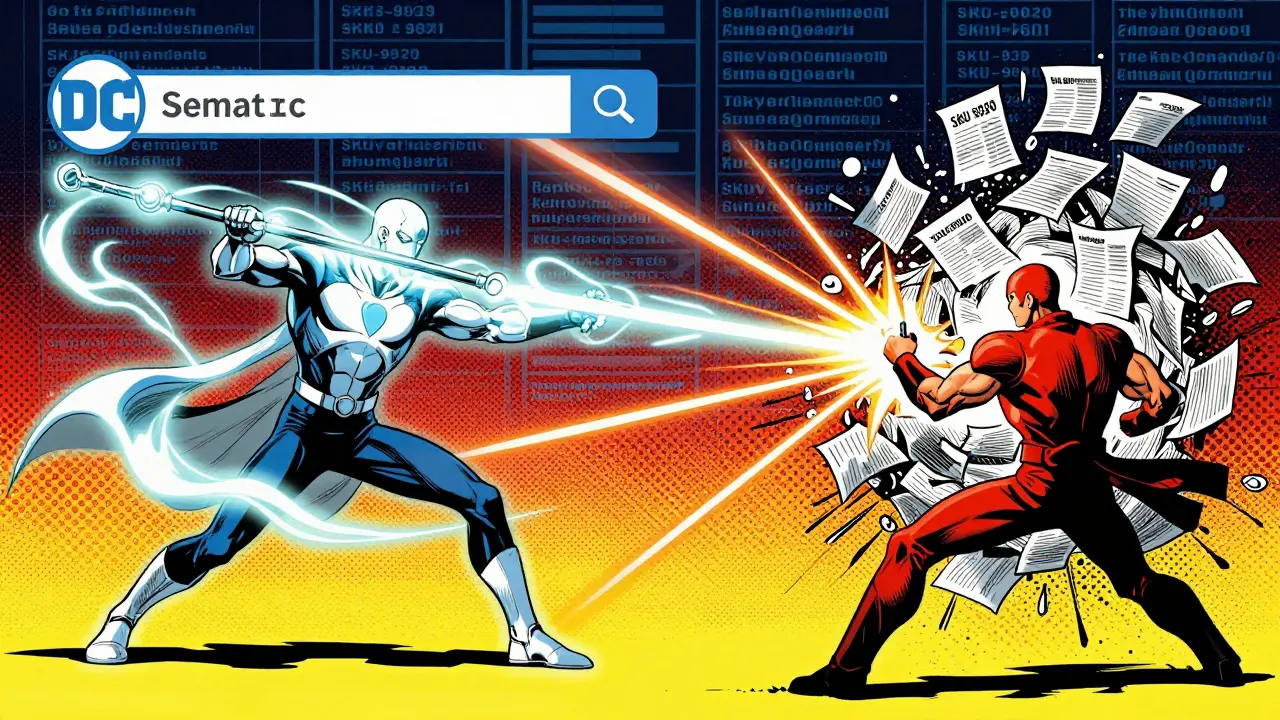
The first step toward better accuracy is abandoning pure vector search. Vector search is great for understanding meaning, but it struggles with exact keywords. If a document mentions "Section 8.1.2" or a specific product code like "SKU-9920," vector embeddings might treat these as generic noise. This is where Hybrid Search becomes essential.
Hybrid search combines two methods:
- Semantic Search: Uses vector embeddings to find conceptually similar text.
- Keyword Search: Uses algorithms like BM25 to find exact term matches.
You weight these results together. A common configuration is 60-70% weight on semantic search and 30-40% on keyword search. This ensures that if a user searches for a specific regulation number, the system finds it via keywords, while still understanding the intent behind broader questions via vectors. Google Cloud’s technical guides highlight that this combination significantly boosts recall, ensuring you don’t miss critical documents just because the phrasing was slightly different.
Pattern 2: Query Transformation
Users rarely ask perfect questions. They use abbreviations, typos, or vague language. Instead of sending the raw query to your retriever, you should transform it first. This pattern involves using an LLM to rewrite the user’s question into a form that is more likely to retrieve relevant documents.
There are two main techniques here:
- Query Expansion: The LLM generates multiple variations of the original question. For example, "How do I reset my password?" might become "password recovery steps," "reset login credentials," and "account access issues." You then search for all three and combine the results.
- Step-Back Prompting: The LLM identifies the broader conceptual category of the question. If a user asks about a specific tax code change in 2024, the system might first search for general principles of that tax law to provide necessary context before drilling down into the specific update.
This approach improves retrieval recall by up to 27%, according to industry benchmarks. It bridges the gap between how humans speak and how documents are written.
Pattern 3: Re-ranking Results
Even with hybrid search, you might pull back ten documents that are only loosely related. Feeding all ten into your LLM’s context window is expensive and confusing. This is where Re-ranking acts as a quality filter.
A re-ranker is a specialized cross-encoder model that takes the user’s query and each retrieved document individually to calculate a precise relevance score. Unlike bi-encoders used in initial vector search, which process the query and document separately, cross-encoders look at them together. This allows the model to understand nuanced relationships.
Tools like Cohere Rerank or open-source alternatives can improve top-3 result relevance by 22%. By keeping only the top 2-3 most relevant chunks, you reduce noise and help the LLM focus on the correct information. This is crucial for maintaining high factual accuracy.
Pattern 4: Recursive Retrieval for Complex Queries
Some questions require synthesizing information from multiple sources. Standard RAG retrieves once and answers. If the answer requires connecting fact A from Document X and fact B from Document Y, standard RAG often fails. This is where recursive or multi-step retrieval patterns shine.
In this pattern, the system breaks down a complex query into sub-questions. It retrieves context for the first sub-question, uses that context to formulate the next sub-question, and repeats until it has enough information to answer the original query. Microsoft’s Azure AI Search documentation notes that this multistep approach can increase accuracy on multi-hop questions by 28%. It mimics how a human researcher would tackle a problem: finding one clue, then using that clue to find the next.
Comparing RAG Approaches
| Pattern | Best Use Case | Accuracy Impact | Complexity |
|---|---|---|---|
| Naive RAG | Simple Q&A on well-structured docs | Baseline | Low |
| Hybrid Search | Queries with specific keywords/codes | +15-20% | Medium |
| Query Transformation | Vague or ambiguous user questions | +20-27% | Medium |
| Re-ranking | High-noise environments | +22% (top-k) | Medium |
| Recursive/Multi-step | Complex reasoning/multi-hop queries | +28-30% | High |
Implementation Challenges and Pitfalls
Implementing these patterns isn’t free. Each layer adds latency. A naive RAG might add 200ms to response time; adding hybrid search, transformation, and re-ranking can push that to 500-800ms. You need to balance speed with accuracy. For real-time chatbots, you might skip re-ranking for simple queries but enable it for complex ones.
Another major pitfall is document chunking. If you cut a paragraph in half, you lose context. Semantic-aware chunking, which respects sentence boundaries and logical sections, is critical. One developer reported a 33% accuracy drop simply because their legal documents were split arbitrarily. Using smaller chunks with a "sentence window" overlap helps maintain context without bloating the token count.
Also, beware of false confidence. As Dr. Emily M. Bender warned, RAG can make systems seem accurate even when they’re wrong, especially if the retrieved context is partially relevant but misleading. Always include citations in your final output so users can verify the source. Transparency builds trust.
When to Use Fine-Tuning Instead
RAG is not a silver bullet. If your task requires deep stylistic adaptation or highly specialized domain logic that isn’t easily searchable, fine-tuning might be better. However, for factual accuracy and up-to-date information, RAG wins. A comparative study showed RAG outperforms fine-tuning by 41.7% on time-sensitive queries and costs 6-8x less to implement. Fine-tuning bakes knowledge into the weights; RAG fetches it dynamically. In fast-changing fields like finance or healthcare, dynamic fetching is superior.
Next Steps for Implementation
If you are building a production-grade AI application, start with Hybrid Search and Re-ranking. These two patterns offer the best return on investment for accuracy. Use a framework like LangChain or LlamaIndex to handle the orchestration, but ensure you have control over the retrieval parameters. Monitor your retrieval metrics closely. If users are clicking "not helpful" or asking follow-up questions, your retrieval is likely failing. Iterate on your chunking strategy and query transformations until the context provided is consistently relevant.
What is the difference between RAG and fine-tuning?
Fine-tuning updates the model's internal weights with new data, making the knowledge static and expensive to update. RAG keeps the model unchanged and retrieves external data at runtime, allowing for instant updates and better factual accuracy on current information.
Why does my RAG system give inaccurate answers?
Inaccuracy usually stems from poor retrieval. If the wrong documents are fetched, the LLM will generate incorrect answers based on that bad context. Implementing hybrid search, query transformation, and re-ranking can significantly improve retrieval quality.
How much latency does RAG add?
Basic RAG adds 200-500ms. Advanced patterns with query transformation and re-ranking can add 500-800ms. Optimizations like caching frequent queries and using efficient vector databases can mitigate this.
Is Hybrid Search worth the complexity?
Yes, especially for enterprise applications. Pure vector search misses exact keyword matches, while pure keyword search misses semantic intent. Combining both ensures higher recall and precision, particularly for technical or regulated content.
What is the best chunk size for RAG?
There is no single best size, but 256-512 tokens is common. The key is semantic awareness. Chunks should contain complete thoughts or paragraphs. Overlapping chunks by 10-20% helps preserve context across boundaries.