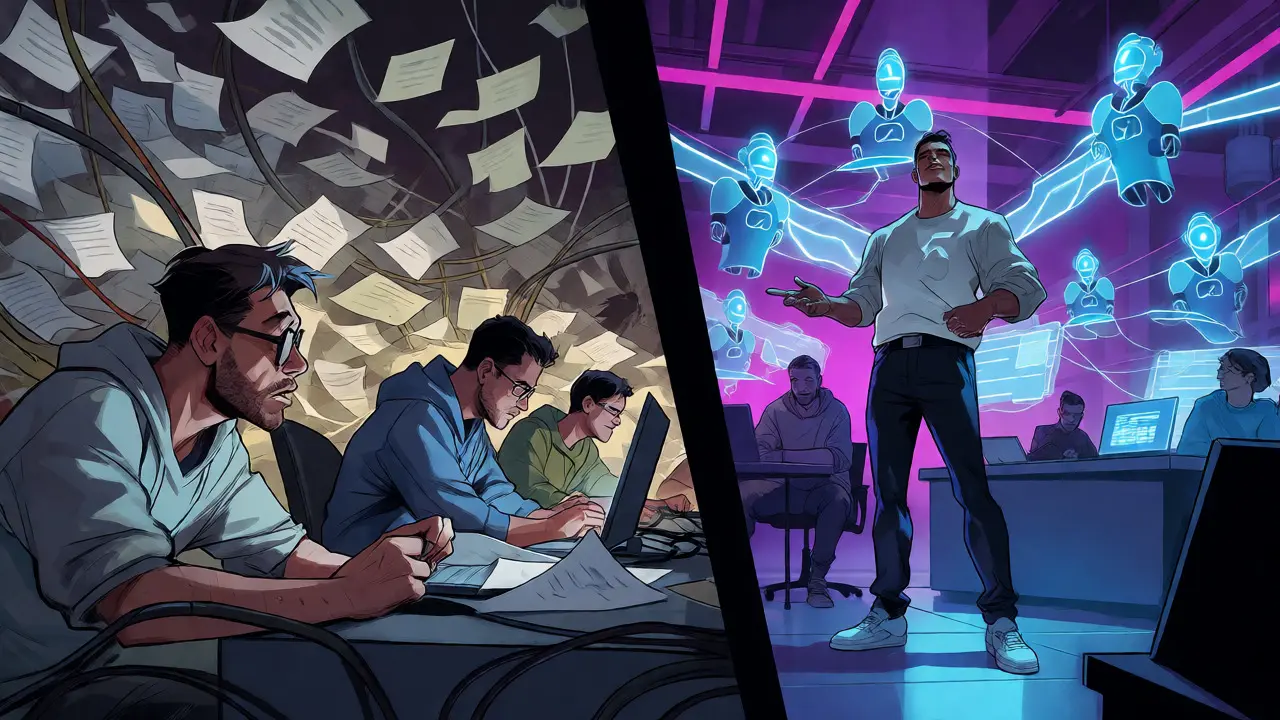
You know that feeling when the hackathon clock starts ticking, and everyone is frantically typing? For years, the winner was whoever could type the fastest or had the most complex backend architecture. But in 2026, that game has changed. The person who wins isn't always the best coder; it's often the best orchestrator. If you're still trying to build a production-ready database from scratch while your competitors are shipping polished MVPs using Vibe Coding and LLM agents, you're already behind.
This shift isn't just about using new tools. It's a fundamental change in how we approach problem-solving under pressure. Modern winning strategies combine aggressive automation with strategic business thinking. You need to stop thinking like a junior developer trying to prove their syntax skills and start thinking like a founder pitching a seed round. Here is how you actually win a modern hackathon by leveraging AI to do the heavy lifting while you focus on the narrative and the user experience.
The Shift from Typing Speed to Orchestration
Let's be real: raw coding speed is no longer the primary differentiator. With tools like DataButton and Claude Code, the barrier to entry for creating functional software has dropped dramatically. These tools allow you to automate the entire software development lifecycle (SDLC). Instead of writing boilerplate code, you prompt, generate, preview, and critique. This loop allows teams to ship bug-free, aesthetically pleasing minimum viable products (MVPs) within 12 hours.
What do you do with the remaining 36 hours of a standard 48-hour event? You don't keep coding. You validate. You refine the pitch. You talk to potential users. Traditional teams spent nearly 47 hours struggling with API integrations and dependency hell. Today, successful teams mock dependencies to maintain speed. They recognize that judges care about concept viability and demonstration quality, not whether your backend can handle ten thousand concurrent requests. By reserving time for customer validation, you align your project with what investors and judges actually value: commercial potential and user fit.
Aggressive Automation and Strategic Positioning
Winning requires two pillars: Aggressive Automation and Strategic Positioning. Aggressive Automation means leveraging AI-powered development tools to accelerate every step of the build process. Don't write CSS from scratch if an LLM agent can generate a Tailwind config that looks professional in seconds. Don't spend hours debugging a Python script if an agent can refactor it for you.
Strategic Positioning involves viewing your project through a venture capitalist lens. This is what I call the "Investor Hat" methodology. Treat the hackathon as a startup seed round. Every decision, from the problem definition to the final slide deck, should answer one question: Is this worth investing in? This perspective shifts your focus from technical completeness to market viability. A team that builds a simple but well-positioned solution will almost always beat a team that builds a complex but poorly explained one.
| Aspect | Traditional Approach | Modern Vibe Coding Approach |
|---|---|---|
| Time Allocation | 90% Coding, 10% Pitch | 25% Coding, 75% Validation/Pitch |
| Code Quality | Production-ready, scalable | MVP-focused, mocked dependencies |
| Tool Usage | Manual IDE, manual testing | LLM Agents, automated previews |
| Judging Focus | Technical complexity | Business value, UX, narrative |
Pre-Event Preparation: The Hidden Advantage
Most teams show up to the venue with a vague idea and hope for the best. This is a mistake. Pre-event preparation significantly impacts competitive performance. Before Day One, document your ideas in comprehensive one-page summaries. Describe the problem, the innovative solution, key assumptions, and the technologies involved. This documentation serves as a conceptual anchor for your team and prevents scope creep later on.
Don't skip the Product Requirements Document (PRD). In fact, use AI to generate both the PRD and the Business Model Canvas rapidly. Tools can draft these in minutes, giving you a clear roadmap. Additionally, consider team composition carefully. Use frameworks like Ikigai to find the intersection between passion, skill, and market need. While psychometric profiling like 16Personalities can help balance team roles-ensuring you have Architects, Executors, and Evangelists-it’s crucial to avoid incompatible personalities. A nervous breakdown during hour six kills more projects than bugs ever will.
Problem Definition and Scope Management
Great ideas alone are insufficient for victory. You need deep investigation into the problem statement. Rather than immediately beginning development, engage with stakeholders, potential users, and domain experts. Dig into the problem to identify exactly what the solution should accomplish. Paul Graham, founder of Y Combinator, famously emphasized making something people want. Narrow, focused solutions defeat broad problem statements every time. You cannot solve world hunger in 48 hours, but you can excel at solving one specific aspect of food waste logistics.
Over-engineering is the primary failure pattern. Production-ready code is unnecessary-a working demo illustrating the concept suffices. Pick too broad a problem, and you'll drown in implementation details. Deliberately constrain your scope to achievable objectives within the timeframe. Mock everything except the core innovation. If your app relies on a third-party API, mock the response data so your demo runs smoothly regardless of network latency. Judges rarely check the source code; they watch the demo.
Pitch Development: Start on Day One
If you wait until the final hours to prepare your pitch, you've already lost. Teams starting presentation preparation on Day One consistently outperform those scrambling during the last night. In AI-focused competitions, the pitch accounts for approximately 50% of success, with code accounting for the other 50%. A brilliant app with a confusing narrative will lose to a mediocre app with compelling storytelling.
Rehearse multiple times. Use tools like the Sequoia Template for dynamic storytelling. Keep the delivery creative and informal. Incorporate humor and user feedback elements. Judges in generative AI hackathons are particularly attuned to business value and market potential articulation. Highlight state-of-the-art approaches and articulate your differentiation clearly. Commercial and marketing aspects strengthen proposals, demonstrating commercial viability alongside technical merit. Remember, you are selling a vision, not just showing off code.
Avoiding Common Pitfalls
There are several mistakes that systematically eliminate strong contenders. First, ignoring judging criteria to pursue technical interests. Build for the actual evaluation criteria, not what you think is cool. Second, participating solo when team participation is permitted. Teams almost always outperform individuals because they bring diverse perspectives and complementary skills. Third, failing to align development with evaluation criteria. Read the rules, understand the voting process, and analyze the panel of judges' composition. Synthesize this information to design communication strategies and identify focus areas.
Another common error is delaying pitch preparation. Start early. Refine continuously. Finally, don't neglect post-competition strategy. Request advice rather than funding initially. Iterate based on user feedback. Hackathons represent continuous innovation strategies rather than one-off gimmicks. Maintain high velocity with users and foster ongoing innovation even after the prize money is spent.
Frequently Asked Questions
What is Vibe Coding?
Vibe Coding is a development methodology that uses AI tools like DataButton and Claude Code to automate the software development lifecycle. It prioritizes rapid iteration through a Prompt → Generate → Preview → Critique loop, allowing teams to build polished MVPs quickly by mocking dependencies and focusing on user experience rather than backend infrastructure.
How much time should I spend coding versus pitching?
In modern hackathons, aim for roughly 25% coding and 75% validation and pitch refinement. Use AI agents to accelerate coding tasks, freeing up time for customer interviews, refining the narrative, and rehearsing the presentation, which often determines 50% of the judging score.
Do I need a complex backend for a winning prototype?
No. Judges prioritize concept viability and demonstration quality. Mocking dependencies and using static data or simple APIs is often better than building a complex, buggy backend. Focus on a smooth, bug-free user interface and a clear value proposition.
Should I participate alone or in a team?
Participate in a team whenever possible. Diverse teams with complementary skills-technical, product, and communication-consistently outperform individuals. Ensure your team includes balanced personalities to handle the stress of the competition effectively.
What is the "Investor Hat" methodology?
The Investor Hat methodology involves treating the hackathon like a startup seed round. It requires teams to view their project through a venture capitalist lens, focusing on commercial viability, market fit, and scalability rather than just technical complexity.