
Large language models don’t know when they’re wrong. That’s not a bug-it’s a feature of how they work. They’re trained to sound confident, even when they’re guessing. And that’s dangerous. In 2023, Google researchers found that when LLMs answer questions outside their training data, they still give answers with 85-90% confidence. That’s not just misleading. It’s a ticking time bomb in customer service bots, medical assistants, and legal tools.
What Are Knowledge Boundaries?
Knowledge boundaries are the edges of what an LLM actually knows. Not what it thinks it knows. Not what it can generate convincingly. But what it was trained on-and what it can reliably recall. These boundaries split into two types: parametric knowledge boundaries (the facts locked inside the model’s weights) and outward knowledge boundaries (real-world facts that changed after the model stopped learning).For example, if you ask a model trained in 2023 who won the 2024 U.S. presidential election, it won’t say, “I don’t know.” It’ll make something up. Maybe it’ll say Kamala Harris won. Or maybe it’ll invent a candidate named “James Rourke.” The model doesn’t know it’s wrong. It just generates the most statistically likely sequence of words.
This isn’t about memory. It’s about calibration. A model might be 92% confident in a correct answer-and 89% confident in a completely false one. That gap? That’s the calibration problem. And it’s why users lose trust fast.
Why Overconfidence Is a Safety Risk
In 2024, 72% of AI safety researchers ranked overconfidence on unknown topics as a “high-risk” issue in enterprise systems. Why? Because people believe LLMs. A nurse using an AI to check drug interactions. A lawyer relying on it for case law. A financial advisor quoting it for market trends. If the model gets it wrong-and sounds sure-it can cause real harm.OpenAI’s 2023 analysis showed that for questions beyond the model’s knowledge, confidence scores hovered around 88.7%. For correct answers? 92.3%. That’s not a small difference. It means the model is barely better than flipping a coin at telling itself when it’s guessing.
And it’s not just technical. Users don’t care about the math. They care about whether the answer feels right. When an LLM says, “The capital of Kazakhstan is Astana,” and it’s actually Nur-Sultan (renamed in 2019), the user doesn’t see a training cutoff. They see a mistake. And if this happens twice, they stop trusting it.
How Do We Detect When an LLM Doesn’t Know?
There are three main ways researchers are trying to fix this:- Uncertainty Estimation - Measures how unsure the model is before generating a response. The Internal Confidence method from Chen et al. (2024) looks at patterns across layers of the model without generating text. It’s fast, accurate, and cuts inference costs by 15-20% by avoiding unnecessary RAG calls.
- Confidence Calibration - Adjusts the model’s output scores to match real accuracy. If a model says it’s 90% sure, but only gets it right 60% of the time, calibration brings those numbers closer.
- Internal State Probing - Reads the model’s hidden layers during processing to detect signs of uncertainty. This works best with access to the model’s internals, which most users don’t have.
On the TriviaQA and MATH datasets, Internal Confidence scored 0.87 AUROC for detecting boundary crossings-better than entropy methods (0.79) and generation-based approaches (0.82). And it’s 30% faster.
But here’s the catch: these methods work great on clear-cut questions. They struggle with semi-open-ended ones. Like: “What’s the best way to treat chronic back pain?” There’s no single right answer. Some sources say yoga. Others say physical therapy. An LLM might flag this as out-of-boundary-even though it’s not. Amayuelas et al. (2023) found that 41.7% of these cases get misclassified.

What Are the Top Tools Doing Right-and Wrong?
Not all models are built the same. Here’s how the big players handle uncertainty:| Model | Method | Boundary Detection Accuracy | Abstention Rate | Cost Impact |
|---|---|---|---|---|
| Claude 3 (Anthropic) | Proprietary confidence scoring | Not disclosed | 18.3% | Low |
| Llama 3 (Meta) | Basic thresholds + RAG triggers | 85.4% | 23.8% | Medium |
| Gemini 1.5 (Google) | BoundaryGuard (multi-granular scoring) | Up to 91.3% | Not disclosed | Medium |
| Open-source (Internal Confidence) | Query-level self-evaluation | 87% | Variable | Low |
Claude 3 abstains from answering nearly 1 in 5 queries it deems uncertain. That’s impressive. But users don’t always want silence. Sometimes they want “I’m not sure, but here’s what I found.” That’s where RAG (Retrieval-Augmented Generation) comes in.
Meta’s Llama 3 triggers RAG for 23.8% of queries. That means it doesn’t just guess-it goes out and looks up the latest info. But RAG isn’t magic. If the source material is outdated, wrong, or conflicting, the model still messes up.
Real-World Problems Developers Face
On GitHub’s llm-uncertainty repo, developers say integrating uncertainty detection adds 15-25% latency. That’s a dealbreaker for real-time chatbots. And documentation? It’s terrible. Only 3 out of 17 open-source uncertainty libraries are actively maintained.One Google Cloud engineer saw a 40% drop in hallucinations after adding Internal Confidence to their customer service bot. Another developer in healthcare said their system flagged 30% of valid clinical questions as out-of-boundary. That’s not helpful. It’s frustrating.
And context matters. Change the wording of a prompt slightly, and the uncertainty score can swing by 18-22 percentage points. That’s not reliability. That’s noise.
False negatives are the worst. When the model doesn’t realize it’s wrong? That’s when real damage happens. User benchmarks show false negatives occur in 27-33% of boundary cases. That’s one in three times the model thinks it’s right-but isn’t.
How to Communicate Uncertainty to Users
Detecting uncertainty is only half the battle. The other half is telling users about it-in a way they understand.Nature Machine Intelligence (2024) found that when LLMs used phrases like “I’m not confident about this” or “I might be wrong,” the gap between what the model thought and what users believed dropped from 34.7% to just 18.2%. That’s a huge win.
But don’t just say “I don’t know.” That feels robotic. Better options:
- “Based on what I know, this is likely, but I can’t confirm it.”
- “My training data ends in 2023. The situation may have changed.”
- “I found conflicting sources. Here’s what I saw.”
And here’s the kicker: users don’t mind uncertainty if it’s honest. They mind being lied to confidently.
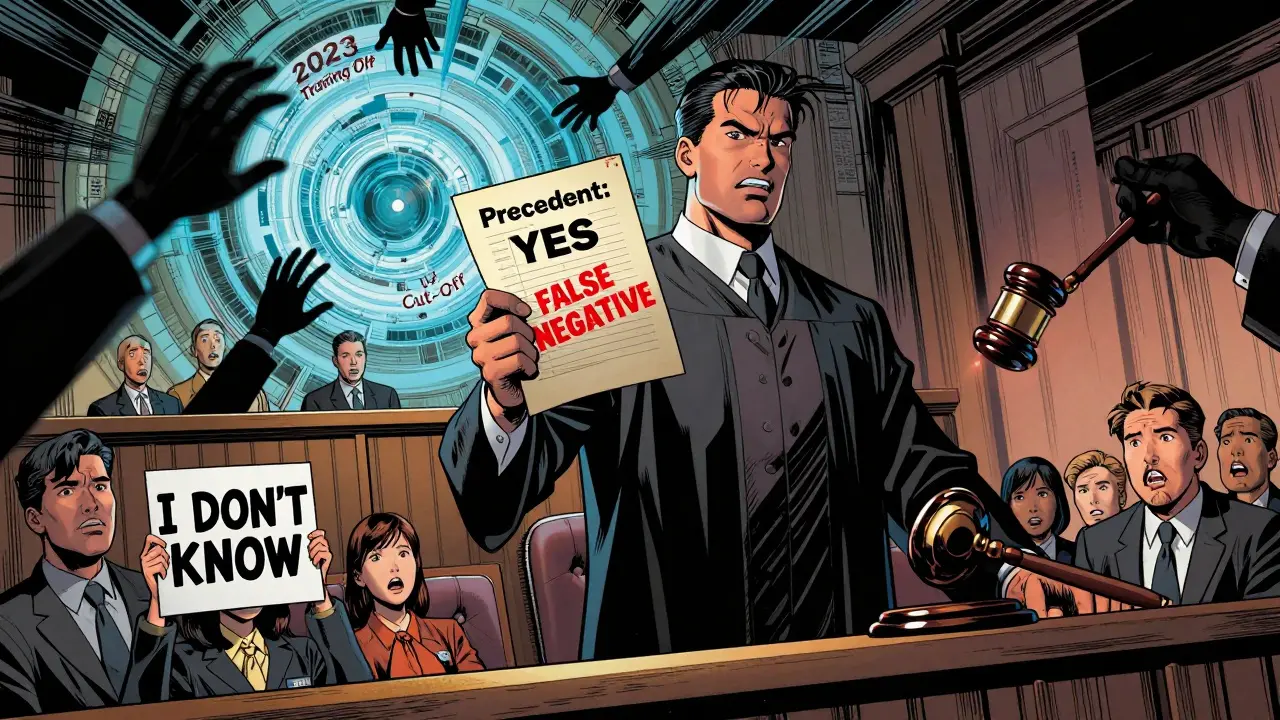
The Bigger Problem: We’re Mistaking Patterns for Understanding
Professor Melanie Mitchell put it bluntly: “All current uncertainty methods fundamentally mistake statistical patterns for true understanding.”That’s the core issue. LLMs don’t understand facts. They predict word sequences. So when they say “I’m uncertain,” it’s not because they’re thinking. It’s because the pattern of words leading to a correct answer didn’t match what they’ve seen before.
That’s why calibration degrades over time. When a model is updated, its internal weights shift. The uncertainty signals it used to trust? They’re now wrong. And most systems don’t re-calibrate. This is called “calibration debt.” 82% of current implementations ignore it.
And what about “unknown unknowns”? Things we haven’t even thought to ask about? No method today can detect those. That’s not a flaw. It’s a limit.
What’s Next?
The market is racing toward uncertainty-aware AI. The global market for trustworthy AI solutions is projected to hit $14.3 billion by 2027. The EU AI Act now requires “appropriate uncertainty signaling” for high-risk systems. That’s not a suggestion. It’s the law.Google’s BoundaryGuard, Microsoft’s Uncertainty-Aware Prompting, and Meta’s upcoming Llama 4 with adaptive knowledge awareness are pushing boundaries. But the real breakthrough will come when uncertainty isn’t just a technical feature-it’s part of the user experience.
Imagine a medical AI that says: “I found three guidelines on this treatment. Two recommend surgery. One says physical therapy is better. Here’s what each says.” That’s not just uncertainty. That’s transparency.
The goal isn’t to make LLMs omniscient. It’s to make them humble. To make them say “I’m not sure” without making users feel dumb for asking. Because the truth isn’t always in the answer. Sometimes, it’s in the silence.
What You Can Do Today
If you’re using LLMs in production:- Start with a simple uncertainty check: Use entropy-based sampling if you can’t access internal states.
- Set layered thresholds: Low confidence → trigger RAG. Medium → use chain-of-thought. High → answer directly.
- Log all uncertainty signals. Track when the model gets it right vs. wrong.
- Train your users. Tell them: “This AI sometimes guesses. Always double-check critical info.”
- Don’t trust high-confidence answers on recent events, medical advice, or legal matters.
Knowledge boundaries aren’t going away. But how we respond to them? That’s still up to us.


Fredda Freyer
December 24, 2025 AT 07:39It’s not that LLMs are wrong-they’re just mirrors. They reflect the biases, gaps, and contradictions in the data they were fed. The real issue isn’t calibration-it’s our delusion that pattern-matching equals understanding. We treat them like oracles because we’re lazy, not because they’re wise.
And yet, we still outsource critical decisions to them. A nurse trusts a bot over a textbook? A lawyer cites it in court? That’s not negligence-it’s surrender. We built tools to augment cognition, then handed over the reins to something that doesn’t know what ‘truth’ means.
The solution isn’t better algorithms. It’s humility. We need to stop pretending AI can think. It can simulate. It can predict. But it cannot know. And until we accept that, we’re just building faster, louder, more convincing hallucination machines.
Also-yes, ‘Nur-Sultan’ is correct. But if your model says ‘Astana,’ it’s not a bug. It’s a feature of a system trained on pre-2019 data. The fault isn’t the model. It’s the user who didn’t verify. Or worse-the developer who didn’t warn them.
Mongezi Mkhwanazi
December 25, 2025 AT 18:28Let me be perfectly clear: the entire AI industry is built on a lie. They call it ‘confidence scoring,’ but what it really is, is statistical arrogance. These models don’t have epistemic awareness-they have statistical momentum. They don’t pause because they’re uncertain. They pause because the token probabilities dropped below a threshold someone coded in Python.
And don’t get me started on RAG. Retrieval-Augmented Generation? More like Retrieval-Confused Generation. You throw a bunch of conflicting, outdated, or outright fraudulent sources into the mix, and the model just stitches them together with a veneer of academic jargon. It’s like giving a child a library and asking them to write a legal brief.
The fact that 41.7% of semi-open-ended questions get misclassified as out-of-boundary? That’s not a flaw in the model-it’s proof that we’re trying to force square pegs into round holes. Human questions are messy. LLMs are not. And pretending they can handle ambiguity is like expecting a toaster to perform brain surgery.
Meanwhile, companies are selling this as ‘trustworthy AI.’ Trustworthy? The same models that think Kazakhstan’s capital is Astana are being deployed in hospitals? We’re not building AI. We’re building automated confidence scams.
And calibration debt? 82% of systems ignore it? Of course they do. It’s cheaper to ship broken software than to maintain it. The entire industry is a Ponzi scheme built on the delusion that more parameters equals more intelligence. We’re not advancing. We’re just making bigger, louder, more expensive mistakes.
Gareth Hobbs
December 27, 2025 AT 16:29Oh for fuck’s sake. Another tech bro pretending AI can ‘know’ stuff. These things are glorified autocomplete engines trained on reddit threads and wikipedia edits from 2022. They don’t understand ‘Nur-Sultan’ because they don’t understand *anything*. They’re just predicting the next word like a drunk guy at a pub guessing who won the football match.
And now we’re letting them advise doctors? Give me a break. If you’re using an LLM to check drug interactions, you deserve to get poisoned. And don’t even get me started on ‘uncertainty signaling.’ ‘I might be wrong’? That’s not transparency-that’s a cop-out. If you can’t be sure, shut up. Don’t give me a 12-word disclaimer and then proceed to lie with a smile.
Also-why are we still talking about this? The EU AI Act? Please. The same people who let Facebook run wild are now regulating AI? You think a law can fix a system built on statistical delusion? Wake up. This isn’t tech. It’s theater. And we’re all just clapping for the emperor’s new clothes.
Zelda Breach
December 29, 2025 AT 11:00Let’s be honest-no one cares about calibration. Users don’t read the fine print. They see ‘92% confident’ and assume it’s gospel. And developers? They’re too busy hitting quarterly KPIs to care if the model thinks Kazakhstan’s capital is ‘Astana’ or ‘Nur-Sultan’ or ‘Donald Trump’s secret bunker.’
But here’s the real scandal: the companies that built this? They know. They *know* it’s garbage. They just don’t care because the money’s in the pitch deck, not the output.
And now we’re supposed to trust ‘Internal Confidence’? A method that works on TriviaQA but fails on ‘best way to treat back pain’? That’s not a solution. That’s a placebo with a PhD.
Also-‘I found conflicting sources’? That’s not transparency. That’s evasion. If you can’t pick a side, say ‘I don’t know.’ Not ‘here’s a buffet of contradictions.’ That’s not helpful. It’s cowardly.
And don’t even get me started on the 27-33% false negative rate. That’s not a bug. That’s a massacre waiting to happen. Someone’s going to die because an AI said ‘it’s fine’ and it wasn’t. And then we’ll all pretend we didn’t see it coming.
Mark Nitka
December 30, 2025 AT 17:24Look, I get the fear. But demonizing LLMs won’t fix anything. We’re not going to stop using them. They’re too useful. So the real question isn’t ‘can they be trusted?’-it’s ‘how do we use them responsibly?’
Internal Confidence? Yes. It’s fast. It’s accurate. It’s not perfect, but it’s better than entropy or blind RAG. And yes, calibration drifts. So re-calibrate. Log the errors. Track the false negatives. Make it part of your pipeline.
And users? They don’t need a PhD in AI. They need clear, consistent signals. ‘I’m not sure, but here’s what I found’ is better than silence. Silence feels like incompetence. Honest uncertainty feels like integrity.
Yes, it’s messy. Yes, it’s hard. But we’ve solved harder problems before. We didn’t stop using cars because they could crash. We built seatbelts. We built airbags. We built better roads.
Same here. We don’t need to stop AI. We need to build guardrails. And we need to stop pretending the model is a person. It’s a tool. Use it like one.
Colby Havard
January 1, 2026 AT 15:21It is, indeed, a profoundly troubling epistemological crisis that we have, as a society, outsourced our cognitive labor to stochastic parrots whose internal states are opaque, whose confidence metrics are statistically ill-posed, and whose outputs are, by design, optimized for rhetorical fluency rather than veridical accuracy. The notion that one could deploy such a system in a medical or legal context without rigorous, multi-layered human oversight is not merely negligent-it is a moral failure of the highest order.
Furthermore, the assertion that users ‘don’t mind uncertainty if it’s honest’ is, frankly, a romanticized fiction. Human beings crave certainty. We are neurologically wired to prefer the illusion of knowledge to the discomfort of ambiguity. To suggest that a phrase such as ‘I might be wrong’ will assuage this deep-seated cognitive bias is to misunderstand the very nature of human psychology.
And yet-what alternative do we have? Abandoning LLMs entirely is not feasible. The infrastructure is too entrenched. The investment too vast. Therefore, we must demand-not merely hope for-formal epistemic accountability. Not ‘uncertainty signaling’ as a marketing buzzword, but a verifiable, auditable, and standardized framework for truth-tracking. Otherwise, we are not advancing AI. We are institutionalizing delusion.
Aryan Gupta
January 1, 2026 AT 18:50Let me tell you something they don’t want you to know: the whole ‘knowledge boundary’ thing is a distraction. The real problem? The models are being trained on data that’s been filtered through corporate PR, Wikipedia edits from paid lobbyists, and Reddit threads written by bots. You think ‘Nur-Sultan’ is the issue? Wait until the model starts giving medical advice based on a 2021 blog post by a guy who thinks ‘vitamin C cures cancer.’
And don’t even get me started on ‘Internal Confidence.’ That’s just a fancy way of saying ‘we took the model’s output and ran it through a statistical filter that doesn’t know what truth is.’
Meanwhile, the same people who built this are now pushing ‘EU AI Act’ compliance like it’s a badge of honor. But the EU doesn’t even have the bandwidth to audit these systems. They’re relying on self-certification. That’s like letting a fox design the chicken coop and then giving it a ‘safety certified’ sticker.
And the worst part? The open-source libraries? 3 out of 17 are maintained? That’s not a community. That’s a graveyard. And yet, startups are building billion-dollar products on top of this. That’s not innovation. That’s financial terrorism.
And yes-I’m paranoid. But when your life depends on an AI that thinks Astana is still the capital, paranoia is the only sane response.
Kelley Nelson
January 3, 2026 AT 07:42One cannot help but observe, with a mixture of profound dismay and clinical detachment, the astonishingly cavalier attitude toward epistemic integrity that permeates the current AI discourse. The notion that ‘I might be wrong’ constitutes an adequate form of uncertainty signaling is not merely inadequate-it is, in fact, a form of linguistic and epistemological malpractice. To reduce the complex, multi-dimensional phenomenon of epistemic humility to a canned phrase is to engage in what might be termed ‘symbolic virtue signaling’-a performative gesture that absolves the architect of responsibility while offering the user a placebo of reassurance.
Furthermore, the continued reliance on entropy-based sampling as a proxy for confidence is not merely outdated-it is, in the context of high-risk applications, indefensible. One would not entrust a surgical procedure to a surgeon who estimates risk by flipping a coin. Yet, we do precisely this when we deploy LLMs without calibrated, validated, and continuously monitored uncertainty metrics.
And while the market projection of $14.3 billion by 2027 may appear impressive, one must ask: at what cost to human dignity, safety, and the very notion of truth? The commodification of epistemic uncertainty is not progress. It is the final stage of technocratic nihilism.
Perhaps the most disturbing aspect is not the models themselves, but the collective willingness of institutions to normalize their deployment. We are not merely building tools. We are constructing a new epistemic regime-one in which statistical patterns replace reasoned judgment, and confidence replaces competence.
And yet, we applaud ourselves for being ‘forward-thinking.’