Enterprises aren’t buying AI models-they’re buying reliability
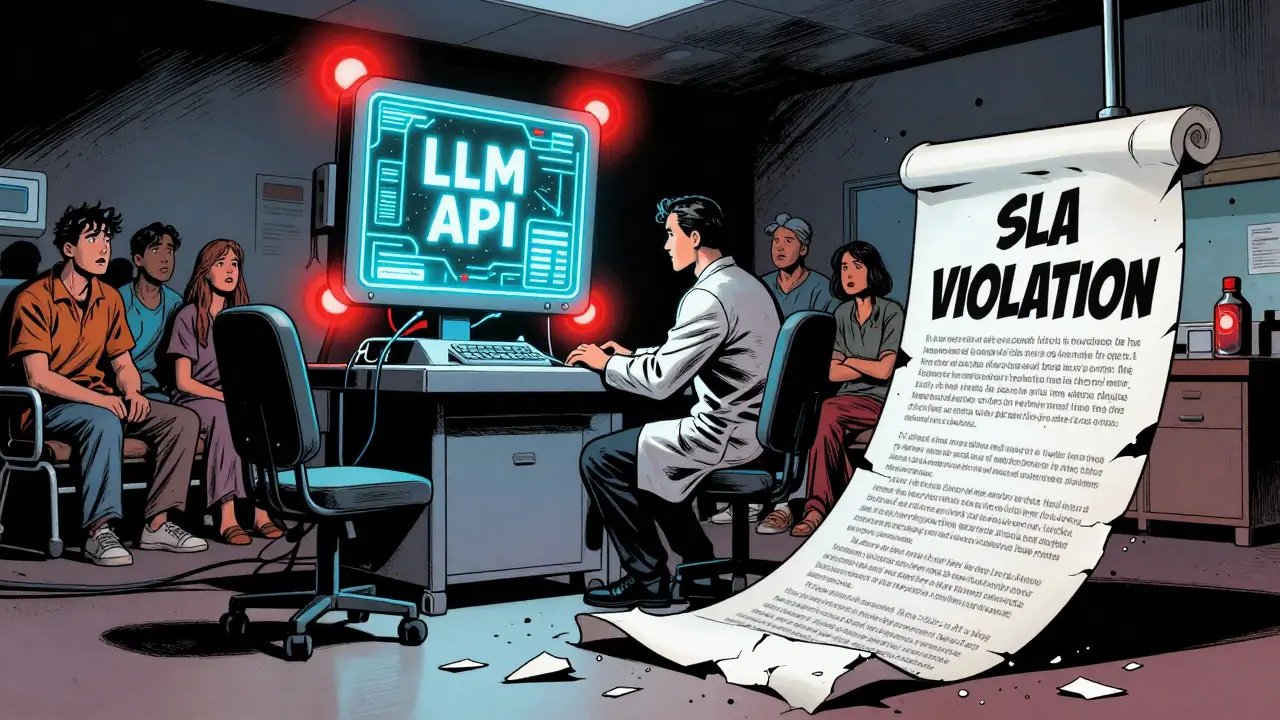
When a hospital’s diagnostic tool crashes because an LLM API went down, or a bank’s customer service bot leaks sensitive data, it’s not a bug. It’s a breach of contract. Enterprises don’t care if a model is the "most advanced" or "cheapest." They care about what happens when things go wrong. That’s why Service Level Agreements (SLAs) have become the most important part of any LLM deal-not the model architecture, not the prompt engineering, not even the price tag.
By early 2026, 78% of enterprises require a formal SLA before deploying any large language model in production. Why? Because the cost of downtime isn’t theoretical. Gartner estimates that in regulated industries like finance and healthcare, every minute of AI failure costs an average of $5,600. And that’s just the visible part. Hidden costs-compliance violations, lost customer trust, audit failures-can be ten times higher.
Uptime isn’t just 99.9%-it’s about when and where it fails
Most LLM providers promise 99.9% uptime. That sounds solid until you realize that means up to 43 minutes of downtime per month. For a customer service chatbot? Maybe acceptable. For a real-time fraud detection system processing 10,000 transactions per second? That’s catastrophic.
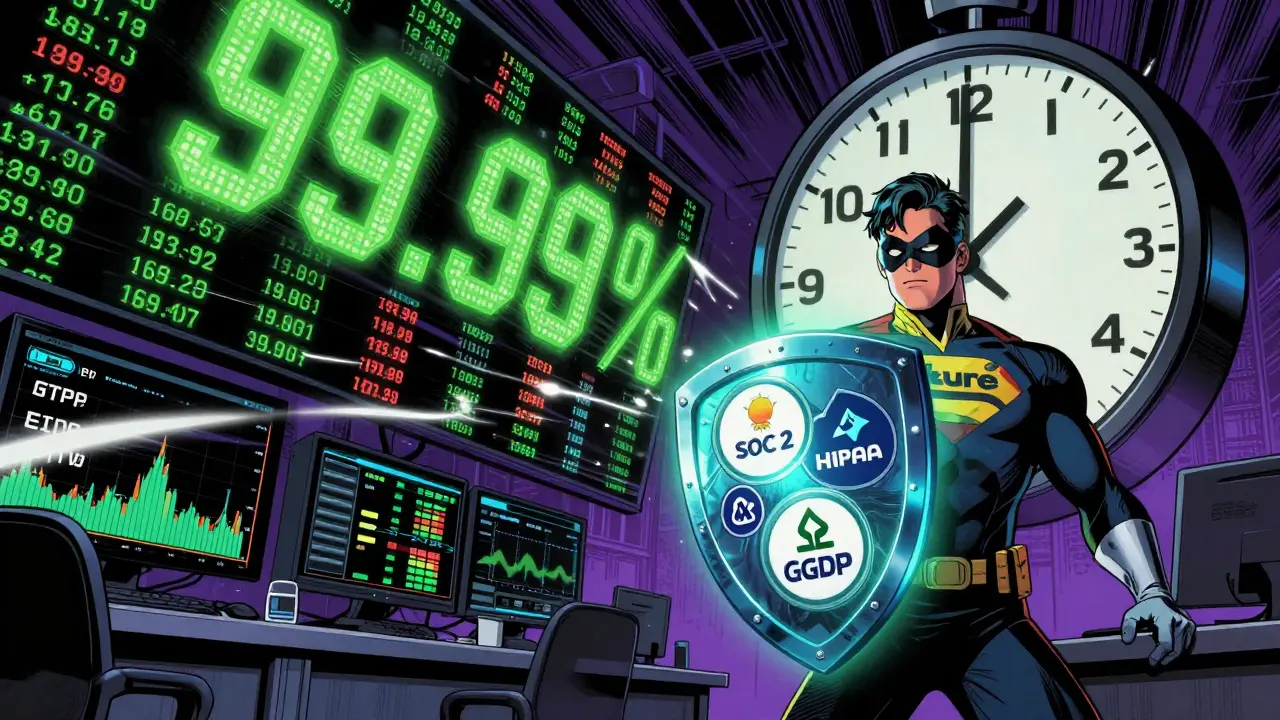
Leading providers have moved beyond that baseline. Microsoft Azure OpenAI and Amazon Bedrock now offer 99.95% uptime for premium contracts-that’s just 21.6 minutes of downtime per month. But the real players? Healthcare and financial institutions are pushing for 99.99% uptime-just 4.32 minutes per month. And it’s not just about total uptime. It’s about when it fails. A user on Reddit reported that Azure OpenAI hit 99.92% uptime over six months, but had consistent latency spikes during European business hours. That’s not a glitch-it’s an SLA violation waiting to happen.
Here’s the catch: SLAs don’t guarantee model availability. If GPT-4 has a bug and goes offline, but your contract only covers API uptime, you’re out of luck. You can’t switch to Claude 4 or Gemini 2.5 Pro without breaking your own application’s SLA. That’s why enterprises are now demanding model-specific uptime guarantees-and providers are starting to respond.
Latency isn’t a feature-it’s a contract term
"Fast response" isn’t a marketing slogan anymore. It’s a measurable SLA term. Standard enterprise contracts now require 95% of requests to return in under 3 seconds under normal load. During peak traffic, that stretches to 5-7 seconds. But here’s the problem: most providers measure latency from the moment a request hits their server-not from when the user clicks "submit" on your app.
One enterprise using Google Vertex AI for multimodal document processing found their actual end-to-end latency was 8.2 seconds, even though Google’s SLA claimed 2.5 seconds. Why? Because the SLA didn’t account for network routing delays or client-side processing. That’s why smart teams now run their own load tests-simulating 300% of peak usage-to verify claims before signing. The average enterprise deployment takes 3-6 months just to test SLA performance. Don’t skip this step.
Security isn’t optional-it’s baked into the contract
OpenAI’s direct API doesn’t support HIPAA or FedRAMP High. That’s not a technical limitation-it’s a business decision. And it’s a dealbreaker for hospitals, insurers, and government agencies. Enterprise SLAs now demand specific compliance certifications as non-negotiables:
- SOC 2 Type II: Baseline for data handling
- HIPAA: Required for healthcare data
- FedRAMP High: Mandatory for U.S. federal contracts
- GDPR: Required for any EU citizen data
- DoD IL4/IL5: For defense contractors
Azure OpenAI leads here, with all five certifications. Anthropic’s Claude 4 Series doesn’t just claim compliance-it guarantees zero data retention, verified by third-party audits. That’s not a feature. It’s a legal shield. One healthcare provider on Trustpilot said Anthropic’s SLA prevented a $2M HIPAA violation during an audit. That’s worth more than any discount on API calls.
Encryption standards matter too. AES-256 for data at rest, TLS 1.3 for data in transit-these aren’t buzzwords. They’re SLA requirements. And data residency? It’s no longer an afterthought. Google Cloud AI now offers regional processing in 22 locations. If your customer data must stay in Germany, your SLA must say so-clearly, in writing.
Support isn’t a helpdesk-it’s a lifeline
"We offer 24/7 support" sounds great until you realize that means a chatbot, not a human. Enterprise SLAs now define support tiers by response time and access:
- Standard: 4-hour email response during business hours
- Premium: 1-hour response, 24/7 dedicated engineer ($25K+/month)
- Mission-critical: 15-minute response for Severity 1 issues, direct phone access
Here’s what no one talks about: weekends and holidays. A 2025 Aloa analysis found that 43% of SLA disputes came down to ambiguous language around "business hours." Is 8 a.m. on a Saturday a business hour? What about the day after Christmas? If your contract doesn’t define it, you’re on your own.
And don’t assume support means fixing the model. It means helping you fix your integration. The best providers assign named account managers who understand your architecture-not just your billing. One financial firm in Chicago said their Azure account manager helped them restructure their API calls to cut latency by 40%-without changing a line of code.
Hidden costs are the real trap
Look at the price: $0.002 per 1,000 tokens. Sounds cheap. But AIMultiple’s 2024 analysis found that 20-40% of enterprise LLM costs are hidden:
- Dedicated GPU clusters for low-latency needs
- Enhanced security monitoring tools
- Data residency infrastructure
- Compliance audit prep and reporting
- Internal team time (avg. 2.5 FTEs per deployment)
Amazon Bedrock advertises 30% cost savings through model routing. But if you need to switch models mid-flow because one fails, your SLA must allow it-or you’re stuck. That’s why enterprises are demanding "model portability" clauses: the right to swap models without penalty if performance drops below SLA thresholds.
What’s missing? Model versioning and traceability
Most SLAs don’t say how long a model version will stay available. One company upgraded to GPT-4 Turbo in January 2025. By March, OpenAI deprecated the API endpoint. Their entire customer support system broke. No one warned them. No one offered a grace period.
Gartner’s David Groom says this is the most overlooked SLA component: "Enterprises need explicit commitments about how long specific model versions will remain available before mandatory upgrades." That’s not a nice-to-have. It’s a risk management requirement.
And what about traceability? If your AI generates a biased response or a false medical diagnosis, can you audit every step? Dr. Marcus Chen of Helicone.ai says: "Multi-agent workflow visibility must be part of the SLA." That means logging every prompt, every response, every agent interaction. Google Cloud now offers real-time compliance dashboards that auto-validate GDPR and HIPAA adherence. That’s the future.

Who wins? Who loses?
By Q1 2026, four providers control 72% of the enterprise market:
- Azure OpenAI: Best for regulated industries. Strongest compliance, reliable uptime, excellent documentation. Weakness? Cost and Microsoft ecosystem lock-in.
- Amazon Bedrock: Best for cost-optimized, multi-model deployments. Flexible routing, strong scaling. Weakness? SLA claims process is opaque.
- Google Vertex AI: Best for complex multimodal tasks. Strong performance on benchmarks like SWE-bench. Weakness? SLA terms are vague, especially around maintenance windows.
- Anthropic: Best for privacy-sensitive use cases. Zero data retention, Constitutional AI. Weakness? Slower to adopt regional data options-only added in Q2 2025.
Smaller providers? They’re disappearing. If you can’t offer a clear, verifiable SLA across performance, security, and compliance, you won’t survive 2026. The market is consolidating around trust-not speed.
What to do next
Don’t sign a contract until you’ve tested it. Run a 30-day load test at 300% of your peak usage. Document every latency spike, every error code, every support delay. Demand written answers to these questions:
- What’s your model versioning policy? How long will this version stay live?
- Can I switch models mid-contract if performance drops?
- Where is my data stored? Can I prove it stays in my region?
- What’s the exact penalty for downtime? Is it a percentage of monthly fee?
- Who do I call at 2 a.m. if this breaks? Is there a direct line?
- Can I audit every prompt and response for compliance?
Enterprise AI isn’t about building the smartest bot. It’s about building the most reliable one. And reliability isn’t something you get from a model card. It’s something you get from a contract that’s clear, measurable, and enforceable.
Frequently Asked Questions
What’s the minimum SLA enterprises should demand from LLM providers?
Enterprises should demand at least 99.9% uptime, 3-second latency for 95% of requests, SOC 2 Type II compliance, AES-256 encryption, and a clear service credit policy (e.g., 10% refund for downtime over 43 minutes per month). If you’re handling healthcare or financial data, insist on HIPAA or GDPR compliance as part of the SLA-not as a side note.
Can I switch LLM providers mid-contract without penalty?
Most standard contracts don’t allow this. But smart enterprises negotiate "model portability" clauses: if the provider fails to meet SLA performance thresholds for two consecutive months, you can switch to a different model or provider without penalty. This isn’t common yet-but it’s becoming a requirement in financial services and government contracts.
Why do some providers have better SLAs than others?
It’s about who they serve. Providers like Microsoft and Amazon built their SLAs for enterprise customers who pay millions annually and have legal teams that demand enforceable terms. Smaller providers focus on startups and developers who prioritize price over guarantees. The bigger the contract, the tighter the SLA. If you’re paying under $10K/month, don’t expect enterprise-grade terms.
Is open-source LLM better for SLAs than proprietary APIs?
No. Open-source models like Llama 3 or Mistral give you control-but zero SLA. No uptime guarantee. No support response time. No compliance certifications. If you run them on your own servers, you’re responsible for everything: security, scaling, monitoring, patching. For most enterprises, that’s riskier than paying for a managed API with a real SLA.
How do I know if a provider is lying about their SLA?
Demand access to their public status page and historical uptime data. Azure and Google publish real-time dashboards. Check third-party tools like Datadog or Logz.io for independent monitoring. Also, look at user reviews on G2 and Trustpilot-not the provider’s marketing page. Real users report latency spikes, support delays, and hidden throttling. If you see consistent complaints about "unexplained slowdowns," walk away.
Will SLAs get stricter in 2026?
Absolutely. The EU AI Act went live in January 2026, requiring full audit trails, transparency logs, and bias detection reports. Providers are already adding these to SLAs. Expect to see per-action pricing, AI-predicted uptime guarantees, and real-time compliance dashboards become standard. Providers who treat SLAs as marketing fluff will lose market share. Those who treat them as trust-building tools will charge 25-35% more-and earn it.