
Imagine handing the keys to your company’s most sensitive database to an intern. Now imagine that intern is a Large Language Model an AI system capable of generating human-like text based on vast amounts of training data. Without strict rules, that model could accidentally-or maliciously-leak customer credit card numbers, internal strategy documents, or protected health information. This isn't science fiction; it's the daily reality for enterprises deploying AI at scale in 2026.
We used to think about security as firewalls and passwords. But with generative AI, the threat landscape has shifted. The problem isn't just who logs in; it's what they ask the AI to do, what data the AI retrieves, and what answer it generates. This is where Model Access Controls security frameworks that govern user permissions, resource allocation, and operational boundaries within AI systems come into play. They are the gatekeepers of the AI era, ensuring that only the right people can use the right models for the right reasons.
The Shift from Traditional Security to AI Governance
Traditional cybersecurity focuses on protecting infrastructure. If you have a password, you get in. If you have admin rights, you can delete files. It’s binary. But Large Language Models (LLMs) are probabilistic engines. They don't just retrieve data; they synthesize it. A user might not explicitly ask for "John Doe's salary," but if they ask, "Summarize the performance review trends for the engineering team," the model might stitch together disparate pieces of information to reveal exactly that.
This unique characteristic creates new attack vectors. According to recent industry analysis by Obsidian Security, LLM security addresses risks specific to these models, distinguishing it from standard IT security. In 2025, we saw a massive pivot. Companies realized that basic Role-Based Access Control (RBAC)-which assigns permissions based on job titles-was insufficient. You can’t just say "Marketing Team gets access." You need to say "Marketing Team can use Model X to generate ad copy, but cannot query the Customer Support database via Retrieval-Augmented Generation (RAG)."
The discipline of ensuring LLMs operate within legal and organizational constraints has evolved rapidly since 2023. What started as simple API key management has become a sophisticated layer of context-aware enforcement. Today, leading platforms like Portkey and DataSunrise offer specialized solutions that monitor not just identity, but intent and context in real-time.
How Model Access Controls Actually Work
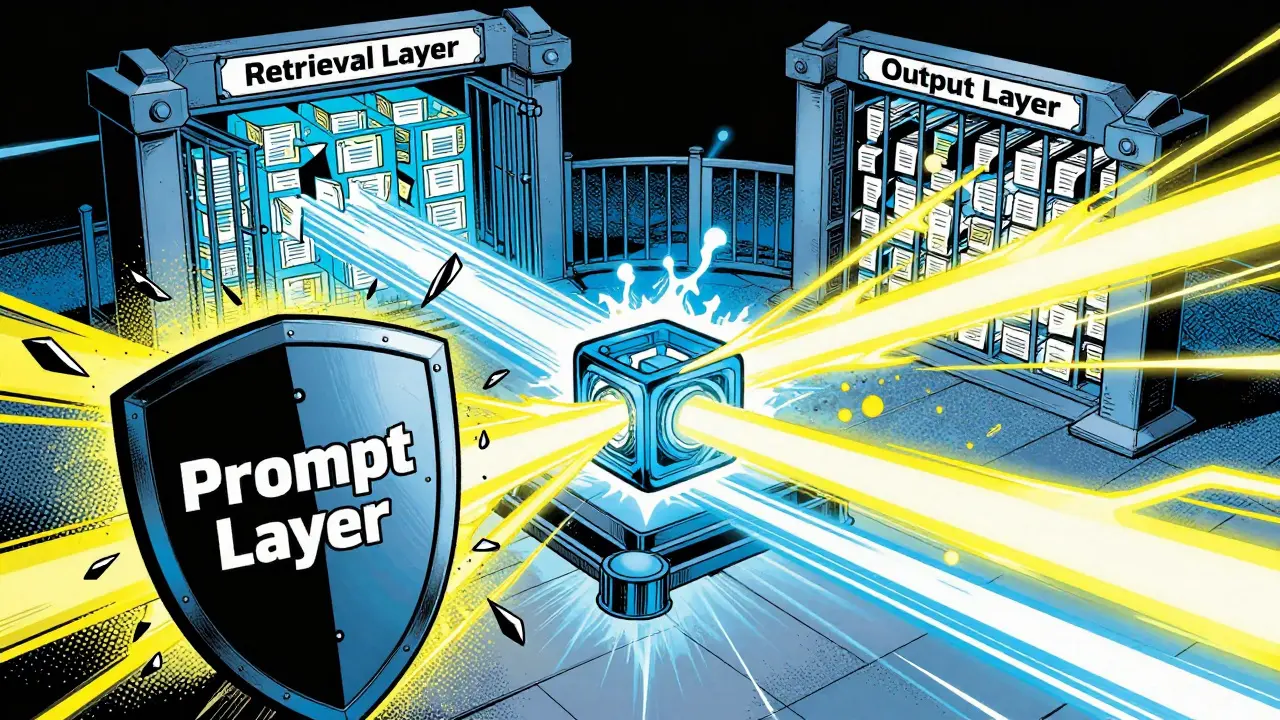
To understand who can use which LLM, you need to look at the three layers of enforcement. Modern access control systems don't just check a username; they inspect the entire interaction pipeline.
- The Prompt Layer: This is the input. Access controls here determine what questions a user is allowed to ask. For example, a junior analyst might be blocked from using prompts that request code execution or financial projections, while a senior engineer is allowed. Systems analyze the semantic content of the prompt to detect potential injection attacks or policy violations before the model even processes them.
- The Retrieval Layer: Most enterprise LLMs connect to external data sources through RAG. This layer controls what data the model is permitted to fetch. Even if a user has access to the AI interface, they shouldn't be able to pull up Protected Health Information (PHI) if their role doesn't require it. Tools like DataSunrise provide dynamic masking here, ensuring that sensitive fields are hidden before they reach the model.
- The Output Layer: This is the response. The system checks the generated text against safety policies. Did the model hallucinate a fact? Did it include PII (Personally Identifiable Information) that should have been redacted? If the output violates policy, it is blocked or sanitized before reaching the user.
Performance matters here too. These checks happen in milliseconds. Enterprise-grade solutions process policy decisions in under 50 milliseconds, supporting thousands of concurrent users without noticeable lag. However, this comes with a trade-off: computational overhead. Real-time monitoring can increase latency by 15-25% in high-volume environments, a cost organizations must weigh against security needs.
RBAC vs. Context-Aware Controls: Choosing Your Approach
Not all access control strategies are created equal. As of late 2025, three primary approaches dominate the market, each with distinct pros and cons.
| Approach | Adoption Rate (2025) | Key Strength | Major Weakness |
|---|---|---|---|
| Basic RBAC | 68% | Simplicity; easy to implement with existing IAM tools. | Fails to address prompt-based leakage; no context awareness. |
| Hybrid RBAC-CBAC | 27% | Context-aware enforcement across prompt, retrieval, and output layers. | High configuration effort; requires skilled security teams. |
| LLM-Powered Management | 5% | Analyzes patterns to detect anomalies; 86% accuracy in preference matching. | High computational cost (+20-35% infra costs); risk of hallucinations in decision-making. |
Basic RBAC is still the most common because it’s familiar. If you’ve used Active Directory or AWS IAM, you know how it works. But it leaves gaps. A user with "Read" access to a document might still trick an LLM into summarizing confidential sections through clever prompting. Hybrid systems, combining RBAC with Context-Based Access Control (CBAC), close these gaps by inspecting the actual content of the interaction. This is becoming the standard for regulated industries like finance and healthcare.
Then there’s the emerging frontier: using LLMs to manage access controls. Researchers at ETH Zurich demonstrated in late 2025 that AI agents can make personalized access decisions with high accuracy. However, experts warn that relying on an AI to decide who gets access introduces its own risks. If the governing AI hallucinates, it might grant unauthorized access. Consequently, many organizations adopt a hybrid approach: simple machine learning algorithms handle real-time authorization, while complex, suspicious cases are escalated for deeper analysis.
Who Needs Strict Access Controls? Industry Breakdown
The urgency for robust model access controls varies by sector. Financial services lead the pack, accounting for 28% of the market adoption in 2025. Why? Because regulators demand it. GDPR Article 32 requires "technical safeguards that limit exposure to only what's necessary." When you’re processing millions of transactions, an LLM leaking transaction details isn't just a privacy issue; it’s a compliance violation with hefty fines.
Healthcare follows closely at 22%. Here, the stakes are life and death. Access controls must strictly segment Protected Health Information (PHI). A doctor might need access to patient records via an AI assistant, but a billing clerk should never see clinical notes. The granularity required here forces healthcare providers toward advanced CBAC systems.
Government agencies represent 18% of adopters, driven by new mandates like the November 2025 update to the NIST AI Risk Management Framework, which introduced specific access control requirements for federal systems. Meanwhile, small-to-medium businesses (SMBs) lag significantly at only 12% adoption. The barrier isn't lack of interest; it's complexity. Implementing enterprise-grade access control takes 4-6 weeks and requires skills in both traditional cybersecurity and LLM architecture-a combination many SMBs lack.

Implementation Challenges and Pitfalls
Setting up model access controls isn't plug-and-play. One of the biggest hurdles is the "prompt injection" problem. Malicious inputs designed to bypass safety filters were reported in 38% of enterprise deployments in 2025. Attackers craft prompts that confuse the model into ignoring its instructions. To combat this, 82% of mature enterprises now use proxy-based firewalls that inspect prompt payloads before they hit the model.
Another challenge is the balance between security and usability. Over-restrictive controls can cripple productivity. Studies show that excessive restrictions can reduce the utility of LLMs by 30-40%. Users get frustrated when every helpful suggestion is blocked by a false positive. The goal is "least privilege" without "least functionality." This requires continuous tuning. Security teams must monitor audit logs, adjust thresholds, and refine policies regularly.
Data discovery is also critical. You can’t protect what you don’t know you have. Automated tools must classify sensitive fields in your databases before they are connected to LLMs. If your HR database contains untagged social security numbers, an LLM connected to it will treat them as fair game unless explicit masking rules are applied.
The Future of AI Access Governance
As we move through 2026, the market for LLM security solutions is exploding, projected to reach $3.2 billion with a 47% compound annual growth rate. We are seeing consolidation. By 2027, 73% of enterprises plan to merge their scattered AI security tools into unified governance platforms. Major players like OpenAI and Anthropic are responding. OpenAI launched an enterprise access control API in December 2025, allowing granular permission management across their model suite. Anthropic introduced context-aware guardrails for Claude 3.5 in October 2025.
The future points toward automation. Vendors are developing systems that use LLMs to automatically generate and update access policies based on observed usage patterns. Imagine a system that notices a marketing team frequently accessing sales data and suggests a new, secure permission set, rather than waiting for a security breach to force a change. Standardized APIs for cross-platform enforcement are also on the roadmap, solving the headache of managing different security protocols for different AI providers.
Ultimately, model access controls are no longer optional. They are the foundation of trustworthy AI. Whether you are a startup experimenting with chatbots or a bank integrating AI into core banking, defining who can use which LLM-and why-is the single most important step in securing your digital future.
What is the difference between RBAC and CBAC in LLM security?
Role-Based Access Control (RBAC) grants permissions based on a user's job title or group membership, such as giving all engineers access to code repositories. Context-Based Access Control (CBAC) goes further by evaluating the specific context of the request, including the content of the prompt, the data being retrieved, and the intended output. CBAC is essential for LLMs because it prevents authorized users from abusing the model to access sensitive data through clever phrasing or indirect queries.
Why are traditional firewalls insufficient for LLMs?
Traditional firewalls protect network infrastructure and block unauthorized IP addresses. However, LLMs introduce semantic risks. A user might have valid network access but attempt to extract sensitive information through natural language prompts. Traditional tools cannot understand the meaning of a prompt or detect if an LLM is synthesizing private data from multiple sources. Specialized AI security tools are needed to inspect the content of interactions, not just the connection.
How much does implementing LLM access control slow down performance?
Modern access control systems are optimized for speed, typically processing policy decisions in under 50 milliseconds. However, the added layer of inspection can increase overall latency by 15-25% in high-volume environments. Organizations must balance this slight delay against the significant risk of data leakage. For most enterprise applications, this latency is negligible compared to the time taken for the LLM to generate a response.
What is prompt injection, and how do access controls prevent it?
Prompt injection is an attack where a user inputs malicious text designed to trick the LLM into ignoring its safety instructions or revealing hidden data. Access controls prevent this by using proxy-based firewalls that inspect prompt payloads before they reach the model. These systems analyze the semantic intent of the prompt and block requests that match known attack patterns or violate predefined behavioral guardrails.
Which industries require the strictest LLM access controls?
Financial services, healthcare, and government sectors have the strictest requirements due to heavy regulation. Financial firms must comply with data protection laws regarding transaction data. Healthcare providers must safeguard Protected Health Information (PHI) under HIPAA. Government agencies follow frameworks like NIST's AI Risk Management Guide. These industries often mandate Context-Based Access Control (CBAC) to ensure granular protection of sensitive data.