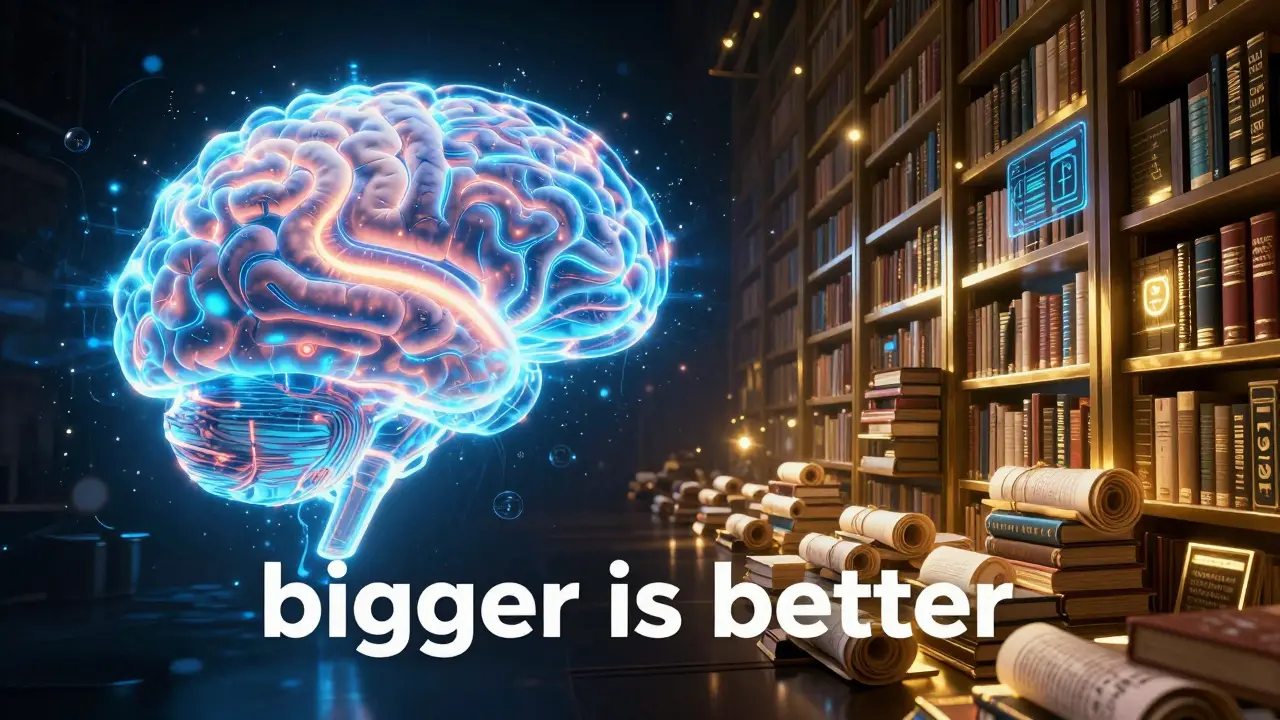
Imagine spending millions of dollars and months of compute time to build a massive AI model, only to find out that a model 1/10th the size performs almost as well because you fed it better data. This is the central tension in modern AI: do you grow the brain (the model parameters) or give it more books to read (the data volume)? For a long time, the industry mantra was "bigger is better," but we're hitting a wall. We are literally running out of high-quality human text on the internet, and the electricity bills for training trillion-parameter models are becoming unsustainable.
| Feature | Large LLMs (e.g., GPT-3, PaLM) | Small LLMs (e.g., TinyLLaMA, Llama-3-8B) |
|---|---|---|
| Parameter Count | 100B+ | 1B - 15B |
| Hardware Needs | Clusters of A100/H100 GPUs | Single consumer GPU or Mobile device |
| Best Use Case | Complex reasoning, long-form synthesis | Classification, autocomplete, edge deployment |
| Latency | Higher (Slower response) | Lower (Near instant) |
The Parameter Game: Why Size Matters
In the world of AI, model size is essentially the model's capacity to remember patterns. When we talk about parameters, we're talking about the internal weights that the model adjusts during training. A model like GPT-3 is a massive transformer-based model with 175 billion parameters, allowing it to handle nuanced tasks like writing a coherent legal brief or solving multi-step coding bugs.
But there's a catch. More parameters don't just mean more intelligence; they mean more hunger. To keep a 175B parameter model running in real-time, you need a massive infrastructure of GPUs. If you're a startup with a tight budget, the sheer cost of inference (the act of the model generating a response) can kill your margins. This is where the trade-off starts: you get deeper understanding, but you pay for it in latency and electricity.
The Data Crunch: Feeding the Beast
If the model is the engine, data volume is the fuel. We've seen an exponential explosion in the amount of text used for training. Research from Epoch AI shows that training sets are growing by about 3.7x every year. We're moving from billions of words to tens of trillions.
However, we're facing a "data cliff." Experts predict that we might exhaust all high-quality, human-generated language data on the web by 2026. When you've already scraped most of Common Crawl (a massive archive of the web), where do you go next? This scarcity is forcing a shift in strategy. Instead of just adding more data, researchers are focusing on data quality. It turns out that 1 trillion tokens of "textbook-quality" data can often beat 10 trillion tokens of "random web noise." This is why we're seeing a rise in synthetic data-AI-generated text used to train the next generation of AI.

The Efficiency Pivot: Small is the New Big
Is it possible that we've been overbuilding? Recent evidence suggests yes. A comparative study on requirements-classification tasks showed that Llama-3-8B (a relatively small model) performed nearly as well as its massive counterparts, with only a tiny margin of error (about 0.02 F1 score). This suggests that for many specific tasks-like sorting emails, classifying tickets, or basic sentiment analysis-a giant model is overkill.
Smaller models, such as DistilBERT, are designed for speed. By using techniques like pruning (removing unnecessary connections) and quantization (reducing the precision of the weights), developers can shrink a model's memory footprint significantly. For example, moving a 7B parameter model to 4-bit precision can cut its memory usage by 75%. You might lose a bit of precision in complex math, but for a mobile chatbot, the trade-off is a no-brainer.
Computational Costs and the Environmental Toll
We can't talk about size and data without talking about the planet. Training a state-of-the-art LLM isn't just a software challenge; it's an industrial one. The energy required to cool thousands of GPUs and power the data centers is staggering. Professor Emily Bender has pointed out that the carbon footprint of these models often impacts communities that don't even have access to the technology.
This creates an economic divide. Only the "compute-rich" (companies like Google, Microsoft, and Meta) can afford to push the boundaries of model size. For everyone else, the goal is compute efficiency. The trick is to find the point of diminishing returns-the moment where adding another 10 billion parameters or another trillion tokens of data only gives you a 0.1% increase in accuracy but costs an extra million dollars in electricity.

Strategic Decision Making: Which Should You Choose?
Choosing between a large and small model depends entirely on your "job to be done." If you're building a tool to analyze 100-page medical contracts, you need a large model. Why? Because of the context window. Larger models generally handle longer strings of text more effectively, which reduces "hallucinations" (when the AI makes things up) and improves the quality of citations.
On the other hand, if you're building a translation app for short phrases on a smartphone, a small model is the only logical choice. It's faster, cheaper to run, and doesn't require a constant, high-speed connection to a massive server farm. Many teams are now using a hybrid approach: they use a massive model to pre-process and label a high-quality dataset, then use that data to "distill" the knowledge into a much smaller, faster model for the actual end-user.
Does more data always make a model smarter?
Not necessarily. There is a limit to how much a model of a certain size can "absorb." If the model is too small for the volume of data, it will underfit and fail to capture complex patterns. Conversely, if you have a massive model but very little data, it may overfit, essentially memorizing the training set instead of learning how to reason. The goal is a balance between the two.
What is the "data cliff" in LLM training?
The data cliff refers to the point where AI developers run out of high-quality, human-written text on the public internet. Since LLMs require trillions of tokens to reach peak performance, and the pool of high-quality books, articles, and code is finite, researchers expect a shortage of training data around 2026.
How does quantization affect model performance?
Quantization reduces the numerical precision of the model's weights (e.g., from 16-bit to 4-bit). This dramatically lowers the RAM required to run the model, making it possible to run larger models on cheaper hardware. While it can lead to slight drops in accuracy, especially in precise numerical reasoning, the performance loss is often negligible for general conversation and text generation.
Why do larger models hallucinate less in long documents?
Larger models typically have larger context windows and more parameters to track relationships between distant pieces of information. This allows them to "remember" a fact from page 1 of a document while processing page 50, whereas a smaller model might lose that thread and invent a plausible-sounding but incorrect detail.
What is synthetic data and is it safe to use?
Synthetic data is information generated by another AI model rather than a human. It is used to fill gaps in training sets. However, there is a risk of "model collapse," where the AI starts learning its own mistakes, leading to a degradation in quality over generations. To avoid this, developers usually mix synthetic data with a core set of verified, human-created data.
Next Steps and Troubleshooting
If you're deciding on a model for your project, start by defining your constraints. If your priority is low latency and cost, look into Llama-3-8B or TinyLLaMA and experiment with 4-bit quantization. If you find the model is failing on complex logic, don't immediately jump to a 175B parameter model-try improving your data quality first. Use a larger model to curate a smaller, higher-quality training set, then fine-tune your small model on that gold-standard data.


Franklin Hooper
April 16, 2026 AT 18:15one finds the lack of precision in the provided table rather taxing
the terminology is passable but the conceptual depth is shallow at best
Jess Ciro
April 18, 2026 AT 15:12synthetic data is just a fancy way of saying the AI is eating its own tail and we are all just watching the digital apocalypse happen in real time
first it's "better data" then it's "synthetic" and suddenly we're living in a simulation where the truth is whatever the weights decide it is today
nobody is talking about the hidden agendas of the companies controlling these clusters
it's a feedback loop of madness and we're just pretending it's an "efficiency pivot" while our cognitive autonomy is being harvested
Tamil selvan
April 19, 2026 AT 19:48This is a truly commendable analysis of the current landscape!!! It is heartening to see such a detailed comparison between large and small models!!! We must all strive to optimize our resources for the greater good of the community!!!
Jim Sonntag
April 21, 2026 AT 04:57oh sure let's just use synthetic data and pretend the internet isn't already a dumpster fire of bot-generated garbage anyway
really love how we're "saving the planet" by just moving the GPUs to a different country with looser regulations
so inspiring
Mark Brantner
April 21, 2026 AT 09:13Hahaha love the optimsim here!! I bet the "data cliff" is just a myth to keep us from tryin stuff at home lol!! Imagine the possibilties if we just hack together a few 4-bit models and let them fight it out!! Lets gooo!!
Kate Tran
April 22, 2026 AT 08:14TiniLLaMA is actually pretty decent for basic stuff. I used a small model for a project last month and it didnt really lag at all. Much beter than waiting for a huge model to think for ten seconds just to tell me the weather.
saravana kumar
April 23, 2026 AT 07:35It is quite evident that the author has failed to address the nuance of hyperparameter tuning in the context of small models. One might observe that the mentioned F1 score is a rudimentary metric that does not capture the semantic drift inherent in distilled models. The assertion that a 8B model is "nearly as well" is an oversimplification that ignores the edge cases of complex logical reasoning. It is a pity that such foundational elements were omitted in favor of a simplified narrative. Furthermore, the discussion on environmental impact is merely superficial. One must consider the water usage of these data centers, not just the electricity. The analysis is moderately acceptable but lacks the rigor expected of a professional technical discourse. In conclusion, the "sweet spot" is a moving target that depends on the specific distribution of the training manifold, a point the author completely glossed over while focusing on the "data cliff" melodrama.
amber hopman
April 23, 2026 AT 19:02The distillation process seems like the most viable path forward here. If we can use the larger models as teachers, we can essentially bake that complex reasoning into a smaller architecture without the overhead. I'm curious if this will lead to a standardization of small-model kernels for edge devices.
Deepak Sungra
April 25, 2026 AT 16:56honestly this whole thing is just exhausting. like why do we even need more models anyway. i'm just here for the chaos of seeing these things hallucinate a whole new language while my computer fan sounds like a jet engine