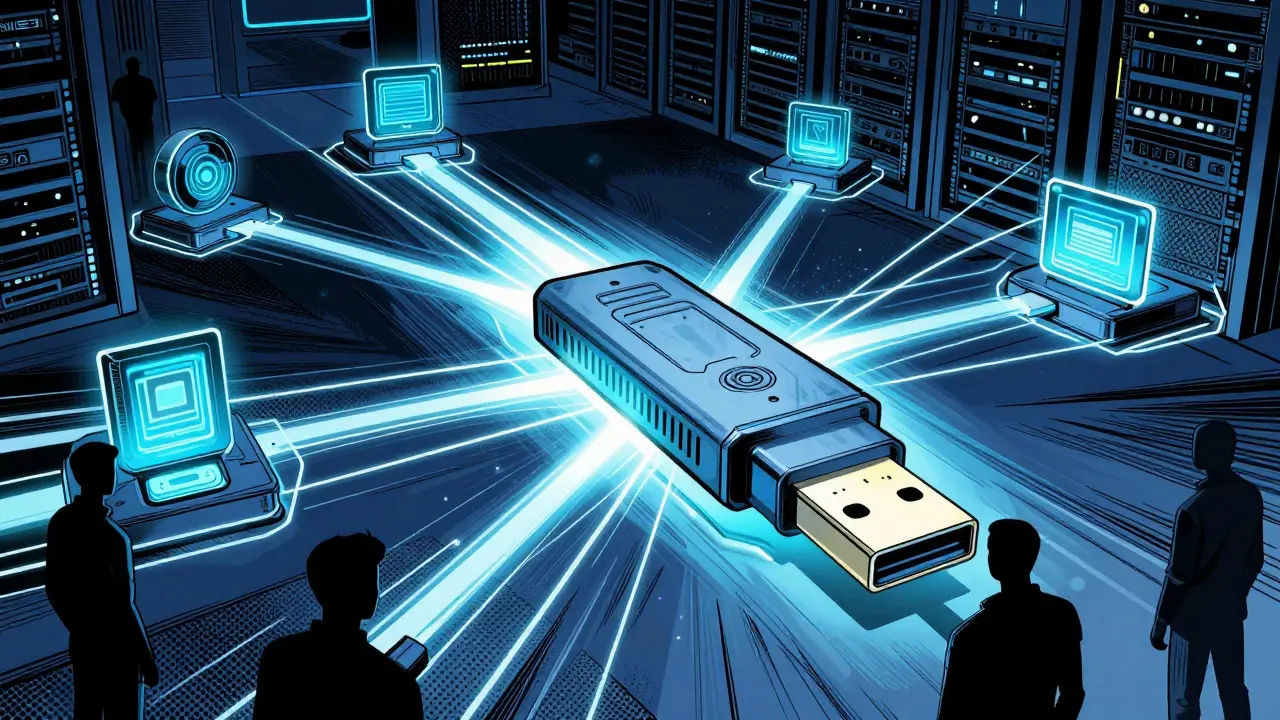
Imagine building an AI agent that needs to check your calendar, query a database, and send an email. Without a standard way to connect these tools, you’d end up writing custom code for every single combination of AI model and external service. This is the "N×M integration problem," and it’s a nightmare for developers trying to scale AI applications. Enter the Model Context Protocol, or MCP. Introduced by Anthropic in November 2024, MCP is an open standard that acts as a universal remote control for AI systems. It allows Large Language Models (LLMs) to seamlessly connect with external data sources, tools, and systems through a standardized interface, drastically reducing the complexity of building capable AI agents.
What Is Model Context Protocol?
At its core, MCP is a specification that defines how AI applications communicate with external resources. Think of it like USB-C for AI. Before USB-C, you had different ports for power, data, and video. Now, one cable does it all. Similarly, MCP provides a single protocol for connecting AI hosts to various servers that expose tools and data. It solves the scalability issue by ensuring that if you have N AI applications and M external services, you only need N+M integrations instead of N×M. Each application implements the client side once, and each service implements the server side once. They plug together automatically.
The protocol was rapidly adopted by major players including OpenAI and Google DeepMind shortly after its release, signaling a shift toward standardized infrastructure in the AI ecosystem. It positions context not just as static text fed into a prompt, but as a dynamic, versioned resource with proper lifecycle management. This means your AI agent can access live, authoritative data rather than relying solely on what it learned during training.
How MCP Works: Architecture and Components
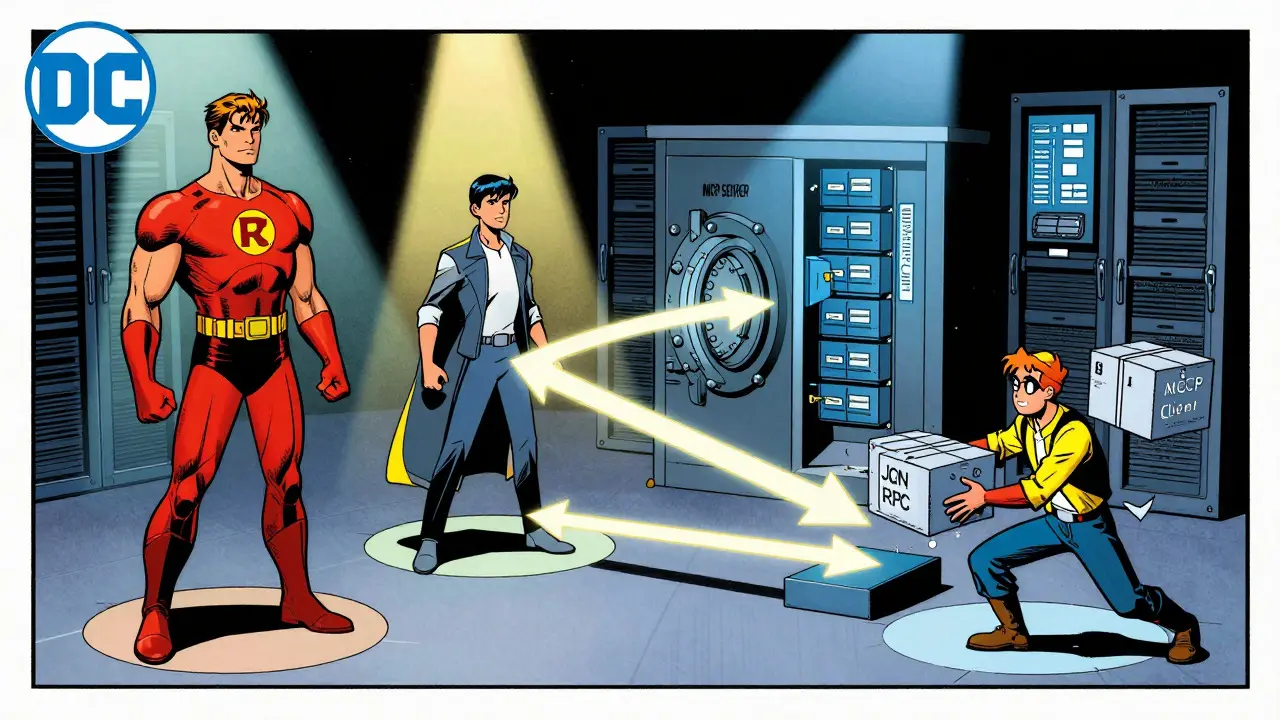
MCP uses a client-server architecture inspired by the Language Server Protocol (LSP), which revolutionized developer tooling. Understanding the four core components is key to grasping how the system functions:
- Host Applications: These are the user-facing apps, such as Claude Desktop, AI-enhanced IDEs like Cursor, or web-based LLM interfaces. They manage the user experience and multiple client connections.
- MCP Clients: Integrated within the host, these handle the actual communication with MCP servers. They maintain the state of the connection and manage the session.
- MCP Servers: These are the back-end services that expose specific capabilities. A server might provide access to a Slack workspace, a PostgreSQL database, or a file system.
- Transport Layer: MCP uses bidirectional, message-driven communication based on JSON-RPC 2.0. Unlike traditional REST APIs which are often one-way requests, MCP allows servers to initiate requests and stream partial results back to the client in real-time.
This bidirectional nature is crucial for agentic AI. It enables structured data exchange rather than screen-scraping or simple request-response cycles. For example, if an agent is running a long-running calculation, the server can stream progress updates to the client without blocking the entire process.
Core Resource Types in MCP
MCP standardizes four primary types of resources that an AI agent can interact with. This standardization reduces serialization complexity and makes it easier for models to understand what they’re working with.
| Resource Type | Description | Example Use Case |
|---|---|---|
| Tools | Functions the LLM can invoke to perform actions. | Sending an email, creating a ticket, querying a stock price. |
| Resources | File-like data structures containing information. | Reading a PDF, accessing a database record, fetching API response data. |
| Prompts | Pre-written templates that guide LLM interactions. | A template for summarizing meeting notes or drafting a legal contract. |
| Sampling | Allows remote servers to use client-hosted LLMs. | An external server requesting a completion from the local model (limited adoption). |
Tools are arguably the most critical component for agentic workflows. They allow the LLM to move beyond generating text and actually *do* things. By exposing tools via MCP, developers create a discoverable capability surface. The AI agent can query the server at runtime to see what tools are available, rather than relying on hardcoded lists defined in the application code.
MCP vs. Traditional Integration Methods
You might wonder why we need MCP when we already have APIs and RAG. The differences are significant and address specific pain points in modern AI development.
Compared to traditional REST/RPC APIs, MCP standardizes protocol-level integration with persistent context management. Traditional APIs treat context as ephemeral payloads passed in each request. MCP treats context as a first-class resource that can be maintained across sessions. This is vital for complex multi-step tasks where the AI needs to remember previous interactions.
When compared to Retrieval-Augmented Generation (RAG), MCP offers a distinct advantage in freshness and provenance. RAG systems primarily retrieve static documents from a vector database. If your data changes, you have to re-index. MCP, however, enables live authoritative lookups. If you connect an MCP server to a live CRM, the AI sees the current customer status, not a snapshot from last week. Furthermore, MCP includes provenance metadata, allowing the AI to trace exactly where a piece of information came from, which is crucial for trust and debugging.
Unlike headless browsing approaches that scrape web content, MCP provides structured data exchange. This eliminates the fragility of parsing HTML and handles data more reliably. While both require initial setup, MCP’s machine-readable capability surface means that once connected, the integration is robust and self-describing.
Implementation Challenges and Security Considerations
While MCP simplifies many aspects of AI integration, it’s not without its hurdles. The biggest challenge cited by early adopters is the learning curve. Teams unfamiliar with JSON-RPC patterns often report needing 2-3 weeks of dedicated training to implement MCP effectively. However, developers with experience in LSP find the transition much smoother due to architectural similarities.
Security is another major concern. Because MCP grants AI agents access to internal systems, improper configuration can lead to privilege escalation. Red Hat’s security analysis in April 2025 warned that without proper controls, MCP implementations could become a significant attack surface. Key security practices include:
- Implementing fine-grained permission controls for each exposed tool.
- Using audit trails to track every action taken by the agent.
- Scoping permissions strictly to what is necessary for the task.
- Regularly reviewing server logs for unexpected behavior.
The latest specification, MCP 1.1 released in April 2025, introduced enhanced security features specifically to address these concerns, including mandatory audit trail requirements and better permission scoping. This evolution shows that the community is taking security seriously as the protocol matures.

Market Adoption and Future Roadmap
Adoption of MCP has been rapid since its launch. Anthropic reported that 78% of enterprise Claude customers implemented MCP integrations within six months of release. Industry surveys show strong uptake across sectors: 62% in financial services, 48% in healthcare, and 71% in e-commerce. The protocol is particularly valuable in scenarios requiring real-time data, such as financial trading systems where sub-second latency is critical.
The competitive landscape includes alternatives like LangChain’s tool integration framework, but MCP’s open standard approach has positioned it as the preferred solution for enterprises seeking vendor-agnostic integration. Gartner predicts MCP will become the de facto standard for AI agent tool integration by 2027, with 85% enterprise adoption in AI agent deployments.
Looking ahead, the MCP working group, which includes representatives from Anthropic, OpenAI, Google DeepMind, and Microsoft, has outlined a clear roadmap. MCP 1.2, scheduled for Q3 2025, will introduce native support for multi-modal context handling. MCP 1.3, planned for Q1 2026, will add standardized observability metrics. These updates aim to make MCP even more powerful for complex, multi-sensory AI applications while providing better insights into system performance.
Frequently Asked Questions
Is Model Context Protocol only for Anthropic products?
No, MCP is an open standard. While launched by Anthropic, it has been adopted by OpenAI, Google DeepMind, and Microsoft. Any application that implements the MCP client spec can connect to any server that implements the MCP server spec, regardless of the underlying LLM provider.
How does MCP differ from Function Calling?
Function calling is a feature within specific LLMs that allows them to output structured data to trigger actions. MCP is a broader protocol that standardizes how those actions are discovered, executed, and managed across different systems. You can use function calling *within* an MCP tool implementation, but MCP provides the infrastructure layer for connecting diverse tools to diverse AI hosts.
What programming languages are supported for MCP implementation?
Anthropic provides official reference implementations in Python, JavaScript, and Java. However, because MCP relies on standard JSON-RPC 2.0 over HTTP or stdio, it can technically be implemented in any language that supports these protocols. Community libraries exist for Go, Rust, and C# as well.
Is MCP secure enough for production environments?
Yes, provided you follow best practices. With the release of MCP 1.1, security features like fine-grained permissions and audit trails were added. However, security is still shared responsibility. You must scope permissions carefully and monitor activity, as giving an AI agent broad access to internal systems without oversight poses risks similar to any other API integration.
Can MCP handle real-time data streams?
Yes. One of MCP's key advantages over static RAG is its support for streaming responses and bidirectional communication. This allows servers to push updates to clients in real-time, making it suitable for use cases like live market data, IoT sensor feeds, or collaborative editing sessions.