You built a chatbot. It hallucinates. You tried prompting. It still fails on your specific legal documents. So you decide to fine-tune. But then you hit a wall: do you train it on just your legal cases (task-specific) or teach it to follow general instructions first? This isn't just a technical detail; it’s the difference between a model that breaks every time you ask something new and one that actually helps your team.
Most developers default to instruction tuning because it sounds more modern. But if you have a narrow, high-stakes problem like medical coding or financial classification, skipping task-specific training might cost you accuracy. Let's break down exactly when to use which strategy, based on real-world data from 2025 and 2026 deployments.
The Core Difference: Specialist vs. Generalist
Think of a base Large Language Model (LLM) like Meta’s Llama 3, released in April 2024, is a prime example of this foundation. It has billions of parameters but doesn't inherently know how to "follow orders." It just predicts the next word.
Instruction Tuning teaches the model to interpret human commands across a wide variety of tasks. It uses datasets with thousands of diverse prompt-response pairs. The goal? Make the model versatile. If you want a chatbot that can summarize emails, write code, and answer trivia, this is your path.
Task-Specific Fine-Tuning is different. You take that same base model and hammer it with hundreds or thousands of examples for one single job-say, classifying SEC filings. The model becomes an expert at that one thing. But here’s the catch: it often forgets everything else. Research from November 2024 showed up to 38% degradation in unrelated capabilities after heavy task-specific tuning.
When Instruction Tuning Wins
If your application needs to handle varied user requests, instruction tuning is the industry standard. In Q4 2025, Gartner reported that 87% of commercial LLM deployments used some form of instruction tuning. Why? Because users don’t speak in rigid templates. They ask messy questions.
Google’s FLAN-T5 model proved back in 2022 that tuning across multiple tasks improves zero-shot performance-meaning the model can handle tasks it wasn't explicitly trained on. A study by Toloka AI found that instruction-tuned models are 47% better at following complex, multi-step prompts compared to base models. If you’re building a customer support bot, you need that flexibility. You don’t want the bot crashing because a user asked for a refund summary instead of a policy check.
| Feature | Instruction Tuning | Task-Specific Fine-Tuning |
|---|---|---|
| Data Requirement | Diverse, high-quality instruction pairs (10k+) | Narrow, labeled dataset (500-1k examples) |
| Generalization | High (handles unseen tasks well) | Low (struggles outside its niche) |
| Catastrophic Forgetting | Minimal (preserves broad knowledge) | High risk (up to 38% capability loss) |
| Setup Time | 4-6 weeks (complex data prep) | 2-3 weeks (simpler pipeline) |
| Best Use Case | Chatbots, assistants, general automation | Classification, extraction, niche tools |

When Task-Specific Fine-Tuning Is Better
Don’t dismiss task-specific tuning. In highly regulated industries like healthcare or finance, precision matters more than versatility. Mistral Healthcare’s 2024 model, specialized via task-specific tuning, hit 98.7% accuracy on ICD-10 medical coding. An instruction-tuned generalist simply couldn’t match that specificity without massive computational overhead.
A recent arXiv study on financial tasks highlighted this trade-off. When fine-tuned specifically for financial classification, task-specific models achieved 5.8% higher accuracy than instruction-tuned counterparts. If your business relies on exact matches-like extracting invoice numbers or diagnosing symptoms-the specialist approach wins. Just be prepared to manage the side effects.
The Hidden Cost: Catastrophic Forgetting
This is the biggest pitfall of task-specific tuning. When you drill a model too hard on one task, it loses its general language skills. Data scientist Alex Chen shared a real-world example on Reddit: he fine-tuned Llama3-8B on financial data. His SEC filing classification accuracy jumped to 92.1%, but the model completely lost the ability to summarize text. He had to switch strategies mid-project.
Instruction-tuned models resist this better. The same financial study showed that instruction-tuned models maintained 83.2% accuracy on unseen tasks even after domain specialization, compared to just 60.9% for base models tuned directly. If your model needs to retain its "personality" or general reasoning while learning a new skill, instruction tuning provides a safer baseline.
Technical Implementation: LoRA and Efficiency
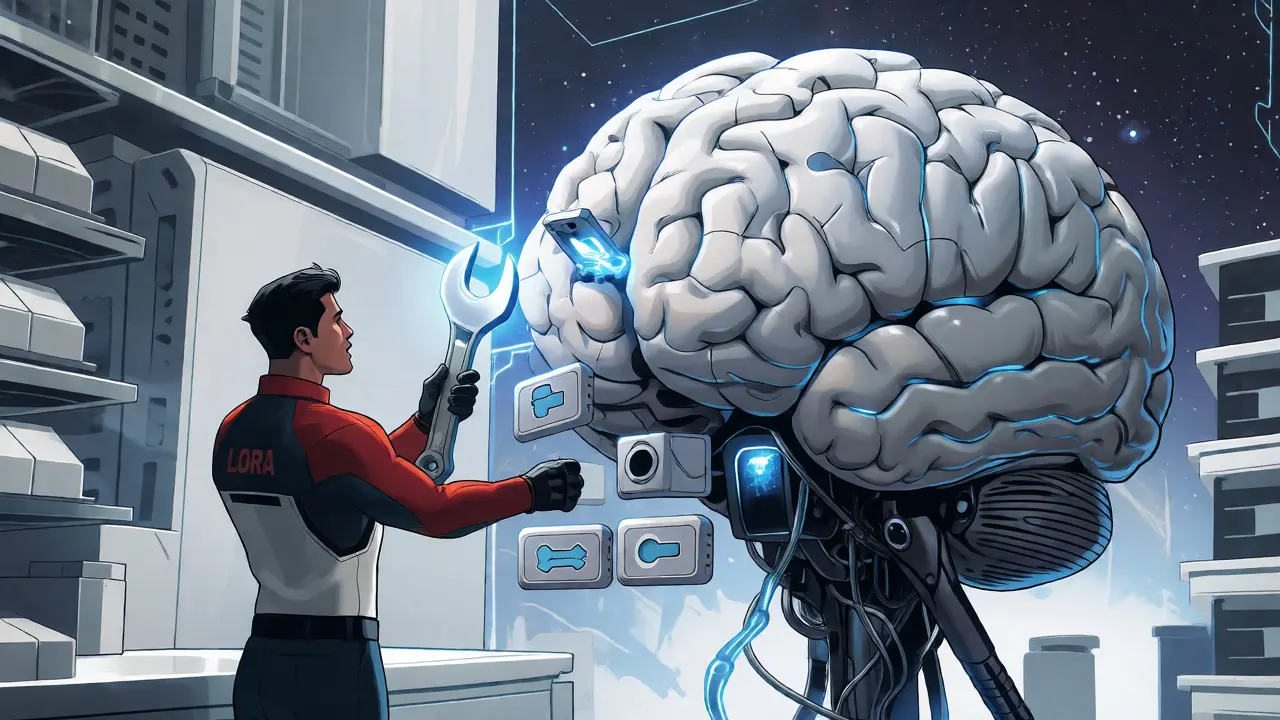
You don’t always need to retrain the whole model. Microsoft’s LoRA (Low-Rank Adaptation), introduced in 2021, changed the game. It allows you to tune only 0.1-1% of the model’s parameters. For a 7B parameter model, this drops memory requirements from 80GB to just 8-10GB.
Neptune AI’s benchmarks show that using PEFT techniques like LoRA reduces implementation time by 35%. This makes both strategies more accessible. However, instruction tuning still demands more compute power during setup because of the larger, more diverse datasets. MIT’s January 2026 study estimated that instruction tuning consumes 27% more energy due to this data volume. If sustainability is a KPI for your company, factor that in.
The Future: Hybrid Approaches
Why choose one when you can combine them? Forrester predicts that by 2027, 68% of enterprise deployments will use hybrid methods. Meta’s recent release of Llama3-70B-Instruct introduced "modular instruction tuning," allowing selective specialization with only 4.2% performance degradation on unrelated tasks.
The trend is moving toward dynamic routing. OpenAI’s leaked internal docs suggest GPT-5 will automatically decide when to apply task-specific adapters versus general instruction capabilities. For now, start with instruction tuning to get a robust base, then add lightweight task-specific adapters (using LoRA) for your critical workflows. This gives you the best of both worlds: a helpful assistant that’s also a precise tool.
Is instruction tuning always better than task-specific fine-tuning?
No. While instruction tuning offers better generalization and resilience against catastrophic forgetting, task-specific fine-tuning often achieves higher peak accuracy for narrow, well-defined tasks like medical coding or sentiment analysis. Choose instruction tuning for versatility and task-specific tuning for maximum precision in a limited domain.
What is catastrophic forgetting in LLMs?
Catastrophic forgetting occurs when a model loses previously learned information after being trained on new data. In task-specific fine-tuning, up to 38% of general capabilities can degrade. Instruction tuning mitigates this by exposing the model to diverse tasks during training, helping it retain broader language skills.
How much data do I need for instruction tuning?
You typically need 10,000 to 15,000+ high-quality instruction-response pairs spanning multiple tasks. Datasets like Stanford's HELM are good references. This is significantly more data than task-specific fine-tuning, which can work effectively with 500-1,000 labeled examples for a single task.
Does LoRA help with instruction tuning?
Yes, LoRA (Low-Rank Adaptation) is highly effective for instruction tuning. It reduces memory usage and training time by updating only a small fraction of the model's parameters. Neptune AI reports that using LoRA can cut implementation time by 35% compared to full fine-tuning, making it ideal for resource-constrained teams.
Which strategy is cheaper to implement?
Task-specific fine-tuning is generally cheaper and faster (2-3 weeks) because it requires less data and simpler preprocessing. Instruction tuning takes longer (4-6 weeks) and costs 30-40% more in data preparation. However, hybrid approaches using LoRA adapters are becoming more cost-efficient as they allow reuse of a single instruction-tuned base.