Large language models are powerful, but they have a nasty habit of making things up. We call this hallucination, and it is the biggest roadblock to using AI in serious business contexts. You cannot trust an AI that confidently cites a law that doesn't exist or gives medical advice based on outdated studies. This is where Retrieval-Augmented Generation (RAG) steps in. It acts as a safety net, forcing the model to look up facts from your own verified data before answering.
RAG is not just a buzzword; it is the industry standard for building trustworthy AI applications in 2026. By connecting large language models (LLMs) to external knowledge bases, you transform them from static guessers into dynamic researchers. This guide explains how RAG works, why it beats fine-tuning for most use cases, and how to implement it without getting lost in technical jargon.
What Is Retrieval-Augmented Generation?
At its core, RAG is a framework that adds a "lookup" step to the AI generation process. Instead of relying solely on the weights learned during training-which freeze at a specific point in time-the model retrieves relevant documents from an external source first. It then uses those documents as context to generate its response.
This concept was formalized in 2020 by Patrick Lewis and colleagues from Meta AI (formerly Facebook AI Research), University College London, and New York University. Their paper, 'Retrieval-Augmented Generation for Knowledge-Intensive NLP Tasks,' showed that combining retrieval with generation significantly improved performance on tasks requiring factual accuracy. Today, platforms like AWS Bedrock, Google Cloud Vertex AI, and IBM Watsonx all support RAG natively.
Think of it like taking an open-book exam. A traditional LLM is a student who memorized textbooks years ago. An RAG-enabled LLM is a student who can flip through current reference books while writing the answer. The result? Fewer hallucinations and more accurate, citable responses.
How the RAG Pipeline Works
The magic of RAG happens in four distinct stages. Understanding these steps helps you troubleshoot issues when answers go wrong.
- Ingestion: Your raw documents-PDFs, web pages, internal wikis-are broken down into smaller chunks. Typically, these chunks are 256 to 512 tokens long. Each chunk is then converted into a vector embedding, a numerical representation of its meaning. Models like OpenAI's text-embedding-3-large or Cohere's Embed Multilingual v3.0 create these high-dimensional vectors.
- Storage: These embeddings are stored in a vector database. Popular choices include Pinecone, Weaviate, and AWS OpenSearch. These databases are designed to find similar vectors quickly, even among billions of entries.
- Retrieval: When a user asks a question, the system converts the query into a vector too. It then searches the database for the most similar document chunks. Algorithms like HNSW (Hierarchical Navigable Small World) help find matches with cosine similarity thresholds usually above 0.78. Hybrid search, which combines keyword matching with vector similarity, often boosts recall by over 30%.
- Augmentation & Generation: The top 3-5 retrieved chunks are combined with the original user query into a prompt. This enriched prompt is sent to the LLM (like Claude 3.5 or Llama 3.1). The model generates an answer based strictly on this provided context, effectively grounding its output in verified sources.
RAG vs. Fine-Tuning: Which Should You Choose?
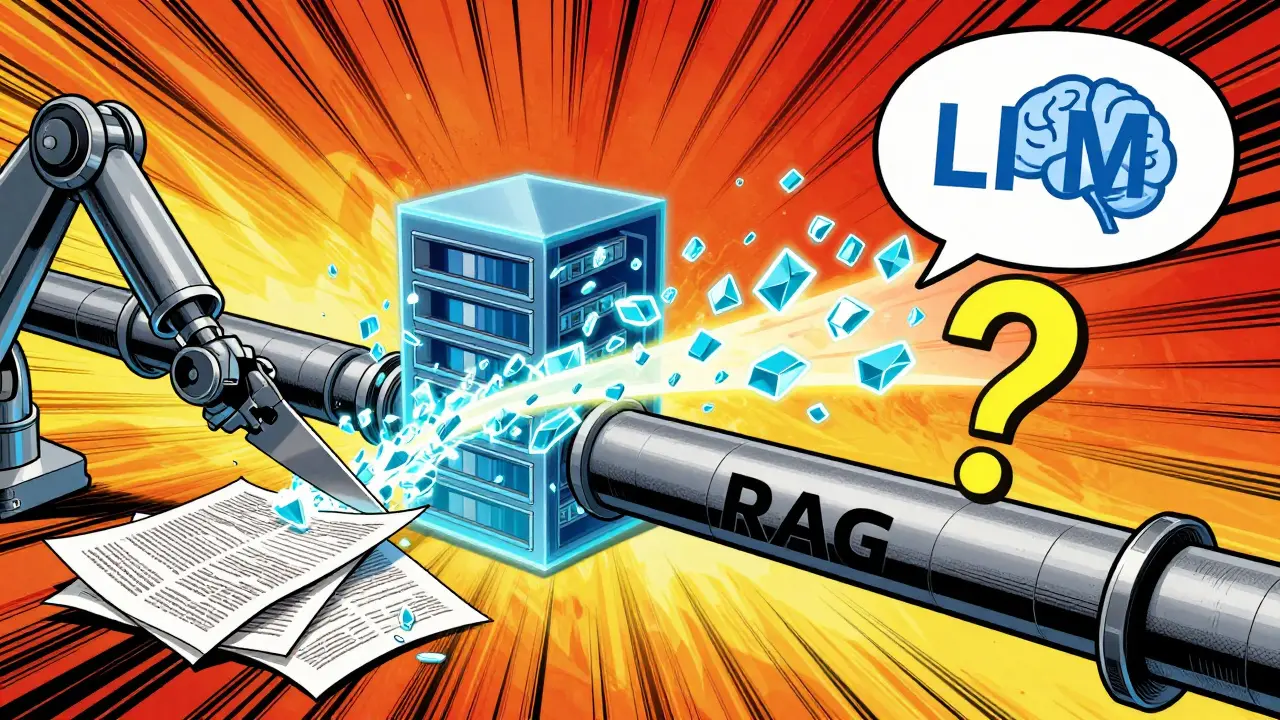
A common mistake is choosing fine-tuning when RAG would be better. Fine-tuning involves retraining the model's weights on new data. It is expensive, slow, and rigid. According to Hugging Face reports from early 2025, a single fine-tuning iteration can cost over $50,000. In contrast, RAG implementations often cost only 5-8% of that amount.
| Feature | Retrieval-Augmented Generation (RAG) | Fine-Tuning |
|---|---|---|
| Cost | Low (5-8% of fine-tuning costs) | High ($50k+ per iteration) |
| Data Freshness | Real-time updates possible | Static until next retrain |
| Hallucination Control | High (grounded in sources) | Moderate (model still guesses) |
| Best Use Case | Factual Q&A, documentation, compliance | Style transfer, specialized reasoning, tone adjustment |
| Latency | Higher (due to retrieval step) | Lower (direct inference) |
Use fine-tuning if you need the model to adopt a specific persona or understand deep domain terminology that changes rarely. Use RAG if your data changes frequently, such as financial regulations, product manuals, or customer support tickets. For example, in a trial by Mayo Clinic, fine-tuning showed higher accuracy for static medical terminology, but RAG maintained 92.7% accuracy on quarterly-updated financial rules compared to fine-tuning's dropping 78.4%.
Common Pitfalls and How to Avoid Them
Implementing RAG sounds simple, but real-world deployment brings challenges. Here are the most common issues developers face in 2026.
1. Retrieval Drift
If a user phrases a question slightly differently than how it appears in your documents, the vector search might miss the mark. This is called retrieval drift. To fix this, use hybrid search (combining keywords and vectors) and implement reranking models like Cohere's Rerank v3.0, which can boost precision by 34% by re-ordering results based on relevance to the specific query.
2. Context Overload
Retrieving too much information can confuse the LLM. If you feed it ten pages of text, it might get distracted by irrelevant details. Stick to retrieving the top 3-5 most relevant chunks. Also, ensure your chunking strategy includes a 15-20% token overlap between chunks to maintain context continuity across boundaries.
3. Silent Failures
Professor Emily M. Bender warned about "dangerous illusions of accuracy." Sometimes, the retrieval fails silently, and the LLM falls back on its pre-trained knowledge, potentially hallucinating. Always design your system to return "I don't know" if the retrieved confidence score is below a certain threshold. Never let the model guess if the evidence isn't there.
4. Latency Issues
Add a retrieval step, and you add time. A developer on Reddit noted latency jumping from 1.2 seconds to 3.8 seconds after adding RAG. While 3.8 seconds feels long, it is often acceptable for complex queries. Optimize by using efficient vector databases like Pinecone or AWS OpenSearch, which can handle thousands of queries per second with sub-100ms latency.
Security Risks in RAG Systems
As RAG becomes widespread, so do attacks against it. One major risk is "retrieval poisoning," where adversaries inject malicious content into your knowledge base. Carnegie Mellon University's Security Lab demonstrated a 63% success rate in manipulating outputs through poisoned documents in 2025 penetration tests.
To mitigate this:
- Validate Sources: Only ingest data from trusted, authenticated sources.
- Monitor Inputs: Use anomaly detection to flag unusual queries or injected prompts.
- Compliance: The EU AI Act requires RAG systems in high-risk applications to disclose source provenance. Ensure your system logs which documents were used for every answer.
The Future of RAG: Agentic and Multimodal
We are moving beyond basic RAG. The next wave is "Agentic RAG," pioneered by Microsoft's AutoGen. In this setup, multiple AI agents collaborate. One agent refines the query, another validates the retrieved information, and a third synthesizes the final answer. This reduces error rates by nearly 30%.
Multimodal RAG is also emerging. Instead of just text, future systems will retrieve images, videos, and audio alongside text. OpenAI's upcoming GPT-5 is expected to feature native multimodal RAG support. This means asking an AI about a diagram in a manual and getting an answer that references both the text and the visual elements.
For now, focus on mastering the basics. Get your ingestion pipeline right, choose a robust vector database, and prioritize retrieval quality over fancy generation tricks. As Dr. Andrew Ng stated, RAG remains the single most effective technique for reducing hallucinations in production systems today.
Does RAG completely eliminate hallucinations?
No, RAG significantly reduces hallucinations (by 47-63% according to MIT benchmarks), but it does not eliminate them entirely. Hallucinations can still occur if the retrieved documents themselves contain errors, or if the LLM misinterprets the context. Proper validation and confidence scoring are essential.
Which vector database is best for RAG?
It depends on your scale and budget. For enterprise-scale, AWS OpenSearch and Pinecone offer high performance and managed services. For open-source flexibility, Weaviate and ChromaDB are popular choices. Consider factors like latency requirements, ease of integration, and whether you need hybrid search capabilities.
How much does it cost to run a RAG system?
Costs vary widely. Cloud-native solutions like AWS Knowledge Base for Amazon Bedrock charge around $0.10 per 1K vector queries. Embedding models may have separate costs. Overall, RAG is typically 5-8% the cost of fine-tuning a large model, making it highly cost-effective for frequent data updates.
Can I use RAG with small language models?
Yes, RAG actually benefits smaller models more because it offloads factual memory to the external database. However, the LLM still needs sufficient reasoning capability to synthesize the retrieved context. Models like Llama 3.1 or Mistral work well, but very small models may struggle with complex augmentation prompts.
What is the ideal chunk size for RAG?
Research suggests 256-512 tokens per chunk is optimal for most use cases. Smaller chunks lose context, while larger chunks introduce noise. Using a 15-20% overlap between consecutive chunks helps preserve sentence boundaries and improves context continuity.