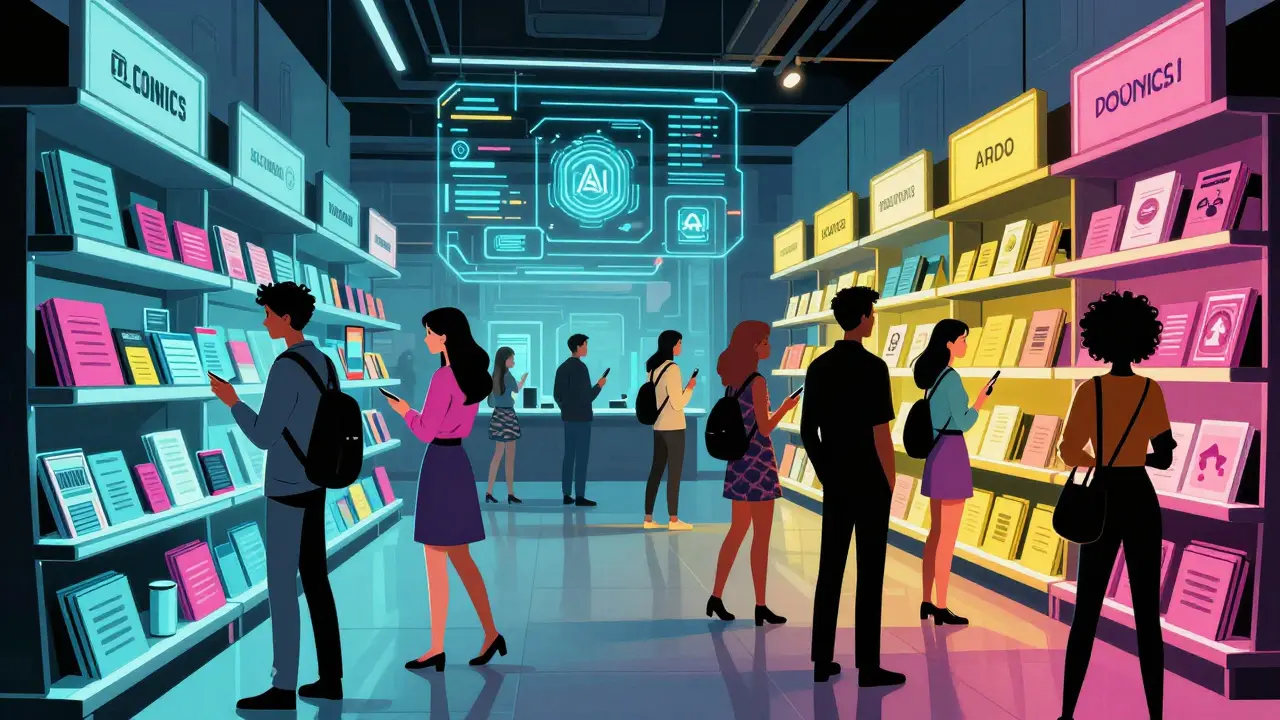
Imagine walking into a store where every shelf label updates itself to match your personal style, or browsing an online shop that writes product descriptions tailored specifically to your shopping habits. This isn't science fiction anymore. By mid-2025, 78% of major retailers had implemented at least one generative AI solution for content creation. The shift is massive. Retailers are no longer just using artificial intelligence for inventory tracking; they are using it to write, design, and sell. If you are in the retail industry, ignoring this wave means falling behind competitors who are cutting content costs by over 30% while boosting engagement significantly.
The core promise of generative AI in retail is simple: automate the tedious parts of content production so humans can focus on strategy. Whether it is writing thousands of product descriptions, creating virtual try-on images, or personalizing merchandising layouts, AI handles the scale. But how does it actually work under the hood, and what are the real-world results? Let's break down the three pillars of this transformation: product copy, merchandising, and visual assets.
Automating Product Copy at Scale
Writing product descriptions is often the most time-consuming part of launching new inventory. For large catalogs with tens of thousands of SKUs, hiring enough writers to keep up is impossible. Enter Large Language Models (LLMs), which are transformer-based systems fine-tuned on retail-specific datasets. These models don't just guess; they analyze brand voice guidelines, technical specifications, and customer data to produce accurate copy.
The speed difference is staggering. Modern retail Gen AI systems can generate between 5,000 and 7,500 product descriptions per hour. That is roughly 15 to 20 times faster than human writers. More importantly, the quality is holding up. Benchmarks show these systems achieve 92-95% accuracy compared to human-written copy for standard categories like electronics or home goods. A Shopify merchant using their Magic suite reported a 22% increase in organic search traffic because the AI optimized descriptions for SEO keywords automatically.
However, there is a catch. The AI is only as good as the data you feed it. To get optimal results, your system needs 85-90% data completeness. If your product information management (PIM) system is missing details about fabric weight or battery life, the AI will hallucinate or produce vague copy. This is why successful retailers spend 3-4 months cleaning their data before deploying these tools. Without clean data, you risk homogenizing your brand voice, a problem cited by 67% of retailers in Adobe's 2025 report.
Hyper-Personalized Merchandising Strategies
Moving beyond static text, generative AI is revolutionizing how products are presented to customers. Traditional rule-based personalization might show "customers who bought X also bought Y." Generative AI goes deeper. It integrates with Customer Data Platforms (CDPs) containing 12-18 months of purchase history, browsing behavior, and demographic info to create dynamic merchandising strategies in real-time.
Consider the example of Sephora's Smart Skin Scan. By analyzing individual skin types and preferences, the AI doesn't just recommend products; it generates personalized content explaining why those specific items fit the user's unique profile. The result? A 31% average increase in sales conversion and 2.5x higher engagement compared to older methods. Similarly, Home Depot used Gen AI-powered employee knowledge tools to reduce product information lookup time from 3-4 minutes to just 15-20 seconds, boosting in-store conversions by 17%.
This level of personalization requires significant integration effort. About 68% of implementations take 3-6 months to fully connect with platforms like Salesforce Commerce Cloud or SAP Commerce. The payoff, however, is measurable ROI. Early adopters see 19-23% improvements in conversion rates. The key insight here is that AI invalidates old assumptions about complexity. You no longer need a team of analysts to segment audiences manually; the AI does it instantly for every single visitor.

Creating Visual Assets and Virtual Try-Ons
Visual assets are perhaps the most exciting-and technically challenging-application of Gen AI in retail. We are talking about generating lifestyle images, removing backgrounds, and creating virtual try-ons without needing expensive photoshoots. Systems can now create 200-300 virtual try-on images per minute. This allows brands to showcase how clothes look on different body types or how furniture fits in various room styles dynamically.
Yet, visual AI still has blind spots. Accuracy for color-sensitive products like cosmetics sits at only 82%. Complex fabric draping simulations often fail, leading to unrealistic representations. Trustpilot reviews indicate that 34% of users feel frustrated with inaccurate virtual try-on results for intricate patterns or textured fabrics. Consequently, 18-22% of users still prefer physical verification before buying high-end apparel.
To mitigate this, AWS launched domain-specific foundation models in 2025 that improved virtual try-on accuracy by 19 percentage points. Despite these gains, regulatory hurdles are emerging. The EU's AI Act, effective Q1 2026, requires disclosure of AI-generated visual assets. This affects nearly half of current virtual try-on implementations. Brands must balance the allure of cost-saving visuals with the need for transparency and trust.
| Feature | Generative AI | Human Creation | Rule-Based Automation |
|---|---|---|---|
| Speed | 15-20x faster | Baseline | Instant but rigid |
| Cost Efficiency | 30-35% reduction | High labor cost | Low maintenance |
| Personalization Depth | Hyper-personalized | Limited by scale | Segment-level only |
| Brand Voice Consistency | Requires oversight | Natural consistency | Template-dependent |
| Visual Accuracy | 82-90% (varies) | 100% | N/A |
Implementation Challenges and Best Practices
Deploying generative AI is not a plug-and-play scenario. The biggest hurdle is maintaining brand voice. While AI can mimic tone, it lacks genuine understanding of cultural nuances. Dr. Alan Chen from MIT's Retail Innovation Lab warns that over-reliance on AI can lead to a 12% drop in customer satisfaction if human editorial oversight is removed entirely.
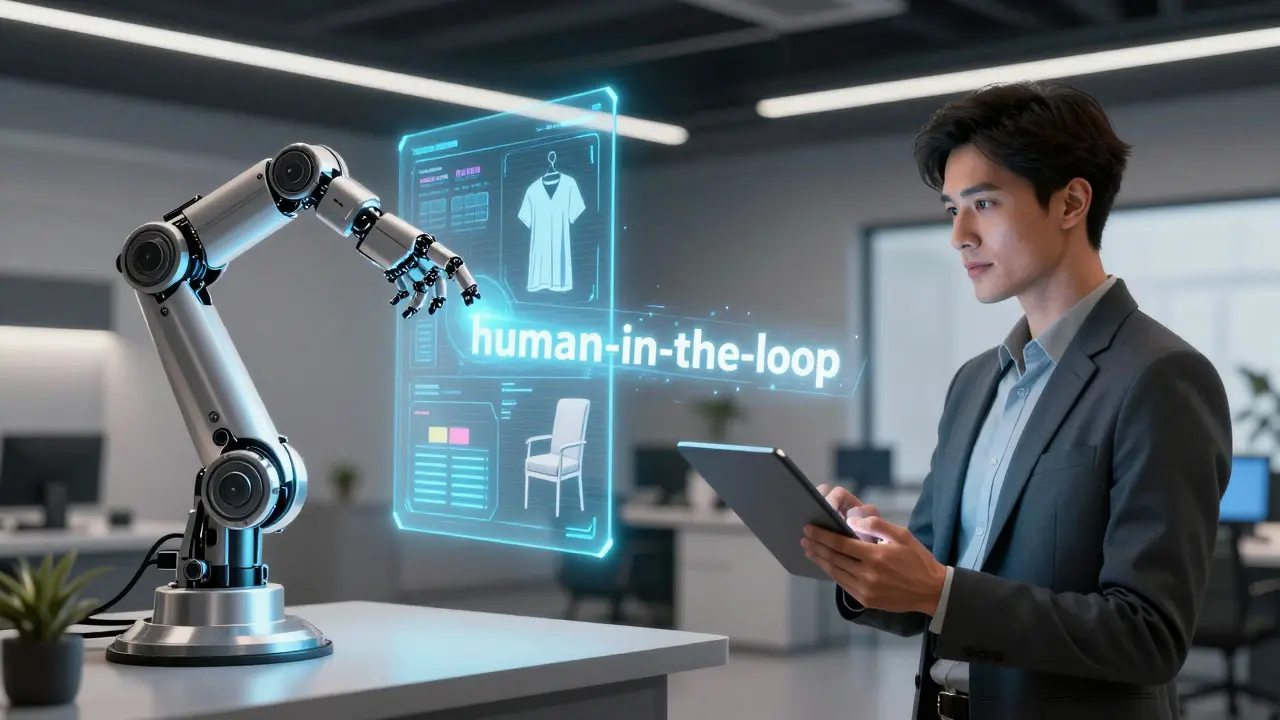
The solution lies in the "human-in-the-loop" model recommended by Deloitte. In this approach, AI generates 80% of the content, while human editors focus on quality assurance and strategic alignment. This hybrid method reduces production time by 65% while keeping brand consistency at 95%. Training is also crucial. Marketing staff typically need 2-3 weeks to master these tools, whereas data engineers require 6-8 weeks to build proper pipelines.
Security cannot be overlooked. Since these systems process sensitive customer data, they must adhere to ISO/IEC 27001 standards. For visual assets involving biometric data (like facial scans for try-ons), extra privacy protocols are mandatory. Companies like Estée Lauder have successfully navigated this by reducing campaign development time from 14 days to 48 hours while maintaining 94% brand effectiveness through strict human review processes.
Future Outlook: Where Retail AI is Heading
The market for retail Gen AI is exploding. Spending jumped from $11.5 billion in 2024 to $37 billion in 2025 across all industries, with retail capturing about 22% of that share ($8.14 billion). By 2027, McKinsey predicts that 95% of product content in retail will have some level of AI generation. Fully automated visual asset creation could reach 60% adoption for standard apparel categories.
We are also seeing the rise of "computer use technology," where AI agents operate retail systems directly. IDC forecasts this will transform 40% of merchandising workflows by 2026. However, Gartner predicts that 85% of successful implementations will preserve strategic human oversight through 2030. The future isn't about replacing marketers; it's about augmenting them. AI handles the execution-the writing, the designing, the sorting-while humans guide the strategy, ensure ethical compliance, and maintain the emotional connection with customers.
For retailers, the question is no longer whether to adopt generative AI, but how quickly they can integrate it without losing their brand soul. Start with clean data, embrace the human-in-the-loop model, and focus on hyper-personalization. The rewards in efficiency and engagement are too significant to ignore.
How much does implementing generative AI for retail content cost?
While specific licensing fees vary by platform, the broader economic impact is clear. Retailers implementing Gen AI for product content achieve 30-35% reductions in content production costs. The initial investment includes 3-6 months of integration work and data cleaning, but the long-term savings from reduced manual labor and increased conversion rates (19-23%) typically yield a strong ROI within the first year.
Is AI-generated product copy better for SEO than human-written copy?
Yes, when properly optimized. Shopify merchants using AI tools like Magic saw a 22% average increase in organic search traffic. AI excels at incorporating relevant keywords naturally and scaling content volume, which search engines favor. However, the content must still pass human review to ensure it provides genuine value and avoids generic phrasing that could hurt rankings.
What are the risks of using AI for visual assets like virtual try-ons?
The primary risks are accuracy and regulation. AI struggles with complex textures and color representation, achieving only 82% accuracy for cosmetics. This leads to customer frustration and potential returns. Additionally, regulations like the EU's AI Act require disclosure of AI-generated visuals, meaning brands must be transparent to avoid legal penalties and maintain consumer trust.
Do I need to replace my marketing team with AI?
Absolutely not. The most successful strategy is "human-in-the-loop." AI handles the heavy lifting of generation and data processing, while your marketing team focuses on strategy, brand voice, and quality control. Deloitte recommends this hybrid approach, noting it maintains 95% brand consistency while cutting production time by 65%.
Which retailers are leading in generative AI adoption?
Major players include Sephora, which uses AI for personalized skin analysis and sees 31% higher conversion rates, and Home Depot, which uses AI to speed up employee product lookups. Shopify merchants are also rapidly adopting tools like Sidekick and Magic, with 28% of their base using these features by mid-2025. Enterprise adoption generally leads SMB usage by a 3:1 ratio.