
You have a powerful Large Language Model (LLM) that can write code, summarize documents, and answer questions with impressive accuracy. But there is a catch: it needs a massive GPU cluster to run, or you need to send every prompt over the internet to a cloud server. That means latency, privacy risks, and recurring costs. What if you could run that same intelligence locally on your smartphone, a Raspberry Pi, or an industrial sensor? You can, but only if you shrink the model without breaking its brain. This process is called model compression. It is not just about making files smaller; it is about re-engineering how neural networks think so they fit into tight hardware constraints.
Edge deployment has moved from a niche experiment to a business necessity. By 2026, Gartner projects that 40% of enterprise edge AI deployments will use compressed LLMs, up from less than 5% in 2023. Why the rush? Real-time applications like medical diagnostics or autonomous driving cannot wait for a network round-trip. They need answers in milliseconds, not seconds. To get there, developers rely on three main pillars of compression: quantization, pruning, and knowledge distillation. Each offers different trade-offs between speed, size, and accuracy. Choosing the right one depends entirely on your hardware and your tolerance for error.
The Three Pillars of Model Compression
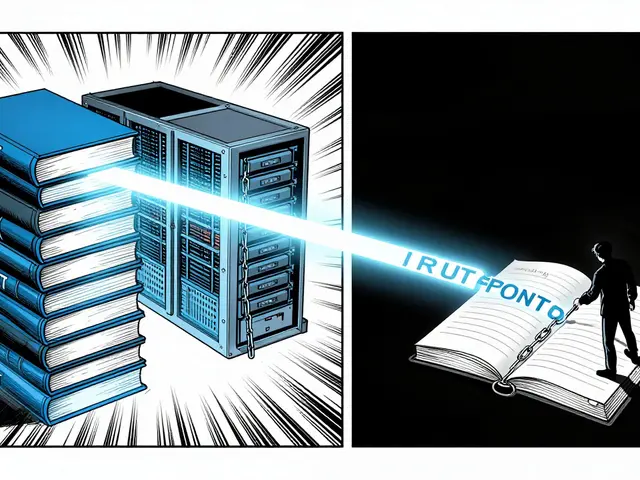
Think of an LLM as a library with billions of books (parameters). In standard formats, each book is written in high-resolution ink (32-bit floating point numbers). Compression techniques either rewrite those books in lower resolution, throw away unnecessary pages, or hire a student to memorize the key points instead of reading everything.
Quantization is the most popular starting point. It reduces the precision of the model’s weights. Instead of using 32 bits per number, you might use 16, 8, or even 4 bits. This directly cuts memory usage by half or more. Tools like GPTQ allow you to convert models to 4-bit integer format without retraining them, which saves weeks of computational work. However, dropping below 4 bits often causes the model to hallucinate or lose coherence, especially in complex reasoning tasks.
Pruning takes a different approach. It removes connections between neurons that contribute little to the final output. Unstructured pruning deletes individual weights, creating a sparse matrix. While this shrinks the file size significantly, it doesn’t always speed up inference because standard hardware isn’t optimized for irregular patterns. Structured pruning, however, removes entire rows or columns. NVIDIA’s Ampere architecture, for example, supports 2:4 sparsity, where exactly two out of every four weights are zeroed out. This pattern allows specialized hardware to skip calculations, delivering up to 2x speedups.
Knowledge Distillation involves training a small "student" model to mimic a large "teacher" model. The student learns to predict the teacher’s outputs rather than just the ground truth labels. This method preserves accuracy better than aggressive quantization but requires significant compute power during the training phase. Recent techniques like E-Sparse have achieved 1.5x runtime speedups while maintaining 95% of the original accuracy, making them ideal for scenarios where quality is non-negotiable.
Choosing the Right Technique for Your Hardware
Not all devices are created equal. A smartphone with a Snapdragon 8 Gen 3 processor handles quantized models differently than a microcontroller with 256MB of RAM. You need to match the compression strategy to the hardware capabilities.
| Technique | Best For | Hardware Requirement | Accuracy Impact | Implementation Effort |
|---|---|---|---|---|
| Post-Training Quantization (PTQ) | Mobile apps, quick prototypes | Standard CPUs/GPUs | Moderate (if >4-bit) | Low (<10 lines of code) |
| Structured Pruning | NVIDIA Jetson, specialized accelerators | Supports sparsity patterns | Low to Moderate | Medium (requires retraining) |
| Knowledge Distillation | High-stakes decisions, healthcare | Cloud GPU for training | Very Low | High (long training time) |
| QLoRA | Fine-tuning on consumer GPUs | 4GB+ VRAM | Negligible | Medium |
If you are working with Android devices using TensorFlow Lite, quantization is your best friend. It requires minimal code changes and works well on general-purpose CPUs. Conversely, if you are deploying to industrial IoT controllers with limited flash storage, structured pruning might be better because it physically removes data, reducing the footprint beyond what quantization alone can achieve.
A common pitfall is assuming that higher compression ratios always mean better performance. On ARM Cortex-A78 CPUs, SmoothQuant (INT8 activation quantization) achieves a 2.7x speedup with only a 2.1% accuracy drop on GLUE benchmarks. Meanwhile, GPTQ’s INT4 quantization pushes speed to 3.1x but suffers a 3.8% accuracy hit. Is that extra 0.4x speed worth losing nearly 4% of your model’s understanding? For a chatbot, maybe. For a legal document analyzer, probably not.

Real-World Implementation Challenges
Getting a compressed model to run is one thing; getting it to run reliably is another. Developers frequently encounter numerical instability when pushing quantization too far. A November 2024 survey of 127 developers on Hugging Face forums found that 63% experienced unexpected accuracy degradation when compressing beyond 4-bit precision, particularly for multilingual tasks. English-only models tend to hold up better under pressure than those trained on diverse language datasets.
Another hurdle is hardware inconsistency. Identical compression parameters can yield wildly different results across platforms. One developer reported a 15% accuracy drop on complex reasoning tasks when moving a quantized Mistral-7B model from a desktop GPU to a Jetson Nano. The solution wasn’t more compression-it was additional prompt engineering to compensate for the lost nuance. This highlights a critical rule: compression shifts the burden from compute resources to application logic.
Integration with existing pipelines also trips people up. According to industry surveys, 52% of implementation failures stem from compatibility issues with current edge infrastructure. Using libraries like Hugging Face Optimum helps bridge this gap, providing pre-optimized kernels for various backends. Similarly, NVIDIA’s TensorRT-LLM offers deep integration with Jetson devices, achieving 18 tokens per second for 7B-parameter models-six times faster than standard CPU inference.

Step-by-Step Workflow for Edge Deployment
If you are ready to compress your first LLM, follow this proven four-phase process. Skipping steps usually leads to debugging nightmares later.
- Baseline Measurement: Run your uncompressed model on the target device. Record latency, memory usage, and accuracy scores. You cannot improve what you do not measure. This step typically takes 1-2 days.
- Technique Selection: Analyze your constraints. If storage is tight, choose pruning. If latency is the bottleneck, try quantization. If accuracy is paramount, consider distillation. Allocate 1-3 days for this analysis.
- Compression Execution: Apply the chosen technique. For PTQ, use tools like AutoGPTQ or Bitsandbytes. For pruning, start with magnitude-based methods before trying structured approaches. Expect 2-5 days depending on model size.
- Validation and Fine-Tuning: Test the compressed model against your baseline. If accuracy drops too much, apply Parameter-Efficient Fine-Tuning (PEFT) techniques like LoRA. These require only 0.1-1% of the original training data but can recover significant performance. Allow 3-7 days for thorough testing.
One expert tip: combine techniques. Many production systems use quantization after pruning. For instance, prune 50% of the weights structurally, then quantize the remaining weights to 4-bit integers. This hybrid approach often yields better results than either method alone, balancing memory savings with computational efficiency.
The Future of Edge AI
The field is evolving rapidly. Meta’s recent release of Llama-3-8B-Edge includes built-in quantization support, signaling that compression is becoming part of the model design process, not just an afterthought. Qualcomm’s AI Stack 2.0 introduced hardware-accelerated sparse tensor operations, boosting pruned models by an additional 35%. Looking ahead, NVIDIA plans to introduce Adaptive Quantization in late 2025, which will dynamically adjust precision based on input complexity. Imagine a model that uses 4-bit precision for simple greetings but switches to 8-bit for complex coding queries-all automatically.
Dr. Fei-Fei Li predicts that by 2028, edge-optimized models will match cloud performance for 80% of real-world tasks. We are already seeing this in sectors like manufacturing, where Siemens engineers use structured pruning to enable real-time predictive maintenance on factory floor devices with just 256MB of RAM. Their compressed models reduced false positives by 18% compared to cloud solutions simply because they reacted faster.
However, challenges remain. Current techniques still struggle with maintaining temporal consistency in multi-turn conversations. As models get smaller, they sometimes forget earlier parts of a dialogue. Researchers are actively working on state-space models and attention mechanisms tailored for low-memory environments to solve this. Until then, careful context management remains essential for any edge-deployed assistant.
What is the minimum hardware required to run a compressed LLM?
It depends on the model size and compression level. Basic post-training quantization allows a 7-billion parameter model like Llama-2-7B to run on devices with 4GB of RAM, such as modern smartphones with Snapdragon 8 Gen 3 processors. More aggressive compression techniques like QLoRA can enable 65-billion parameter models to operate on a Raspberry Pi 4 with 4GB of RAM, though with higher latency (under 500ms per token).
Does quantization always reduce accuracy?
Yes, but the extent varies. Moving from FP32 to INT8 often results in negligible accuracy loss (less than 1%). Dropping to INT4 can cause moderate degradation (2-4%) on complex tasks. Going below 4-bit (e.g., INT2) usually leads to significant performance drops unless combined with advanced techniques like Quantization-Aware Training (QAT), which adjusts the model during training to handle lower precision.
Which compression technique is best for mobile devices?
For most mobile applications, Post-Training Quantization (PTQ) to 4-bit or 8-bit integers is the best choice. It requires no retraining, integrates easily with frameworks like TensorFlow Lite or CoreML, and provides substantial memory savings. Structured pruning is also effective if the mobile chipset supports sparse tensor operations, but it requires more engineering effort to implement correctly.
Can I fine-tune a compressed model?
Yes, using Parameter-Efficient Fine-Tuning (PEFT) methods like LoRA (Low-Rank Adaptation). LoRA adds small trainable matrices to the frozen compressed model, allowing customization with minimal computational cost. This is crucial for adapting generic models to specific domains without needing to retrain the entire network from scratch.
How does edge deployment help with privacy?
Edge deployment processes data locally on the device, meaning sensitive information never leaves the user's control. There is no need to transmit personal health records, financial data, or private conversations to a cloud server. This eliminates the risk of data interception during transit and ensures compliance with strict privacy regulations like GDPR and HIPAA.


Ian Mason-Laurence
October 4, 2026 AT 17:36The distinction between structured and unstructured pruning is often glossed over in introductory texts, yet it is the single most critical factor for inference latency on modern hardware. While unstructured pruning achieves higher theoretical sparsity rates, the irregular memory access patterns negate the benefits on standard SIMD architectures unless one employs specialized kernels that are rarely production-ready. Conversely, NVIDIA's support for 2:4 sparsity in Ampere and Hopper architectures allows for deterministic speedups, but this constraint limits the maximum achievable compression ratio to 50% by definition. Furthermore, the assertion that knowledge distillation preserves accuracy better than aggressive quantization requires nuance; recent literature suggests that when combined with quantization-aware training, the student model can actually surpass the teacher in specific downstream tasks due to regularization effects. The omission of mixed-precision strategies as a fourth pillar is also notable, given their ubiquity in enterprise deployments where FP8 inference is becoming the new baseline.
Ejike Ugwu
October 4, 2026 AT 20:22They tell you it is about efficiency, but look closer at who owns the hardware patents for these 'compressed' formats.
Every time you run a model locally, they claim it saves privacy, but have you checked the telemetry hooks in those so-called open-source libraries? They want you to think you are free from the cloud, but the dependency chain is a web of corporate surveillance disguised as optimization.
If your phone starts acting up after an update, do not blame the battery; blame the algorithmic leash tightening around your neck.
It is all connected, man.
You cannot escape the matrix just by shrinking the weights.
Lauren Martin
October 6, 2026 AT 05:39This article is painfully superficial and misses the fundamental architectural bottlenecks that render edge LLMs largely useless for serious engineering applications outside of toy demos.
You casually mention GPTQ as if it is a silver bullet, completely ignoring the catastrophic degradation in perplexity scores when moving below 4-bit precision on reasoning-heavy benchmarks like MMLU or GSM8K.
Moreover, the discussion on knowledge distillation fails to address the massive compute overhead required for the teacher-student alignment phase, which often exceeds the cost of simply running the larger model in the cloud for low-volume use cases.
The comparison table is misleading because it assumes idealized conditions where memory bandwidth is not the limiting factor, which is rarely true on mobile SoCs where thermal throttling kicks in within seconds of sustained inference.
Real-world deployment requires handling KV-cache management dynamically, something this guide completely neglects despite it being the primary source of OOM errors on devices with less than 8GB of RAM.
Until we see robust solutions for dynamic batch size handling and efficient attention mechanisms like FlashAttention adaptations for ARM cores, these 'edge' claims remain marketing fluff rather than viable technical solutions.
The author seems confused about the difference between model size reduction and actual latency reduction, conflating two distinct metrics that do not scale linearly.
Furthermore, the lack of discussion regarding compiler backends such as TVM or MLIR means readers will struggle to translate these theoretical gains into actual runtime performance on heterogeneous hardware.
It is frustrating to see such a popular topic covered with such a shallow understanding of the underlying systems engineering challenges.
We need rigorous benchmarking against native C++ implementations, not just Python wrapper abstractions that hide the real costs.
Ultimately, this piece serves only to confuse beginners while offering no new insights for practitioners already working in the field.
The reliance on outdated examples further diminishes its credibility in a rapidly evolving landscape.
Save your money and read the original papers instead of relying on this diluted summary.