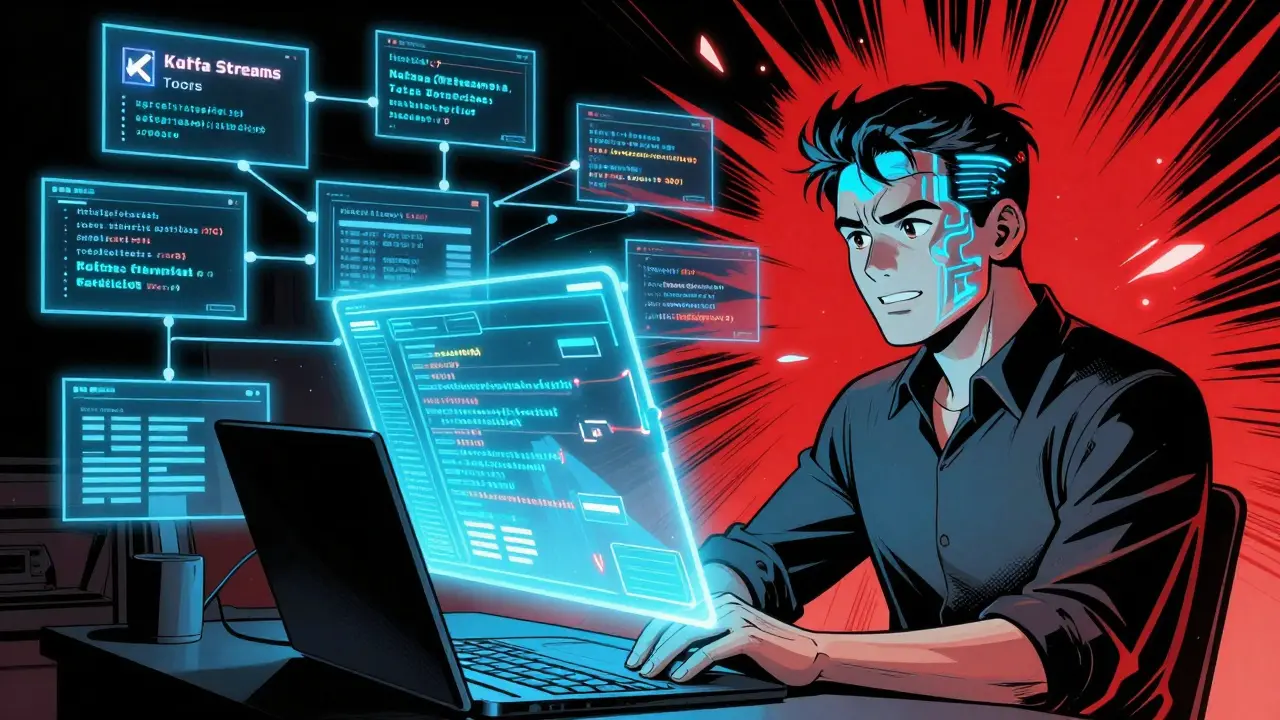
What Is Vibe Coding, Really?
It’s not magic. It’s not a buzzword you throw around to sound cool. Vibe coding is what happens when you stop writing every line of code by hand and start talking to an AI like it’s your pair programmer. You say, "Build me a service that takes orders, checks inventory across three warehouses, and sends confirmations if stock is low," and it spits out working code - or at least, code that looks like it should work.
This isn’t sci-fi. It’s happening right now. According to a January 2025 Gartner survey, 67% of developers at large tech companies use vibe coding in some form. At companies like Shopify and Stripe, teams are using GitHub Copilot and Google’s Gemini for Developers to skip the boilerplate and jump straight into logic. But here’s the catch: most of that work is still CRUD - create, read, update, delete. Simple data flows. Forms. Dashboards. What happens when you try this with something real? Something that spans continents, handles failures, and can’t afford to lose a single transaction?
Why Distributed Systems Are the Hard Part
Distributed systems aren’t just "a bunch of microservices." They’re systems that must work even when networks drop, servers crash, and clocks drift. Think payment processing. Logistics tracking. Real-time inventory sync across global warehouses. These aren’t apps you can rebuild in a weekend. They need consistency, fault tolerance, retry logic, idempotency, and distributed tracing. And they need it right - because when they fail, money disappears, customers get angry, and regulators show up.
Traditional developers spend months learning these patterns. They study the CAP theorem. They write unit tests for network partitions. They simulate failure scenarios with Chaos Mesh. They argue over whether to use Saga transactions or two-phase commit. Vibe coding doesn’t do that. At least, not yet.
What Happens When You Vibe Code a Distributed System?
Let’s say you’re building an order system for an e-commerce startup. You prompt your AI: "Create a distributed order service with inventory checks, payment processing, and email confirmation. Use Kafka for events and PostgreSQL for storage."
Within minutes, you have:
- A Node.js service with Express routes
- A Kafka producer sending "order_created" events
- A PostgreSQL schema with tables for orders and inventory
- A basic email sender using SendGrid
Looks good. You deploy it. Everything works in staging.
Then production hits. 1,000 orders per second. A network glitch happens. Two services try to update the same inventory record at the same time. The AI didn’t add a lock. Didn’t implement idempotency keys. Didn’t account for duplicate events. The system starts double-charging customers. Inventory goes negative. You spend 37 hours debugging race conditions the AI didn’t see.
That’s not hypothetical. A November 2024 Reddit thread with over 1,200 upvotes told the exact same story. The developer got it working - but only after manually fixing what the AI missed.

The Numbers Don’t Lie - But They Don’t Tell the Whole Story
Google Cloud’s February 2025 study found vibe-coded distributed systems deploy 38% faster than traditional ones. That’s huge. You go from idea to prototype in days, not weeks. But here’s what they didn’t highlight: those systems require 22% more refinement cycles. And when you stress-test them under network partitions, they show 17% higher latency and 23% more errors.
Forrester’s December 2024 analysis found vibe coding cuts initial development time by 41% - but increases technical debt by 63%. Why? Because AI doesn’t understand tradeoffs. It doesn’t know that choosing eventual consistency over strong consistency might save you time now, but cost you customers later. It doesn’t know that a missing circuit breaker in a payment service can lead to cascading failures.
And here’s the kicker: without guardrails, vibe-coded systems only follow 67% of distributed systems best practices. Traditional code? 92%. That gap isn’t small. It’s dangerous.
When Vibe Coding Actually Works - And When It Doesn’t
It’s not all bad. Vibe coding shines where speed matters more than perfection. Internal tools. Developer portals. Reporting dashboards. Teams at companies like Airbnb and Dropbox use it to build prototypes in hours, not days. One team built a full internal ticketing system with AI in two days - and it’s still running.
But try it with:
- Payment systems: MongoDB’s 2025 case study showed 33% higher failure rates in distributed transactions.
- Saga patterns: 41% of vibe-coded implementations missed compensation logic. That’s not a bug. That’s a financial risk.
- Five-nines availability: 32% of distributed systems architects say vibe coding introduces unacceptable risk for systems that can’t afford downtime.
There’s a clear line: vibe coding is great for building things that can fail. Not for building things that must never fail.
The Tools That Make It Work (Sort Of)
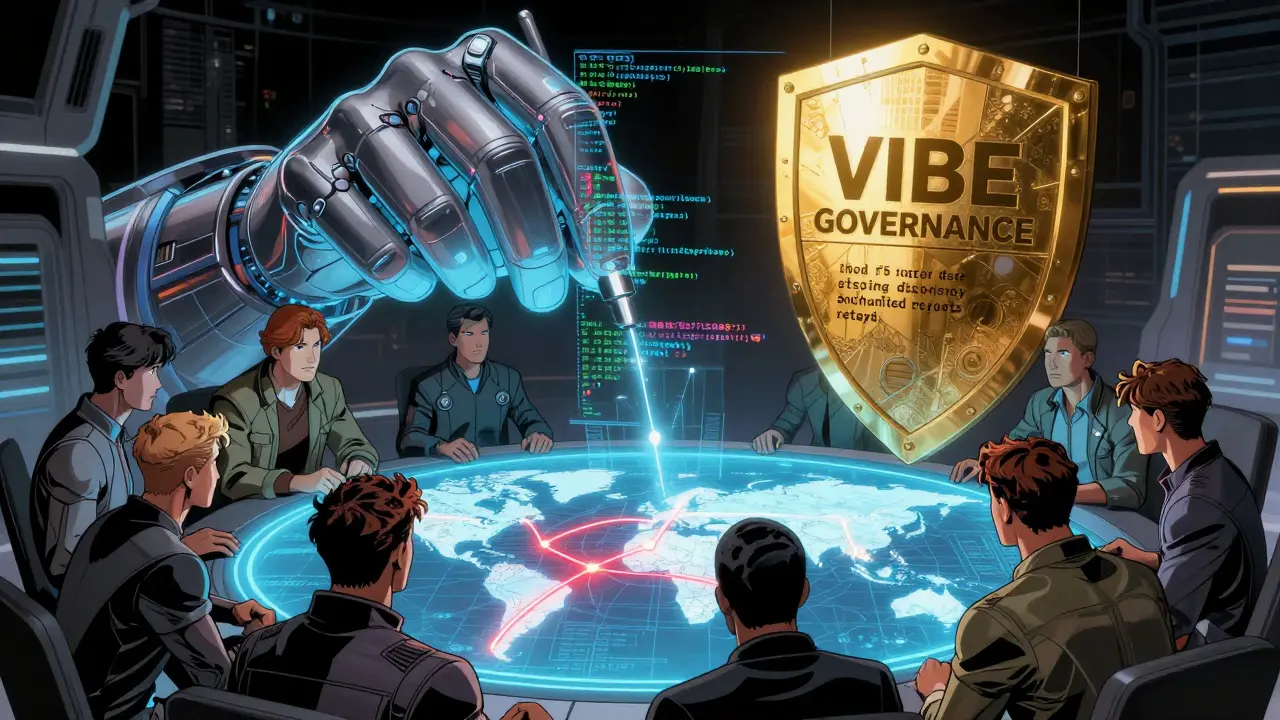
Some companies aren’t just relying on AI to guess what they need. They’re adding layers of control. Superblocks’ Vibe Governance Suite, used by 38% of Fortune 500 companies, enforces rules like:
- "All services must declare their CAP choice before generating code."
- "No distributed transaction without explicit retry logic."
- "Generate test cases for network partitions automatically."
That pushes compliance from 67% to 89%. That’s a game-changer.
Other tools help too:
- Chaos Mesh: Automatically breaks networks and tests if your vibe-coded service survives. Companies using it report 44% fewer production incidents.
- Distributed Systems Copilot (Google Cloud): New in June 2025. Understands Paxos, Raft, and consensus algorithms. Reduces errors by 39% in internal tests.
- Observability stacks: You can’t vibe your way out of missing traces. You need Prometheus, Grafana, and OpenTelemetry - and you need to know how to read them.
Who Should Be Doing This?
Not everyone. A March 2025 Pluralsight survey found only 28% of developers attempting vibe coding for distributed systems actually have solid knowledge of the underlying patterns. The rest? They’re guessing. And guessing in distributed systems is how outages happen.
Successful teams have:
- At least 5 years of experience with microservices, queues, and state management
- Strong prompt engineering skills - they don’t just say "build me a service," they say "build me a service that handles idempotency, uses Kafka exactly like this, and fails gracefully if the inventory service is down for more than 3 seconds."
- Deep familiarity with tracing tools like Jaeger and Datadog
If you’re new to distributed systems, vibe coding will make you feel powerful - until it breaks. Then you’ll be stuck fixing something you don’t fully understand.
The Future: Augmentation, Not Replacement
Andrej Karpathy says vibe coding raises the floor. He’s right. Most developers can’t implement idempotency correctly without help. AI fixes that. But Dr. Jane Chen from Microsoft Research says it conflicts with the deterministic nature of distributed systems. She’s also right.
The truth? Vibe coding isn’t replacing engineers. It’s replacing junior coding tasks. The best teams now use it like a turbocharged skeleton crew:
- AI writes the initial service structure
- Senior engineers audit the logic
- Automated tests validate failure modes
- Observability tools catch what tests miss
Google’s acquisition of Baseten and Microsoft’s investment in AI-assisted development show the big players aren’t betting against this. They’re betting on controlled vibe coding.
By 2027, Gartner predicts 55% of distributed systems will use vibe coding for non-critical components. But the core? The transactional, financial, safety-critical parts? Those will still be hand-built. Because some things can’t be left to vibes.
So Should You Try It?
Yes - but with eyes wide open.
Start small. Build an internal tool. Use it to learn. Then try a low-risk service - maybe a notification system or a data sync job. Don’t touch payments. Don’t touch inventory. Don’t touch user authentication.
Use governance tools. Enforce rules. Require tests. Monitor everything. Treat the AI like a very smart intern - one who can write code fast but doesn’t understand consequences.
And never forget: the AI doesn’t care if your system crashes. You do. That’s your job. Not the AI’s.
Johnathan Rhyne
December 23, 2025 AT 18:27Okay but let’s be real - if your AI can’t handle idempotency, it’s not vibe coding, it’s vibe *crying* in a corner while your customers get charged twice. I’ve seen this play out three times this year. The AI writes the code like it’s a TikTok dance, and then you’re the one doing the funeral pyre for your production DB. Grammar note: ‘vibe coding’ shouldn’t be capitalized unless it’s a cult. Which, honestly, it kinda is.
Jawaharlal Thota
December 23, 2025 AT 23:15Let me tell you something - I come from a small town in India where we don’t have fancy AI tools, but we have patience, we have grit, and we have developers who learned distributed systems by reading papers at 3 AM while drinking chai. Vibe coding? It’s like giving a child a Ferrari and saying, ‘Go drive to the moon.’ Sure, the wheels spin, the engine roars, but without understanding how the transmission works, you’ll crash before you even leave the driveway. The real power isn’t in the AI writing code - it’s in the human knowing when to say, ‘Wait, that’s wrong.’ And that takes years. Not minutes.
sonny dirgantara
December 24, 2025 AT 16:19Andrew Nashaat
December 26, 2025 AT 14:46Let’s be brutally honest - if you’re using vibe coding for anything that touches money, you’re not a developer, you’re a liability with a GitHub account. And yes, I’m talking to you, the guy who said ‘it works in staging’ and deployed to prod anyway. You didn’t just skip testing - you skipped basic human responsibility. The fact that 63% more technical debt is being created isn’t a bug - it’s a feature of your arrogance. And before you reply - yes, I know you think you’re ‘efficient.’ You’re not. You’re just lazy with consequences.
Gina Grub
December 27, 2025 AT 08:45Let’s not sugarcoat this - vibe coding is the digital equivalent of Tinder dates: easy to start, impossible to maintain, and always ends in tears. The AI doesn’t care if your system crashes. But your CFO does. Your customers do. Your sleep schedule does. And when the audit hits? You’ll be the one explaining why you trusted a bot with your company’s financial heartbeat. The real tragedy? You thought you were being innovative. You were just being reckless. With receipts.
Nathan Jimerson
December 28, 2025 AT 00:50I’ve seen teams go from zero to production in two days using AI tools - and yes, it broke. But they didn’t give up. They learned. They added tests. They learned how to prompt better. The AI didn’t replace them - it forced them to become better engineers. It’s not about whether vibe coding is perfect - it’s about whether you’re willing to grow with it. Every tool has limits. The best developers don’t fight the tool - they learn its edges and work with them. You can build something beautiful with AI - if you’re humble enough to clean up after it.
Sandy Pan
December 29, 2025 AT 22:26What is ‘vibe’ but a human attempt to outsource intuition? We’ve spent decades trying to encode logic into machines - and now we’re trying to encode *wisdom*? But wisdom isn’t a pattern. It’s not a rule in a governance suite. It’s the quiet, accumulated understanding of failure - the kind you only get when you’ve watched a system collapse at 2 a.m. and realized you built it to avoid thinking about the edge cases. The AI gives you speed. But it can’t give you the scar tissue that teaches you when to pause. Maybe the real question isn’t whether vibe coding works - but whether we’re still willing to earn the right to use it.