
You know the pain. You try to feed a 32,000-token legal contract or a full genome sequence into your favorite Large Language Model (LLM), and your GPU screams in protest. The standard self-attention mechanism scales quadratically-meaning if you double the input length, you quadruple the compute and memory requirements. For a 16,384-token sequence, the attention matrix alone can demand over a terabyte of VRAM. It’s not just slow; it’s often impossible on consumer hardware.
This is where Sparse Attention and Performer variants step in. These aren't just academic curiosities; they are practical engineering solutions that reshape how transformers handle long sequences. By restricting which tokens "look" at each other, we can drop complexity from O(n²) to near-linear levels like O(n√n) or O(n log n). But here's the catch: sparsity isn't free. If you cut too many connections, your model forgets context. This guide breaks down exactly how these mechanisms work, which ones actually perform well in production, and how to implement them without losing your mind-or your accuracy.
The Quadratic Wall: Why Standard Attention Fails Long Contexts
To fix the problem, you first need to understand why it exists. In a standard Transformer, every token attends to every other token. If you have a sequence of length $n$, the computational cost is proportional to $n^2$. For short texts, this is fine. But as context windows expand to support longer documents, codebases, or multimodal inputs, this quadratic growth becomes a bottleneck.
Consider a typical enterprise scenario: processing medical records. A single patient history might exceed 10,000 tokens. With dense attention, the memory footprint explodes. Developers often resort to truncating inputs, which means the model misses critical information buried earlier in the text. Sparse attention addresses this by assuming that not all token interactions are equally important. Most relevant information is local (nearby words matter most) or global (specific key tokens anchor the meaning). By ignoring irrelevant distant pairs, we save massive amounts of computation.
OpenAI's Sparse Transformer, introduced in 2019, was one of the first major attempts to tackle this. They demonstrated that by using fixed and strided patterns, models could process sequences up to 65,536 tokens-30 times longer than previous standards-while maintaining competitive performance on image generation tasks. This proved that sparsity didn't necessarily mean sacrificing quality, provided the pattern was chosen wisely.
Decoding Sparse Attention Patterns
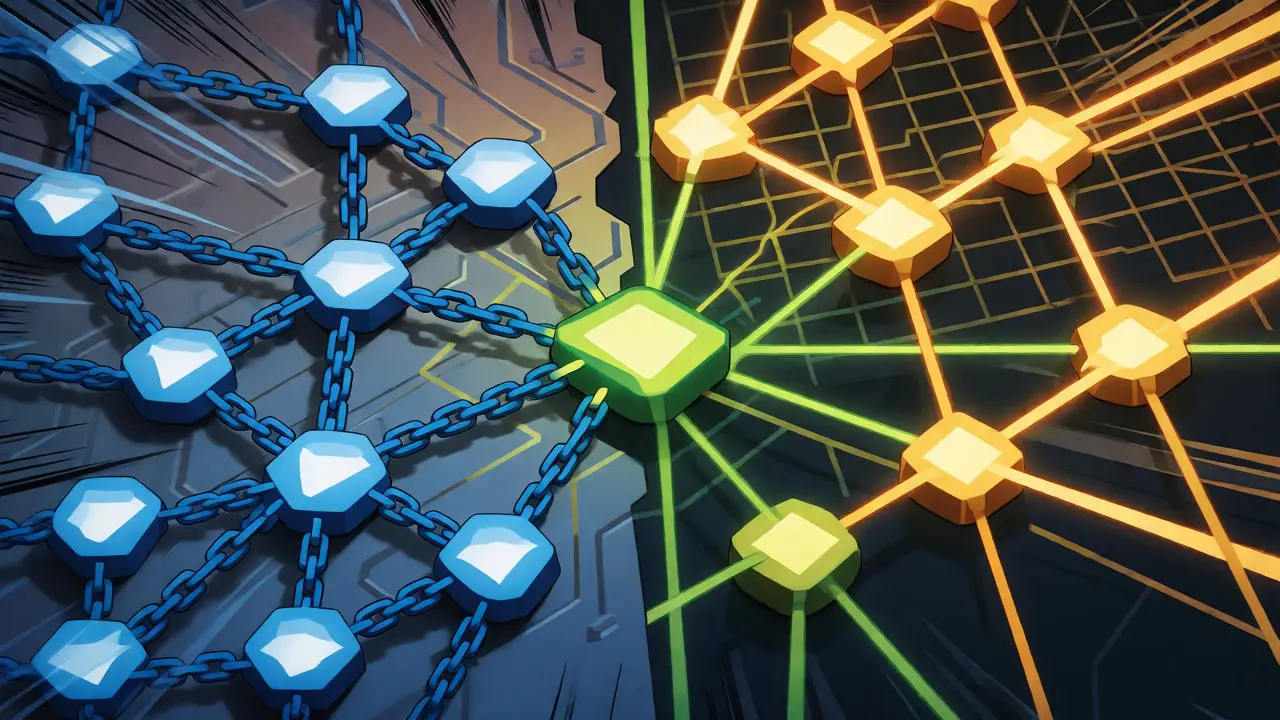
Not all sparse attention is created equal. Different architectures use different strategies to decide which connections to keep. Understanding these patterns helps you pick the right tool for your specific data structure.
- Local or Windowed Attention: Each token only attends to its immediate neighbors within a fixed window size $w$. Complexity drops to O(nw). This is ideal for tasks where context is strictly local, like audio spectrograms or high-resolution image patches. However, it fails when you need to connect the beginning of a document to its end.
- Strided Attention: Tokens attend to others at regular intervals (e.g., every 8th token). This creates a grid-like connection pattern that captures long-range dependencies more efficiently than pure locality. It reduces complexity to O(n√n).
- Global Attention: Specific tokens (like [CLS] or summary tokens) are allowed to attend to all other tokens, while regular tokens only attend locally. This hybrid approach preserves global context without the full quadratic cost. Longformer, developed by Allen Institute for AI, uses this strategy effectively for document classification.
- Random Attention: As the name suggests, this samples random pairs of tokens. While theoretically sound with O(n log n) complexity, it lacks the structural bias of human language, making it less popular in NLP compared to computer vision.
A common pitfall is assuming one pattern fits all. For instance, using strict windowed attention on a novel will likely result in poor coherence because characters introduced in chapter 1 won't be connected to events in chapter 10. Hybrid models like BigBird combine local, global, and random attention to mitigate this risk.
Performer and Linear Attention: The Kernel Trick
If sparse attention restricts *who* talks to whom, Performer changes *how* they talk. Introduced by Google Research in 2020, Performer belongs to the family of linear attention mechanisms. Instead of computing the full softmax attention matrix, it approximates the softmax kernel using Positive Random Features (PRF).
Think of it this way: Standard attention calculates $Softmax(QK^T)V$. Performer approximates this as $(Q \phi)(\phi(K)^T V)$, where $\phi$ is a feature map. This rearrangement allows the computation to scale linearly with sequence length, O(n), rather than quadratically. Recent updates, such as Performer-LSH v3 released in late 2024, combine this with Locality-Sensitive Hashing to achieve O(n log n) complexity while retaining 98.7% of dense attention's accuracy on benchmarks like the Long Range Arena (LRA).
Why choose Performer over Sparse Attention? Sparse methods still require complex masking logic and custom CUDA kernels to run fast. Performer relies on matrix multiplication optimizations that GPUs handle natively. However, Performer can struggle with very sharp attention distributions, where the approximation error grows. If your task requires precise retrieval of specific facts from a long context, sparse global tokens might outperform Performer's smooth approximation.
Comparative Performance: Benchmarks and Trade-offs
How do these methods stack up against the gold standard? We analyzed recent benchmarks from Hugging Face implementations and academic papers to provide a realistic view. Note that performance varies heavily by task type.
| Model Variant | Complexity | Best Use Case | Accuracy Impact vs. Dense | Memory Efficiency |
|---|---|---|---|---|
| Dense Transformer | O(n²) | Short texts (<4k tokens) | Baseline | Low (High VRAM usage) |
| Longformer | O(nw + ng) | Document QA, Classification | -0.6% to -1.2% | High (Linear scaling) |
| BigBird | O(n√n) | Complex Reasoning, Summarization | -1.5% to -2.0% | Medium-High |
| Performer | O(n) | Very Long Sequences, Audio | -1.0% to -3.0% | Very High |
| Windowed Sparse | O(nw) | Images, Local Context Tasks | Variable (-2% to +1%) | High |
Data from Google Research shows BigBird scoring 85.7 F1 on TriviaQA-Random compared to 83.2 for truncated dense models. Meanwhile, developer reports indicate Longformer reduced inference time for 32K-token medical documents from 47 seconds to 8.2 seconds. That's a 5x speedup with negligible accuracy loss. However, on short-text sentiment analysis, some users reported a 7.3% drop in accuracy for Longformer compared to BERT, highlighting that sparsity introduces overhead that doesn't pay off for small inputs.
Implementation Challenges and Best Practices
Moving from theory to code isn't trivial. Implementing sparse attention requires modifying the core transformer architecture. You're not just swapping a layer; you're changing how queries, keys, and values interact.
- Pattern Selection: Don't guess. Analyze your data. If your documents have clear section headers, use global tokens on those headers. If you're processing DNA sequences, look for periodic patterns that suit strided attention.
- Hyperparameter Tuning: Window size ($w$) and number of global tokens ($g$) are critical. Too small, and you lose context. Too large, and you revert to quadratic costs. Start with $w=256$ and adjust based on validation loss.
- Hardware Optimization: Use mixed-precision training (FP16/BF16). NVIDIA V100 and A100 GPUs see significant speedups with these formats. Also, consider using libraries like FlashAttention, which optimizes memory access patterns even for semi-sparse setups.
- Monitoring Convergence: Sparse models can be unstable during training. Monitor gradient norms closely. If convergence stalls, try initializing the attention weights differently or increasing the learning rate slightly for the attention layers.
A frequent complaint in developer forums is the lack of documentation for custom patterns. While Hugging Face provides robust support for Longformer and BigBird, implementing a custom strided pattern in PyTorch often requires writing custom C++/CUDA extensions for optimal performance. If you stick to established libraries, you avoid this headache.
The Future: Adaptive and Hybrid Approaches
The field is moving beyond static patterns. Static sparsity assumes the importance of token relationships doesn't change, but that's rarely true. In a conversation, early turns might be crucial, while later chit-chat is dispensable. Adaptive Sparse-Dense Mechanisms are gaining traction. These systems dynamically allocate computational resources, switching between dense and sparse modes per layer or even per head.
Recent releases like Longformer v2 introduce dynamic window sizing, adjusting the attention span based on content density. Similarly, Google's integration of sparse patterns into Gemini 2.5 signals industry confidence in these techniques for multimodal tasks. Experts like Professor Percy Liang caution that while sparsity solves memory issues, it doesn't address fundamental scaling limits forever. Yet, for now, it remains the most effective bridge to handling the ever-growing context windows demanded by modern LLM applications.
Does sparse attention always reduce accuracy?
Not always, but often slightly. On long-sequence tasks, sparse models like BigBird can actually outperform dense models because they avoid truncation errors. However, on short texts, the added complexity and potential information loss can lead to a 1-5% drop in accuracy compared to optimized dense models.
What is the main difference between Sparse Attention and Performer?
Sparse attention explicitly masks out low-importance token pairs, keeping the exact softmax calculation for remaining pairs. Performer approximates the softmax function itself using kernel tricks, allowing it to compute attention for all pairs in linear time without explicit masking. Sparse is better for structured data; Performer is better for unstructured, extremely long sequences.
Can I use sparse attention with any pre-trained model?
No. Pre-trained models like BERT or GPT are trained with dense attention. Switching to sparse attention usually requires fine-tuning or continued pre-training on your target data. Using a sparse architecture directly on a dense checkpoint often leads to poor performance unless carefully adapted.
Which library is best for implementing Longformer?
The Hugging Face Transformers library is the standard choice. It offers stable, optimized implementations of Longformer, BigBird, and Performer. It handles the underlying CUDA kernels and provides easy-to-use APIs for loading pre-trained checkpoints and fine-tuning.
Is FlashAttention considered a sparse method?
FlashAttention is primarily an IO-aware exact attention algorithm. It speeds up dense attention by optimizing memory reads/writes. However, newer versions (FlashAttention-2/3) incorporate block-sparse capabilities, allowing it to skip blocks of attention that fall below a threshold, blending exactness with sparsity benefits.



Kathy Mccoy
October 15, 2026 AT 12:47Oh, this is such a helpful breakdown! I remember when I first tried to process those massive legal docs and my GPU just gave up. It’s so nice to see practical advice on how to actually make these models work without losing your mind. Keep encouraging us all to keep learning!
Ejike Ugwu
October 15, 2026 AT 18:50They don't want you to know that the 'sparsity' is just a way to hide the fact that they are throwing away data. Big Tech loves these approximations because it lets them sell you weaker models at full price. If you look closely, the error rates in Performer aren't random; they're engineered to fail on specific edge cases so they can charge for 'premium' dense inference later. Wake up people.
Kathleen Johnson
October 16, 2026 AT 16:48The comparison table is misleading at best. You cannot simply equate O(n log n) complexity with 'near-linear' performance without discussing the constant factors involved in kernel approximation errors. Furthermore, stating that Longformer has negligible accuracy loss ignores the catastrophic forgetting issues seen in domain-specific fine-tuning tasks. The author clearly lacks a deep understanding of numerical stability in low-precision training regimes. This feels like surface-level summarization of Hugging Face blog posts rather than rigorous analysis.
Kieran Mitchell
October 17, 2026 AT 00:25FINALLY!!! Someone talks about this!! We need American-made solutions, not just copying Google's research!! Why are we always waiting for Silicon Valley to give us the tools?? I've been screaming into the void that our hardware needs better native support for sparse ops instead of relying on CUDA hacks!! This proves that if we had proper investment in domestic AI infrastructure, we wouldn't be bottlenecked by memory bandwidth!! It's a disgrace that we're still fighting over VRAM limits while other nations innovate faster!!
Darlene Hopkins
October 17, 2026 AT 11:33This really resonates with me. As someone working in healthcare tech, the ability to handle long patient histories without truncating critical early symptoms is a game changer for empathy in diagnosis. Thank you for highlighting the human impact behind the math.