When you use a chatbot to write an email or ask it to summarize a report, you’re not just getting a response-you’re paying for computation. And not all responses cost the same. The real cost of large language models (LLMs) isn’t about how many users you have, or how many seats you buy. It’s about tokens-tiny pieces of text the model processes-and what kind of task you’re asking it to do. This is unit economics in action: the cost per task, not per user.
Input vs Output: Why Some Answers Cost More Than Others
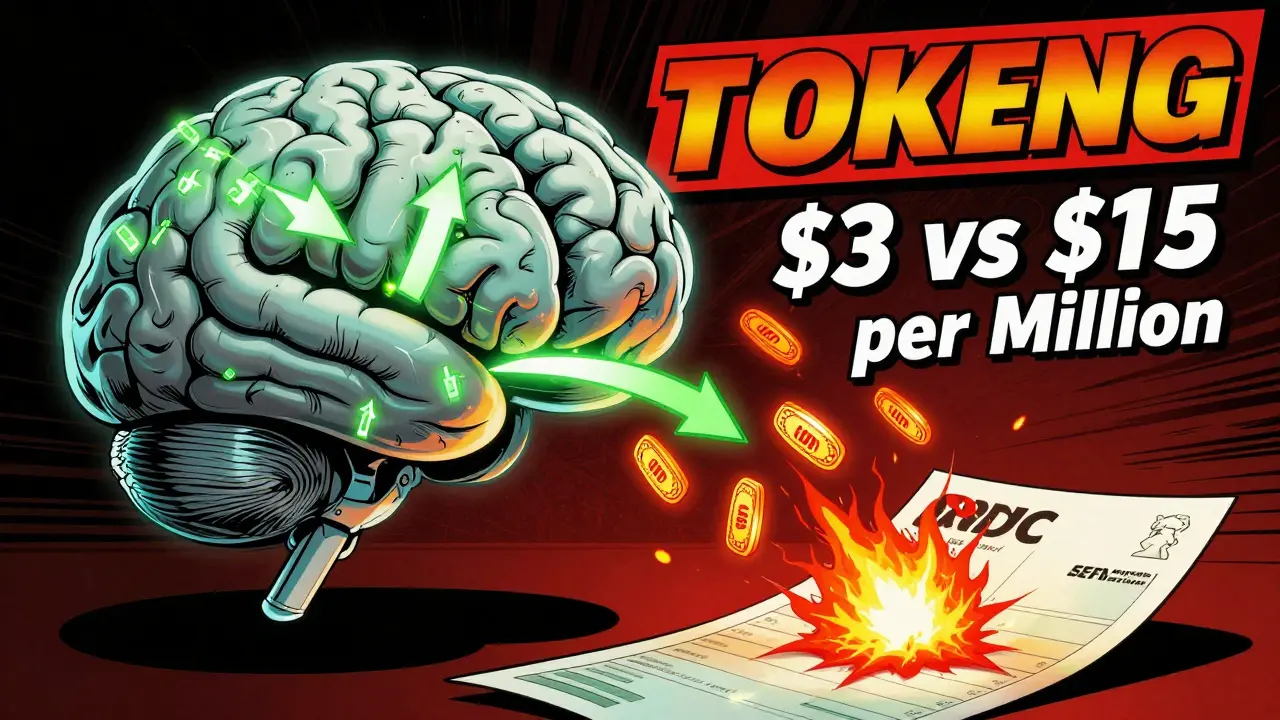
Every time you send a prompt to an LLM, it breaks your text into tokens. A simple word like "cat" might be one token. A longer phrase like "artificial intelligence" could be two or three. But here’s the key: input tokens (what you type) are cheap. Output tokens (what the model writes back) are expensive. Take Anthropic’s Claude Sonnet 4.5, priced in early 2026. Input tokens cost $3 per million. Output tokens? $15 per million. That’s a 5x difference. Why? Because generating text requires far more computing power than reading it. The model has to think, predict, and piece together words-step by step-while you’re just handing it a few sentences. This asymmetry changes everything. If you’re building a tool that asks yes/no questions-like checking if a support ticket should be escalated-you’ll use almost no output tokens. That’s cheap. But if you’re generating a 1,000-word product description, you’re burning through output tokens like crazy. That’s where your bill spikes.The Hidden Cost: Thinking Tokens
Newer models like OpenAI’s o3 and Claude with extended thinking don’t just generate answers. They think first. Before giving you a response, they run internal reasoning steps-planning, analyzing, testing logic. These are called thinking tokens. Think of it like a human solving a math problem. You don’t just write the answer. You scribble on paper, erase, rework. Those scribbles cost time. In LLMs, thinking tokens are those scribbles. And they’re expensive. Some models use 10 to 30 times more thinking tokens than final output tokens. Even if the answer is short, the hidden work behind it can triple your cost. This is why a simple question like "What’s the best way to optimize this code?" can cost more than a long summary. The model isn’t just copying text. It’s building a solution from scratch. And you’re paying for every step.Budget Models Are Changing the Game
In 2024, premium models like GPT-4 or Claude Opus cost $10-$15 per million output tokens. By early 2026, that’s changed. Budget models now run as low as $0.05 per million tokens. Models like Qwen2.5-VL-7B, Meta-Llama-3.1-8B, and GLM-4 are available through providers like SiliconFlow at these rock-bottom prices. These aren’t just "weaker" models. They’re optimized for specific tasks:- Qwen2.5-VL handles images and text together-perfect for document analysis.
- Llama 3.1 excels in multilingual chat-great for global customer service.
- GLM-4 writes clean code-ideal for developer tools.

Fine-Tuning: The Long-Term Cost Saver
If you’re using the same prompts over and over-like answering FAQs about your product-fine-tuning saves money. Instead of stuffing your prompt with 500 tokens of instructions, you train a model to "know" your context. That cuts your input token use by half or more. The math is simple: if each query used to cost $0.02 in tokens, and fine-tuning drops it to $0.01, you break even after 5 million tokens. That’s about 250,000 queries. For a company handling 1,000 customer interactions a day, that’s under a year. After that? Every query is pure profit.Prompt Caching and Batch Processing: Freeing Up Tokens
Ever notice how your chatbot remembers your last message? That’s not magic. It’s prompt caching. If you ask the same system prompt 100 times-"You are a customer support agent for Acme Corp"-the model doesn’t reprocess it each time. It caches it. That saves hundreds of input tokens per session. For apps with stable context (help docs, internal tools), this can cut costs by 30-50%. Then there’s batch processing. Real-time responses cost more. But if you can wait 12 hours? Many providers slash prices by 40-60%. Need to analyze 10,000 support tickets? Don’t run them live. Queue them. Pay less. Same results.
The Shift: From Usage to Fixed Pricing
In 2023, every AI tool charged by the token. Now? The tide is turning. Why? Because tokens are getting cheaper. If a model costs $0.05 per million tokens, you can afford to include AI in your $10/month subscription without tracking usage. Companies like Notion and Zapier are already testing fixed-price AI features. They know their users won’t max out the model. So they bundle it. This isn’t charity. It’s economics. When infrastructure costs drop, fixed pricing becomes more profitable than usage-based billing.What Should You Do in 2026?
If you’re using LLMs, here’s your action plan:- Map your tasks by complexity: simple (classification), moderate (summarization), complex (reasoning).
- Route them to the right model: budget for simple, premium for complex.
- Use prompt caching for static context (like company policies or product specs).
- Batch non-urgent work (reports, bulk analysis) to save on real-time pricing.
- Fine-tune if you’re doing the same task more than 5 million times a year.
- Watch thinking tokens-they’re the silent cost driver in advanced apps.
Final Thought: It’s Not About Power. It’s About Precision.
The most expensive AI setup isn’t the one with the biggest model. It’s the one that uses a $15/token model to answer "What’s the weather?" The best AI strategy isn’t about buying the most powerful tool. It’s about matching the right model to the right task-and knowing exactly what you’re paying for.What’s the cheapest LLM for simple tasks in 2026?
As of early 2026, Qwen2.5-VL-7B-Instruct and Meta-Llama-3.1-8B-Instruct are among the cheapest, costing $0.05-$0.06 per million tokens. These models are optimized for basic classification, summarization, and multilingual chat, making them ideal for customer service bots and document tagging.
Why are output tokens more expensive than input tokens?
Output tokens require the model to generate new text, which involves heavy computation-predicting each word, checking context, ensuring coherence. Input tokens are just read and processed. Generating a paragraph takes 10-30x more compute than reading one, so providers charge more for output.
Do thinking tokens cost more than output tokens?
It varies. Some providers charge thinking tokens at the same rate as output, others at half. But because thinking tokens can be 10-30x more numerous than output tokens, they often dominate total cost. For example, a reasoning task might use 50,000 thinking tokens and only 5,000 output tokens-even if output is priced higher, thinking can be the bigger expense.
Is fine-tuning worth the upfront cost?
Yes-if you’re running the same task over 5 million tokens per year. Fine-tuning reduces prompt length by 50% or more, cutting input token costs. For example, if you process 20,000 customer queries daily, you’ll hit break-even in under 6 months and save hundreds per month after that.
Should I use cloud APIs or self-host models?
For small teams or variable workloads, cloud APIs are simpler. But if you’re running over 100 million tokens monthly, self-hosting open-source models (like Llama 3.1) on your own GPUs can cut costs by 70%. The trade-off? You need engineering staff to manage servers, updates, and scaling.
Can I avoid paying for tokens altogether?
Only if you self-host. Cloud APIs charge per token. But if you run an open-source model on your own hardware, you pay for electricity and servers-not tokens. This works best for high-volume, predictable workloads. For most startups, cloud APIs are still easier.
What’s the future of LLM pricing?
Pricing will keep dropping-20-30% per year through 2027. But the bigger shift is toward hybrid models: fixed monthly fees with performance bonuses. Think Netflix-style pricing for AI: pay a flat rate, get unlimited access, and the provider absorbs the cost because their infrastructure is now so efficient.
Organizations that treat LLM usage like a utility-turning it on only when needed, routing tasks smartly, and optimizing every token-will outpace those treating it like a black box. The future belongs to those who understand not just what the model can do, but what it costs to do it.



Krzysztof Lasocki
March 24, 2026 AT 13:06Also, thinking tokens? Yeah, that’s the real villain. I had a feature where the model "thought" for 30 seconds to answer "Is the sky blue?" Turns out, it was drafting a 5-paragraph essay on atmospheric optics. We killed it. Saved thousands.
Henry Kelley
March 26, 2026 AT 05:06Victoria Kingsbury
March 27, 2026 AT 16:23Also-Qwen2.5-VL for document tagging? Yes. We’re deploying it across 30+ internal workflows. It’s not glamorous, but it’s saving us $12k/month. Budget models aren’t "cheap," they’re strategic.
Tonya Trottman
March 29, 2026 AT 08:35Also, "fine-tuning"? You mean rewriting your prompt into a 500-token essay? No. Just no. Fine-tuning is for when you’re doing the same thing 5 million times. If you’re not, you’re wasting compute. And your IT team. And your sanity.
Rocky Wyatt
March 31, 2026 AT 02:11Turns out, we were using a $15/token model to answer "Where’s my order?"
Now we route everything. Simple? Llama. Complex? Claude. And we batched our reports. Cost dropped 85%.
Stop treating AI like magic. It’s a calculator with a personality disorder.
Santhosh Santhosh
March 31, 2026 AT 19:37And batch processing? We started queuing nightly support ticket analysis. It used to cost $400/day. Now it’s $50. The users don’t notice the delay. The CFO notices the savings. That’s the sweet spot. Also, self-hosting Llama 3.1 on our own NVIDIA A100s? Worth it. We hit break-even at 70 million tokens/month. After that? Pure margin. The cloud providers are scared. They know this is coming for them.
Krzysztof Lasocki
April 1, 2026 AT 22:40Also, I just realized I’ve been paying for thinking tokens on every single customer survey response. That’s probably why our bill spiked last month. Time to re-route.