
You type a question into your favorite AI chatbot. You hit enter. Then... you wait. Even if it’s just for a second, that pause feels like an eternity. You might think the model is “thinking,” but what’s actually happening under the hood is a complex dance of math, memory management, and hardware constraints. This delay is called prompt-to-response latency, defined as the total time elapsed between submitting an input prompt and receiving the complete response from a large language model. Understanding this latency isn’t just about patience; it’s critical for building responsive applications and managing operational costs.
The Two Phases of Latency: TTFT and ITL
To truly grasp why there’s a delay, we need to split the process into two distinct phases. Industry professionals don’t look at latency as one big block of time. They break it down into Time to First Token (TTFT), which measures the time from submitting the prompt until the very first word appears on screen, and Inter-Token Latency (ITL), also known as Time Per Output Token (TPOT), measuring the speed at which subsequent tokens arrive after generation begins.
Think of TTFT as the “loading” phase. During this time, the model is reading your entire prompt, converting text into numbers, and preparing its internal state. If TTFT is high, the app feels sluggish. You click, nothing happens, and you wonder if it broke. Low TTFT makes the interaction feel instant and snappy, even if the rest of the answer takes a moment to stream in.
Once that first token appears, we enter the ITL phase. This is the “streaming” phase. Here, the model generates text one token at a time. ITL determines how fast the rest of the sentence flows out. If ITL is low, words appear rapidly. If it’s high, you see individual words pop up with noticeable gaps between them. For real-time applications like voice assistants or live coding help, both metrics matter, but they are influenced by different factors.
Why Transformers Are Sequentially Bound
The root cause of this latency lies in the architecture itself. Modern LLMs use Transformer models, which rely on a mechanism that predicts the next token based on all previously observed text, repeating this process sequentially until an end token is generated. Unlike image processing, where a GPU can analyze millions of pixels simultaneously, text generation in LLMs is inherently sequential. The model cannot predict the second word until it has finished predicting the first. It cannot predict the third until the second is done. This creates a hard ceiling on how fast output can be generated.
This sequential nature means that processing time correlates directly with token count. Research from Proxet benchmarking OpenAI’s API showed that for a 500-token prompt, the normalized processing time was approximately 1.0 second. When they pushed prompts to 4,000 tokens, the median total processing time rose to about 1.25 seconds. While that doesn’t sound like much, scale it across thousands of concurrent users, and those milliseconds add up to significant delays. The model must build a Key-Value (KV) cache for every token in the prompt before it can start generating any output. Longer prompts mean larger caches, which take more time to construct.
Hardware and Infrastructure Constraints
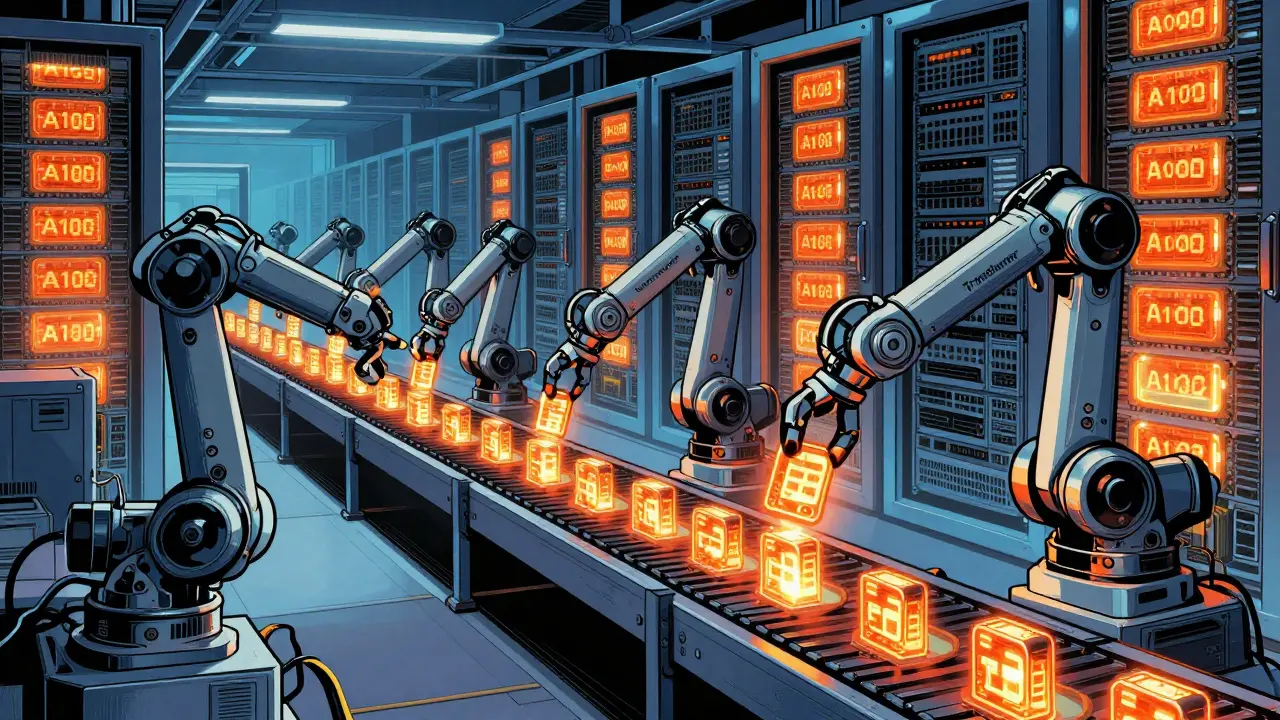
If the architecture sets the rules, hardware determines how well we play them. The speed at which a model processes tokens depends heavily on the underlying infrastructure. Faster GPUs, such as the NVIDIA A100 or H100 processors, significantly reduce per-token computation time. These chips have higher memory bandwidth and compute density, allowing them to handle the massive matrix multiplications required for inference more efficiently than older generations.
However, raw power isn’t the only factor. How the system is architected matters just as much. When models are too large to fit on a single GPU, they are sharded across multiple devices. In these scenarios, high-speed interconnects like NVIDIA NVLink, which enables high-bandwidth communication between GPUs to minimize data transfer overhead during distributed inference, become critical. Without NVLink, the time spent moving data between GPUs would drastically increase latency, negating the benefits of having more powerful hardware.
System load also plays a huge role. If a server is handling hundreds of requests simultaneously, new prompts may sit in a queue waiting for their turn. This queuing adds variable delays to TTFT. Providers often use autoscaling to spin up more instances during peak traffic, but there’s always a lag before those new resources come online. During that window, users experience higher latency due to congestion, not because the model itself is slow.
| Factor | Impact on TTFT | Impact on ITL | Mitigation Strategy |
|---|---|---|---|
| Prompt Length | High (Linear Increase) | Low | Summarize context, remove redundant instructions |
| Model Size | Medium | High (Slower Forward Passes) | Use smaller specialized models for simple tasks |
| GPU Hardware | High | High | Upgrade to A100/H100 clusters |
| System Load | High (Queuing Delays) | Medium | Implement request prioritization and autoscaling |
| KV Cache Size | High | Low | Optimize context window usage |
The Cost-Latency Tradeoff
Latency isn’t just a technical metric; it’s an economic one. Most cloud providers, including OpenAI, bill customers per token. This means that longer prompts cost more money AND take longer to process. It’s a double penalty. If you send a 10,000-token document to summarize, you pay for every token in that document, and the model spends extra time building its KV cache before it even starts writing the summary.
This creates a strong incentive to optimize prompt size. Engineers are constantly balancing accuracy against efficiency. Few-shot prompting, where you provide examples in the prompt to guide the model’s behavior, improves quality but increases length. P-tuning, a technique that uses small trainable modules to generate task-specific virtual tokens, offers a way to control behavior without bloating the prompt. By keeping prompts lean, you reduce both the financial cost and the latency burden on the system.
Optimizing for Real-World Applications
For developers building real-time applications, understanding these mechanics allows for smarter design choices. If you’re building a chatbot, prioritize low TTFT. Users expect immediate feedback. You can achieve this by using smaller models for initial responses or caching common queries. If you’re building a code generator, ITL becomes more important. Developers can tolerate a slight delay while the model “thinks,” but they want the code to stream out quickly once it starts.
Batching parameters also offer levers for optimization. Increasing the number of sequences batched together can improve overall throughput (Requests Per Second) but may increase individual request latency. Conversely, prioritizing token throughput over request completion can make streaming faster but leave some requests hanging longer. There’s no perfect setting-only trade-offs tailored to your specific user experience goals.
As AI capabilities advance, the frontier of innovation shifts from pure intelligence to efficiency. We’re seeing rapid improvements in inference kernels, speculative decoding techniques, and hardware acceleration. But the fundamental constraint remains: transformers are sequential. Until that changes, prompt-to-response latency will remain a key challenge for anyone deploying LLMs at scale.
What is the difference between TTFT and ITL?
TTFT (Time to First Token) is the delay before the first word appears, dominated by prompt processing and KV cache construction. ITL (Inter-Token Latency) is the time between each subsequent word appearing, dominated by the speed of the forward pass and hardware performance.
Why does prompt length affect latency so much?
Longer prompts require the model to process more tokens before generating any output. This increases the time needed to build the Key-Value (KV) cache, which stores contextual information. Since this step must complete before generation begins, TTFT increases linearly with prompt length.
Can hardware upgrades eliminate LLM latency?
No. While faster GPUs like NVIDIA H100s reduce computation time, the sequential nature of transformer architectures means each token must be generated one after another. Hardware speeds up each step, but cannot parallelize the generation process itself.
How does batching affect latency?
Batching multiple requests together improves overall system throughput (RPS) by keeping GPUs busy. However, it can increase individual request latency because requests may wait in a queue or share compute resources, leading to higher ITL or TTFT for specific users.
Is there a way to reduce latency without sacrificing accuracy?
Yes. Techniques like prompt compression, removing redundant context, and using parameter-efficient tuning methods like P-tuning can maintain accuracy while reducing token count. Additionally, using smaller, specialized models for simpler tasks reduces computational load.