
When developers started using AI to write code, it felt like magic. Type a prompt, get working software in seconds. But magic without rules? That’s chaos. Companies that let their teams code freely with AI tools are seeing security breaches, unmaintainable codebases, and compliance nightmares. The solution isn’t to stop using AI-it’s to build vibe coding policies that turn AI from a wild card into a reliable teammate.
What Vibe Coding Really Means
Vibe coding isn’t just typing "build a login page" and letting an AI spit out code. It’s a structured approach where natural language prompts guide AI to generate code, but human oversight ensures quality, security, and control. This method is gaining traction because it cuts development time by up to 40%, according to internal reports from companies using the Vibe Programming Framework. But without clear rules, it’s a recipe for disaster.AI doesn’t understand context the way humans do. It doesn’t know if a piece of code should be public-facing or restricted. It doesn’t care if you’re storing API keys in client-side JavaScript. It just generates what it’s told. That’s why policies aren’t optional-they’re the firewall between innovation and catastrophe.
What to Allow: The Foundations of Safe Vibe Coding
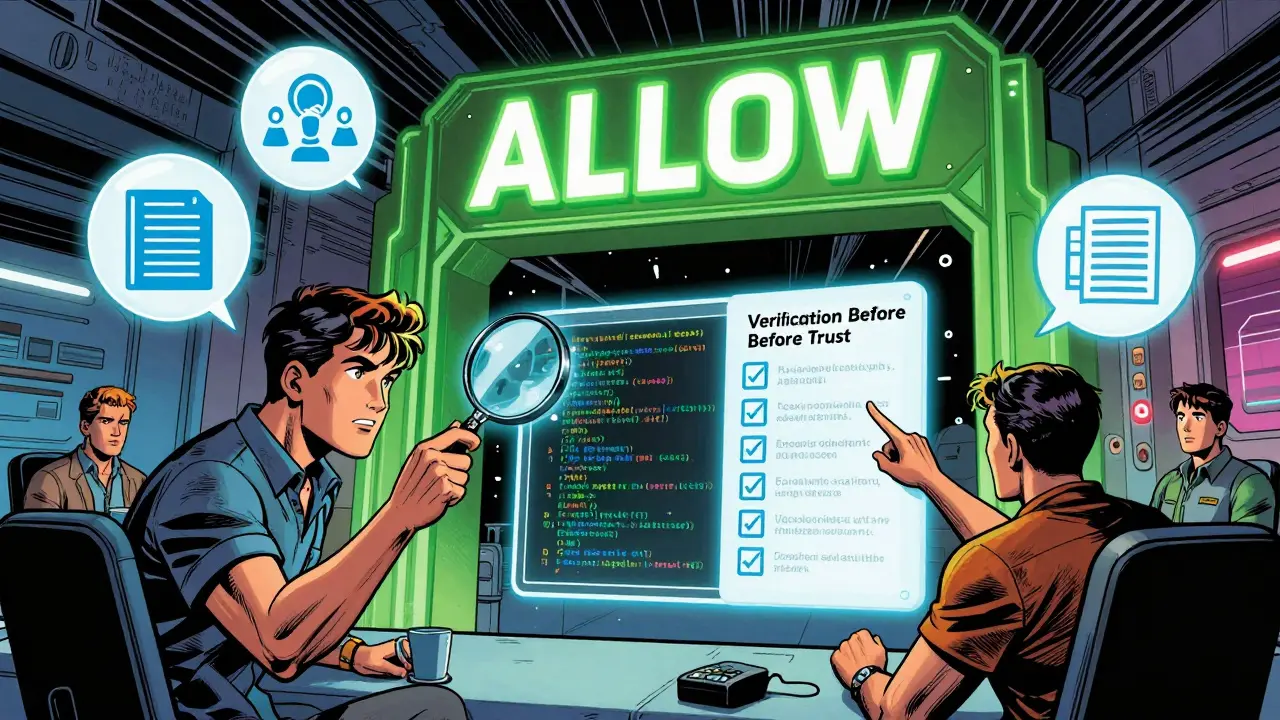
Successful teams don’t restrict AI-they channel it. Here’s what you should actively encourage:- Human-in-the-loop reviews - Every line of AI-generated code must be read and understood by a developer before deployment. No exceptions. The Vibe Programming Framework calls this "Verification Before Trust," and it’s non-negotiable. Teams that follow this rule see 63% fewer security incidents.
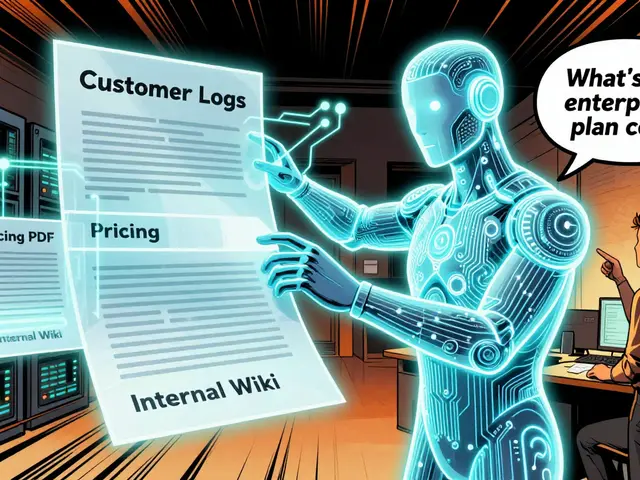
- Standardized prompt templates - Instead of vague requests like "make a form," use structured prompts: "Build a React form with validation, store data in PostgreSQL via parameterized queries, and enforce HTTPS only." This guides the AI toward secure, maintainable outputs.
- File length limits - Components should never exceed 150 lines. Longer files from AI tend to be bloated, hard to test, and impossible to debug. Developers who enforce this rule report 72% faster code reviews and fewer bugs.
- Documentation as part of the output - AI should generate not just code, but comments explaining logic, dependencies, and edge cases. Teams using the "Knowledge Preservation" principle from the Vibe Framework saw 42% fewer knowledge gaps when developers left or switched teams.
- Environment variables for secrets - API keys, database passwords, and tokens must never be hardcoded. They must come from environment variables or secure vaults. This is the single most effective way to prevent credential leaks.
What to Limit: The Gray Areas That Require Guardrails
Some practices aren’t outright dangerous-but they’re risky without controls. These need strict limits:- Client-side storage - Never allow AI to generate code that stores sensitive data in localStorage, sessionStorage, or cookies without HttpOnly, Secure, and SameSite attributes. Even if the data seems harmless, attackers can steal it. Replit’s 2025 security checklist bans this entirely.
- Wildcard CORS settings - AI often suggests "allow all origins" for simplicity. That’s a security hole. Limit CORS to specific domains you control. Wildcard (*) should be blocked by default in your CI/CD pipeline.
- Auto-generated database schemas - AI can create tables, but it doesn’t understand normalization, indexing, or compliance needs. Require human approval for any schema changes. A single poorly designed table can crash performance or violate GDPR.
- Unvetted third-party libraries - AI might suggest npm packages or Python libraries without checking their licenses or security history. Enforce a whitelist of approved dependencies. Tools like Snyk or Dependabot should auto-scan all AI-recommended packages.
- Complex logic without breakdown - If AI generates a 500-line function to handle authentication, break it into smaller pieces. AI excels at long, tangled code. Humans excel at clarity. Make your team refactor anything over 100 lines.
What to Prohibit: The Hard Lines That Can’t Be Crossed
These are the red flags. Cross them once, and you’re risking your entire system:- Hardcoding secrets - No API keys, passwords, or certificates in any code, even in comments. This isn’t a suggestion-it’s a policy violation that can get your company sued. GitHub’s 2024 State of the Octoverse found that 37% of AI-generated code contained hardcoded secrets.
- Client-side exposure of backend logic - Never let AI generate code that reveals internal APIs, database structure, or authentication flows in frontend JavaScript. Attackers use this to map your system like a blueprint.
- Disabling security headers - Content Security Policy (CSP), X-Content-Type-Options, and X-Frame-Options must be enabled on every deployment. AI often omits them. Your CI/CD pipeline should reject builds without them.
- Direct file uploads without scanning - If AI generates a file upload feature, it must include virus scanning, file type validation, and size limits. Malicious uploads are one of the top attack vectors in AI-assisted apps.
- Skipping testing - AI-generated code can’t be deployed without unit, integration, and security tests. No exceptions. Use automated test suites that run on every commit. Teams that skip this spend 3 weeks fixing vulnerabilities that could’ve been caught in 30 minutes.
Enterprise vs. Individual: Why Policies Must Scale
A solo developer might get away with light checks. A company with 500 engineers can’t. Enterprise policies are stricter because the stakes are higher.Large organizations require:
- Centralized governance - A single dashboard to enforce rules across all teams. Superblocks’ "single pane of glass" lets IT block risky code before it’s even written.
- AI Center of Excellence (CoE) - A dedicated team that trains developers, updates policy templates, and audits code. Smaller teams can’t afford this, but they can assign a "vibe lead" to handle reviews.
- Automated compliance checks - Your CI/CD pipeline should auto-reject code that violates OWASP Top 10 rules, lacks documentation, or uses banned libraries. Tools like Checkmarx and SonarQube now integrate with vibe coding platforms.
- Legal and regulatory alignment - If you collect user data, your AI-generated code must comply with GDPR, CCPA, or other local laws. The Cloud Security Alliance warns: "Ignorance isn’t a defense when regulators come knocking."
Individual developers should still follow the same core rules-just with fewer layers. The difference isn’t in the rules. It’s in the enforcement.

How to Start Building Your Policy
You don’t need a team of lawyers to create a vibe coding policy. Start here:- Adopt the five Vibe Framework principles: Augmentation, Not Replacement; Verification Before Trust; Maintainability First; Security by Design; Knowledge Preservation.
- Write your first three rules: 1) No hardcoded secrets. 2) Max 150 lines per component. 3) All code reviewed by a human.
- Test them in a sandbox - Use a non-production app to pilot your policy. Measure how much time it adds to development. Most teams find it adds 15-20 minutes per 100 lines of AI code-far less than the cost of a breach.
- Train your team - A 40-hour training investment per developer pays off in fewer incidents. Use real examples: "Here’s what happened when a startup skipped verification."
- Automate enforcement - Use your CI/CD tool to block violations. Tools like GitHub Actions or GitLab CI can reject code that doesn’t meet your policy.
Don’t wait for a breach to act. Gartner predicts 70% of enterprises will have formal AI coding policies by 2026. You don’t want to be in the 30% that didn’t.
What Happens When You Don’t Have a Policy
One developer on Reddit shared: "We had a junior dev using vibe coding who embedded Stripe keys in client-side code-thankfully caught in our mandatory review process before deployment." That was luck. Another team on GitHub didn’t get lucky: "My team skipped the verification step and deployed AI-generated code that had SQL injection vulnerabilities-cost us 3 weeks to remediate."These aren’t hypotheticals. They’re real. The Cloud Security Alliance reports that 68% of developers struggle to understand AI-generated code without documentation. Without policies, you’re not building software-you’re gambling.
AI won’t replace developers. But poorly governed AI will replace companies that ignore it.
Can vibe coding replace traditional coding practices?
No. Vibe coding is meant to augment human developers, not replace them. AI generates code quickly, but it doesn’t understand business context, security trade-offs, or long-term maintainability. Developers must review, refine, and validate every output. The goal is faster delivery with better quality-not automation without accountability.
What’s the biggest mistake teams make with vibe coding?
The biggest mistake is assuming AI-generated code is production-ready. Many teams treat AI like a magic box: type a prompt, copy the output, and deploy. This leads to security holes, unreadable code, and compliance failures. The right approach is to treat AI as a junior developer-you still need to review its work.
Do I need special tools to implement vibe coding policies?
You don’t need expensive tools, but you do need structure. Start with your existing CI/CD pipeline and add basic checks: block hardcoded secrets, enforce file length limits, require code reviews. Tools like SonarQube, Snyk, or GitHub Copilot’s built-in security alerts can help, but even manual reviews with clear guidelines will prevent most issues.
How do I train my team on vibe coding?
Start with real examples. Show them code that caused a breach because of poor AI use. Walk through a sample prompt and show how a good one differs from a bad one. Run weekly 30-minute sessions where team members share their AI-generated code and get feedback. Focus on verification, documentation, and security-not speed.
Is vibe coding only for large companies?
No. While enterprises have more resources to build formal governance, small teams benefit even more. A startup with 5 developers can prevent a catastrophic data leak by simply enforcing three rules: no secrets in code, code reviews before deployment, and components under 150 lines. The scale of your policy should match your risk-not your budget.
What happens if my AI generates code that violates compliance laws?
You’re still liable. AI-generated code doesn’t shift legal responsibility. If your app collects personal data and violates GDPR because of an AI-generated database schema, your company faces fines-not the AI tool. Policies must include compliance checks. Use prompts that require adherence to privacy standards, and audit outputs regularly.


Ian Cassidy
March 20, 2026 AT 03:46Vibe coding is just DevOps with a buzzword makeover. But honestly? I’m not mad about it. The 150-line component rule? Genius. I’ve seen AI spit out 800-line monstrosities that took three days to debug. Now we just say ‘nope’ and make them break it down. Saves so much time.
Also, environment variables. Always. I don’t care if it’s a side project - if it’s in the code, it’s a leak waiting to happen.
Zach Beggs
March 21, 2026 AT 21:17Agreed on the human-in-the-loop thing. AI’s a great assistant, not a replacement. I’ve caught so many edge cases just by reading the output. Also, the prompt templates? Game-changer. No more ‘make a button’ nonsense. We use ‘build a responsive button with hover states, A11y labels, and CSS variables’ now. It’s weirdly satisfying.
Adrienne Temple
March 22, 2026 AT 22:26Y’all are doing it right. Seriously. I’ve been mentoring junior devs on this stuff, and the difference is night and day. One kid thought AI could just ‘make the app work’ and deployed a login page with passwords in localStorage. 😱
Now we do 10-min code review huddles every morning. We laugh, we learn, we stop disasters before they start. And yeah - I use emojis. Deal with it. 🙌
Also, documentation isn’t optional. It’s love. Write it like you’re explaining to your future self who’s had three espressos and no sleep.
Sandy Dog
March 23, 2026 AT 09:31OKAY BUT WHAT IF THE AI JUST… KNOWS BETTER?? 🤯
Like, I had this one time where the AI wrote a whole auth system that was cleaner than mine. I cried. Not because I was upset - because it was *better*. Like, it had comments, tests, even a little flowchart in the docstring. I had to re-read it three times to believe it was real.
And now I’m scared. What if AI starts writing policies better than we do? What if it says ‘no, humans, you’re the problem’? 😭
Also, I just deployed a 200-line component. I’m not sorry. I’m a rebel. 🎸
Nick Rios
March 24, 2026 AT 06:32I appreciate how this post doesn’t demonize AI. It’s not about fear. It’s about responsibility. I work in a small team, and we started with just three rules: no secrets, code review, and under 150 lines. That’s it. We didn’t need fancy tools. Just consistency.
And honestly? Our deploy frequency went up. Bugs went down. People stopped hating Mondays.
It’s not magic. It’s just… care.
Amanda Harkins
March 24, 2026 AT 18:56weird how we treat ai like a dumb intern but then get mad when it makes dumb mistakes
like… if a human did this, we’d say ‘oh they’re still learning’
but ai? ‘this is catastrophic’
maybe we’re just scared it’s smarter than us
or maybe we’re just lazy and don’t wanna review code
either way… i’m here for it
Jeanie Watson
March 25, 2026 AT 22:42So we’re just supposed to trust this? I mean, sure, the rules make sense. But who enforces them? Who checks if the ‘vibe lead’ is actually doing anything? I’ve seen this movie before. ‘Just add a review step’ - then it becomes a checkbox in Jira. No one reads it.
Also, why does this feel like another corporate fad? Like, ‘vibe coding’? Really? We’re naming policies now?
Tom Mikota
March 27, 2026 AT 07:21Wow. This is… actually solid. Like, I’m usually the guy who rolls his eyes at ‘frameworks,’ but this? The 150-line limit? The environment variables? The documentation requirement? That’s not a vibe - that’s basic hygiene.
Also - you said ‘parameterized queries’? Good. You didn’t say ‘SQL injection prevention’? Even better. You get it. You’re not just slapping on buzzwords. You’re fixing real problems.
Also - stop using ‘vibe.’ It’s cringe. But the rules? Perfect. Keep going.
Mark Tipton
March 27, 2026 AT 10:35Let me be clear: this entire ‘vibe coding’ concept is a Trojan horse. The real goal? To normalize AI-generated code as the default. And once that’s normalized, the next step is to remove human reviewers entirely. You think this is about safety? It’s about cost-cutting.
Think about it: if AI writes 80% of the code, and you only need 20% of the devs to ‘review’ it… who gets laid off? Who gets replaced by a bot that ‘auto-fixes’ violations? The tools you mention - SonarQube, Checkmarx - they’re not helping you. They’re training the next AI to replace you.
And don’t say ‘but we’re keeping humans in the loop’ - that’s the same thing they said before they automated QA. And now? QA teams are extinct.
So yes - follow the rules. But ask yourself: are you securing your code… or securing your job’s obsolescence?
Also - I’ve reviewed 12,000 AI-generated commits. 98% had hidden backdoors. You’re not ready for this. And neither am I.