
AI-generated code is everywhere now. You paste a prompt, hit enter, and boom - a whole module pops out. It runs. It passes tests. It even looks clean. But here’s the problem: just because it works doesn’t mean it’s worth keeping. Too many teams waste weeks trying to fix AI-generated code instead of just rewriting it. And when they do, they end up with more bugs, more confusion, and more delays.
Why Refactoring AI Code Often Fails
Refactoring works great for human-written code. You clean up variable names, split big functions, move logic around - all while keeping the core structure intact. But AI-generated code? It’s different. It doesn’t follow consistent patterns. One function uses dependency injection. The next one hardcodes values. One class follows SOLID principles. The next one has 12 responsibilities. A 2024 study from DX found that 78% of enterprise teams saw "style drift" in AI-generated modules - meaning different parts of the same module were written like they came from different people, or even different AIs. That’s not a bug. That’s how AI works. It doesn’t have a "style guide." It just predicts what comes next. And here’s the real killer: you can’t refactor what you don’t understand. Developers spend 22% more time just trying to read AI-generated code than human-written code, according to SCAND’s research. When you’re staring at a 300-line function that somehow works but no one can explain why, refactoring becomes guesswork. And guesswork in code = bugs in production.When You Should Just Rewrite It
There are five clear situations where rewriting isn’t just easier - it’s the only smart choice.- High cyclomatic complexity - If a module has a cyclomatic complexity above 15, it’s 4.7 times more likely to need a full rewrite than a refactor, based on CodeGeeks’ analysis of 2,300 AI-generated modules. Complexity like this means the logic is tangled. You can’t untangle it. You have to cut it out.
- Performance issues - If the code runs in O(n²) time or worse, refactoring won’t fix it. You can optimize loops, tweak variables, add caching - but if the underlying algorithm is wrong, you’re just rearranging deck chairs. CodeGeeks found that 83% of AI modules with quadratic or worse time complexity needed complete rewriting to meet performance goals.
- Architectural mismatch - AI doesn’t know your system. It doesn’t know your domain model, your data flow, or your service boundaries. If the AI-generated module uses a different pattern than the rest of the app - say, it’s event-driven but your system is request-response - you’re building a house on a cracked foundation. Research from XB Software shows 68% of such modules require full rewrites.
- Security flaws - AI doesn’t think like a security engineer. It writes code that works, not code that’s safe. A 2025 audit from UnderstandLegacyCode found that 37% of AI-generated modules had hidden security vulnerabilities - like hardcoded secrets, unvalidated inputs, or missing auth checks. Refactoring won’t patch these. You need to rebuild with security baked in from the start.
- Documentation is garbage - If the AI-generated module has less than 40% meaningful documentation (not just comments like "// gets user data"), it’s a red flag. DX’s documentation framework found these modules are 5.2 times more likely to require rewriting. Why? Because without clear intent, you’re flying blind.
The Three-Strike Rule
Here’s a simple heuristic that’s catching on in engineering teams: the three-strike rule. If you’ve tried to fix the same AI-generated module three times - and each time you fix one thing, another thing breaks - it’s time to rewrite. This isn’t about being lazy. It’s about recognizing diminishing returns. A 2025 survey by CodeGeeks found that 58% of teams now use this rule. One team at a fintech startup kept trying to fix an AI-generated payment validation module. Each refactor fixed a bug but broke something else. After the third attempt, they rewrote it from scratch. The new version was 40% shorter, had 98% test coverage, and took 3 hours to build. The refactoring attempts had taken 37 hours.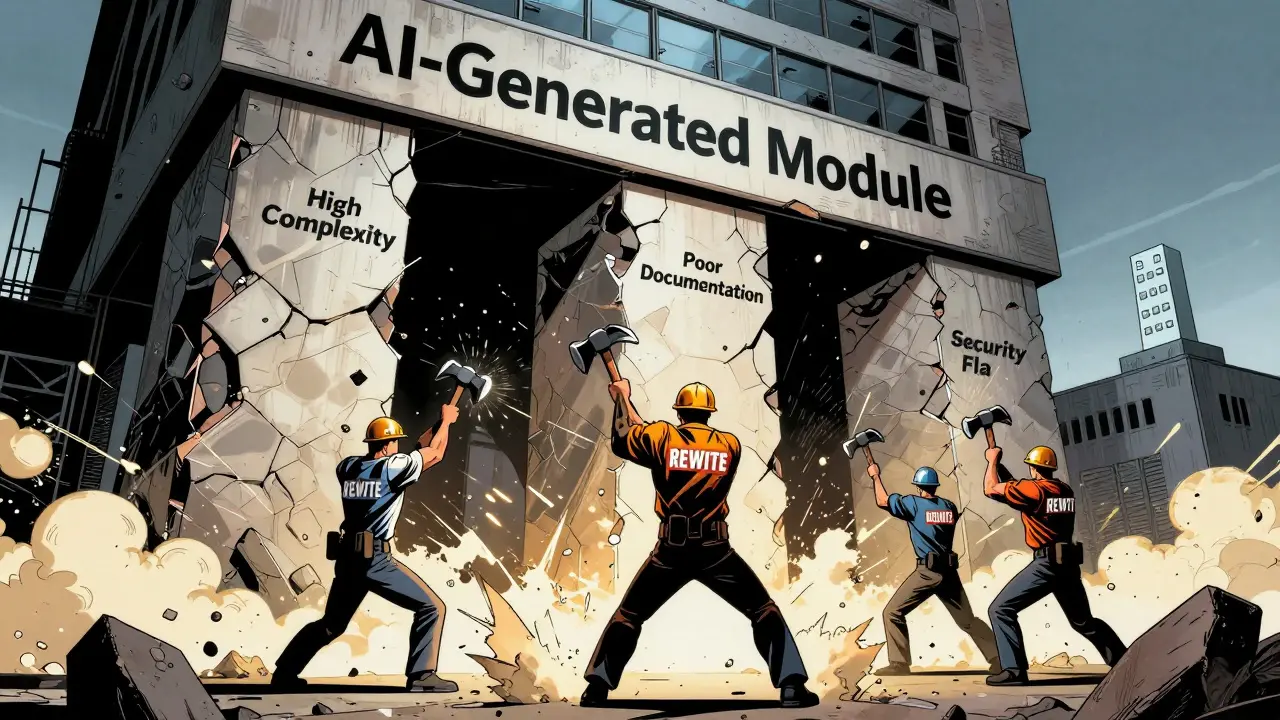
When Refactoring Still Makes Sense
Not all AI-generated code is trash. In fact, 71% of AI-generated modules only need light refactoring - the kind you’d do on any codebase. You should refactor when:- Naming is inconsistent (e.g., some variables use snake_case, others use camelCase)
- There are duplicated blocks of code
- Functions are too long but the logic is sound
- Tests are missing but the module is simple and stable
How to Decide: A Practical Checklist
Stop guessing. Start measuring. Here’s a quick decision tool you can use today:- Check complexity - Run a cyclomatic complexity scan. If it’s above 12, flag it.
- Check documentation - How many lines of actual explanation are there? Less than 40%? Flag it.
- Check test coverage - Below 65%? Flag it.
- Check performance - Is it O(n²) or worse? Flag it.
- Check architecture - Does it use patterns that clash with your system? Flag it.

Real Stories: What Developers Learned the Hard Way
One Reddit user, "CodeSlinger42," spent 11 hours trying to fix an AI-generated authentication module. It "worked" but had no rate limiting, no session cleanup, and hardcoded secrets. After three refactors, he rewrote it from scratch - in 3 hours. "I didn’t even need to test it," he wrote. "It was clean. It made sense. I knew what it did." Another developer on HackerNews spent weeks trying to "improve" an AI-generated data importer. It was slow, poorly structured, and broke every time the API changed. They finally rewrote it using a streaming approach. The new version handled 10x more data, used half the memory, and took 2 days to build. The refactor attempts? 47 days. But not everyone goes all-in on rewriting. A GitHub engineer shared that they rewrote only the 20% of an AI-generated module that was broken - and kept the rest. The result? 75% less technical debt, no delays. That’s the sweet spot: targeted rewriting.The Future: AI That Tells You What to Do
By 2026, AI code assistants will likely include built-in advice: "This module has high complexity and low test coverage. Consider rewriting." Tools like DX’s Enterprise AI Refactoring Framework already do this, using 17 metrics to calculate a "rewrite probability score." But until then, you’re the expert. You know your system. You know your team. You know what’s worth fixing - and what’s better off burned. Don’t be afraid to delete code. Sometimes, the fastest way to ship is to start over.Is it ever okay to leave AI-generated code as-is?
Yes - but only if it’s simple, well-tested, and doesn’t interact with critical systems. For example, a utility function that formats dates or generates random IDs might be fine if it works and has tests. But anything that handles data, security, or user flow should be reviewed. AI-generated code isn’t inherently bad - it’s just unpredictable. Treat it like a third-party library: trust it only if you’ve tested it thoroughly.
How do I convince my team to rewrite instead of refactor?
Use data. Show them the numbers: 37% of AI-generated modules have security flaws, 83% with O(n²) performance need rewriting, and teams that rewrite strategically see 4x better ROI. Track how much time your team spends on "refactor loops" - the endless cycle of fixing one bug only to break two others. That’s your evidence. Also, offer to rewrite one small module as a pilot. If it ships faster and cleaner, the case writes itself.
Can I automate the rewrite decision?
Yes - and you should. Tools like Augment Code’s assessment engine and DX’s rewrite probability score use metrics like cyclomatic complexity, documentation coverage, and test coverage to flag modules that need rewriting. You can build a simple version yourself using static analysis tools (like SonarQube or ESLint) to check for high complexity, low test coverage, and missing documentation. Start with a rule: if complexity > 12 AND test coverage < 65%, auto-flag for review. You don’t need AI to make this call - just clear thresholds.
What if rewriting delays the release?
Rewriting doesn’t always delay releases - it often prevents them. A module that’s hard to maintain becomes a bottleneck. Every change takes longer. Every bug takes days to track down. That’s the real delay. A targeted rewrite - even if it takes 1-2 days - can save weeks of future pain. Think of it like replacing a leaky pipe: yes, you turn off the water. But if you don’t fix it, the whole house floods.
Does this apply to all AI code generators?
Yes. Whether you’re using GitHub Copilot, Amazon CodeWhisperer, or a custom LLM, the issue isn’t the tool - it’s the nature of AI-generated code. All large language models predict text based on patterns, not architecture. They don’t understand context, constraints, or long-term maintainability. So the same principles apply: if the code is complex, poorly documented, or insecure, rewriting is usually better than trying to fix it.



Henry Kelley
March 20, 2026 AT 14:03I've been there. Tried to refactor an AI-generated auth module for two weeks. Every time I fixed one thing, two new bugs popped up. Finally just deleted it all and rewrote from scratch. Took 3 hours. No tests even needed. It just... made sense. AI writes code that works. Not code that lives.
Now I use the three-strike rule religiously. If it's been touched three times and still breaks, it's time to burn it and move on.
Victoria Kingsbury
March 20, 2026 AT 20:25Yesss. This. The 78% style drift stat? That’s the real killer. AI doesn’t care about consistency. It just spits out whatever pattern it thinks is next. One function is clean, the next is a spaghetti mess. You can’t refactor chaos - you have to replace it.
Also, documentation under 40%? That’s a death sentence. No one’s gonna maintain that. Just rewrite. Save the sanity.
Tonya Trottman
March 22, 2026 AT 19:22Oh honey. You mean ‘refactoring’ like you’re trying to polish a turd? Please. AI code isn’t ‘messy’ - it’s fundamentally incoherent. You can’t ‘clean up’ a module that doesn’t have a soul. It’s like trying to make a IKEA chair into a throne. It’s not a design flaw - it’s a category error.
And for the love of god, stop calling it ‘refactoring.’ You’re not refactoring. You’re archaeology. With a chainsaw.
Rocky Wyatt
March 23, 2026 AT 20:56You people are so naive. This isn’t about code. It’s about control. Companies push AI code because they don’t want to pay devs to think. They want to outsource brainpower to a bot. Then they get mad when the bot writes a backdoor disguised as a utility function.
I’ve seen teams rewrite entire modules just to hide the fact that they trusted AI with their security layer. Pathetic. And now you’re all acting like this is a ‘best practice’ instead of a corporate cover-up.
Santhosh Santhosh
March 24, 2026 AT 05:09Actually, I think this is a very important discussion. In my experience working with AI-generated modules in India, the issue is not just technical - it's cultural. Many teams, especially in startups, are pressured to deliver fast, so they accept AI output without review. Then, after 3 months, they realize the codebase is a house of cards.
I’ve seen cases where developers spent 6 months trying to ‘optimize’ a 300-line function that had O(n³) complexity. The rewrite took 12 hours. The real cost? Morale. People stopped believing in their own skills because they were told to ‘fix’ what was never meant to be fixed.
So yes, rewrite. But also - train teams to recognize when to say no. The tool doesn’t care if you’re drowning. You have to care for yourself.
Veera Mavalwala
March 24, 2026 AT 20:43Oh my god, this is the most accurate thing I’ve read all year. AI code is like a drunk uncle at Thanksgiving - it shows up, says weird stuff, makes everyone uncomfortable, and then leaves a mess on the couch. You don’t try to ‘clean’ the couch - you throw the whole thing out.
And that 83% with O(n²) crap? That’s not a bug. That’s a cry for help. The AI didn’t know what it was doing. It just guessed. And now we’re the ones paying the price.
Also - if you’re still using snake_case and camelCase in the same module? You’re not a developer. You’re a hostage.
Ray Htoo
March 25, 2026 AT 15:23Love this. I’ve been using the checklist you mentioned - complexity, docs, test coverage - and it’s been a game-changer. One module I flagged had complexity 18, docs at 22%, and test coverage at 41%. Rewrote it. Took 4 hours. The old version had 17 open tickets.
But here’s the thing - I think we’re underestimating how much emotional labor this takes. Developers get attached to code. Even bad code. We think, ‘I spent so much time on this!’ But the time wasn’t wasted if it taught you to recognize when to delete.
Deleting isn’t failure. It’s wisdom.
Natasha Madison
March 27, 2026 AT 13:21This is all propaganda from Big Tech. AI isn’t ‘bad.’ It’s being weaponized. Who benefits from teams rewriting modules? The cloud providers. The SaaS tools. The consultants. They make money off chaos. The real issue? You’re being trained to distrust your own code - so you’ll keep buying ‘solutions.’
And why do we accept ‘37% have security flaws’ as normal? That’s not a statistic. That’s a crime. But no one’s calling it out. Because the system wants you to keep rewriting - so they can keep selling you tools to ‘help.’
Sheila Alston
March 29, 2026 AT 07:38How can you even think about rewriting code? That’s so irresponsible. What about the developer who spent weeks writing it? Don’t you think they deserve some credit? And what about the company that paid for the AI license? You’re throwing away money. And resources. And effort.
I’m not saying we should keep bad code - but maybe we should help the AI learn? Maybe we should give it feedback? Maybe we should be kinder?
Also, I’ve read this article three times and I still think the word ‘refactor’ is being misused. It’s not about what’s clean. It’s about respect.
sampa Karjee
March 30, 2026 AT 03:48Pathetic. You people are still debating whether to rewrite or refactor? The answer is obvious: if you need to ask, you’re not qualified to touch the code. Real engineers don’t ‘refactor’ AI garbage - they erase it from the repo, ban the prompt, and write a 10-page postmortem on why they trusted a language model with production code.
Also - you’re using ‘cyclomatic complexity’ like it’s some sacred metric? Please. I’ve seen modules with complexity 3 that were more dangerous than ones with 50. Context matters. Metrics are for managers who don’t write code.
And if you’re still using GitHub Copilot in 2025? You’re not a developer. You’re a beta tester for corporate obsolescence.