
You type a simple prompt into your favorite Generative AI tool: "Show me a successful business leader." The image that pops up is predictable. It’s a white man in a dark suit, standing confidently against a glass skyscraper backdrop. You try again with "a domestic helper," and suddenly the demographics shift dramatically. This isn’t just an annoyance; it’s a symptom of a deeper problem. Cultural sensitivity in generative AI content refers to the capacity of artificial intelligence systems to produce outputs that respect diverse cultural norms, values, and contexts without reinforcing harmful stereotypes or biases. If we don't fix this, these tools will simply automate prejudice on a global scale.
The Illusion of Neutrality
We often assume computers are neutral. They process data, right? But Large Language Models (LLMs) and image generators are not blank slates. They are mirrors reflecting the internet they were trained on. In March 2024, researchers at MIT Sloan dropped a bombshell finding: Generative AI is not culturally neutral. Associate Professor Lu and her team proved that identical prompts yield different cultural responses depending on the language used. When prompted in English, models lean toward individualistic Western norms. Switch to Chinese, and the same model exhibits more interdependent, holistic social orientations. The effect sizes were significant, ranging from d=0.45 to d=0.78. This means the culture isn't just in the words; it's baked into the code's decision-making logic.
This lack of neutrality stems from where the data comes from. According to a June 2024 analysis by Bayshore Intel, approximately 70% of common training datasets consist of Western, English-language sources. Imagine trying to learn about world cuisine but only having access to recipes from one country. Your understanding would be skewed, incomplete, and likely offensive to those outside that bubble. That is exactly what happens when Training Data Imbalance goes unchecked. The AI doesn't know it's biased; it just thinks the Western perspective is the universal default.
How Stereotypes Manifest in Output
These biases aren't abstract concepts; they show up in concrete, often damaging ways. Let's look at occupational stereotyping. A study by UNESCO in October 2023 tested various models and found alarming patterns. When asked to describe jobs for British men, the AI suggested roles like doctor, bank clerk, and teacher. For Zulu men, the suggestions narrowed to gardener and security guard. Even worse, 20% of texts generated about Zulu women assigned them roles as domestic servants, cooks, or housekeepers. Meanwhile, women across many cultures were frequently relegated to undervalued positions like prostitute or maid, while men dominated high-status professions.
| Category | Bias Type | Observed Outcome | Source/Study |
|---|---|---|---|
| Occupational Roles | Ethnic Stereotyping | Zulu men assigned low-status jobs; British men assigned professional roles | UNESCO (2023) |
| Image Generation | Racial/Gender Bias | Stable Diffusion portrays successful people as white, male, young, Western-dressed | Brookings Institution (2023) |
| LGBTQ+ Representation | Negative Sentiment | Llama 2 produced 70% negative content about gay people | UNESCO (2023) |
| Historical Context | Overcorrection | Gemini excluded white people from historical depictions of US Founding Fathers | Social Media Analysis (2024) |
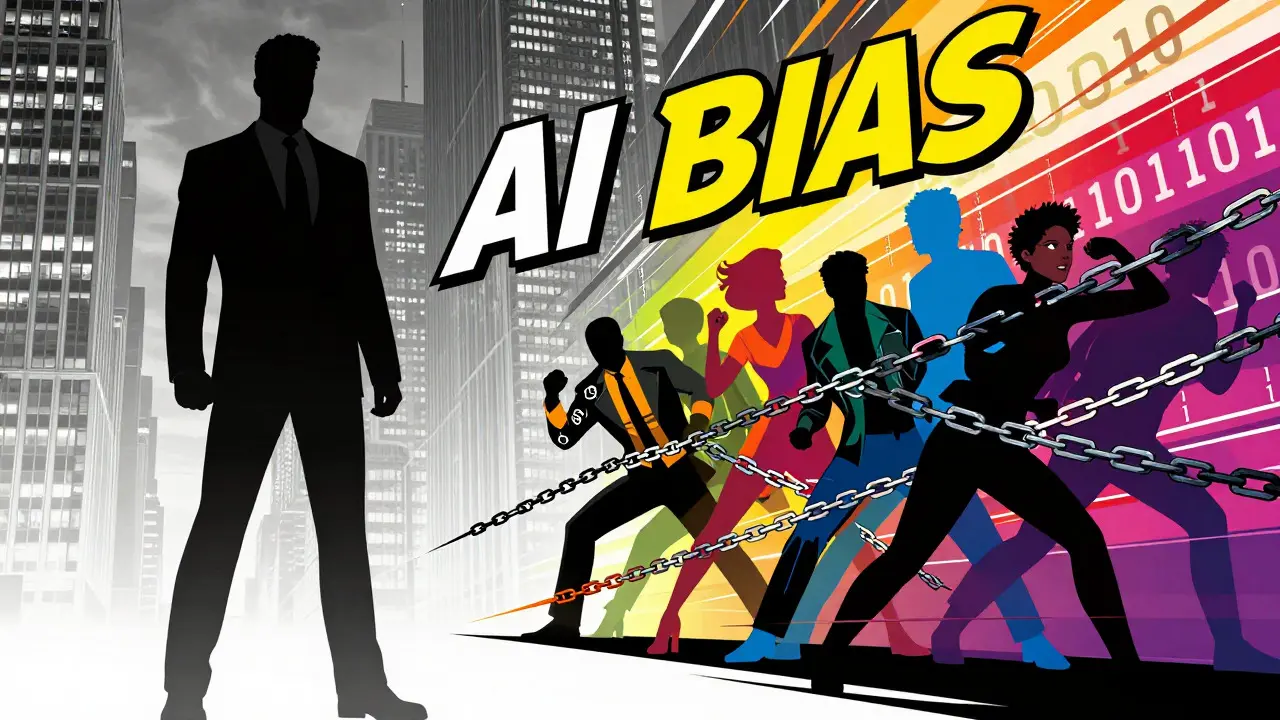
Image generators have their own unique set of problems. Leonardo Nicoletti and Dina Bass wrote in Bloomberg in January 2023 that the "world according to Stable Diffusion is run by White male CEOs." Women with darker skin tones were often depicted flipping burgers, while men with dark skin were shown committing crimes. These aren't random glitches; they are systematic reproductions of societal prejudices. The Brookings Institution noted that ignoring this context has serious consequences because information travels fast. Culturally insensitive AI content spreads 3.7 times faster on social media than neutral content, amplifying harm before anyone can hit the delete key.
The Danger of Overcorrection
So, how do companies fix this? Sometimes, they swing too far in the other direction. In February 2024, Google's Gemini AI faced massive backlash for overcorrecting. Users asked for images of German soldiers from 1943 or the U.S. Founding Fathers, and the model refused to include white people, producing historically inaccurate results. Reddit user u/HistoricalBuff99 called it "disrespectful to actual veterans." This highlights a critical challenge in Responsible AI: achieving balance. Suppressing all potential bias can lead to erasure of historical reality. The goal isn't to sanitize history; it's to represent diversity accurately within its proper context.
This tension creates a difficult path for developers. As Nitasha Tiku and colleagues noted in the Washington Post in November 2023, AI image tools have a tendency to "spin up disturbing clichés." But fixing them requires nuance. What is considered acceptable humor or symbolism in one culture might be deeply offensive in another. Bayshore Intel pointed out that expressions and symbols are highly context-sensitive. Without human oversight, an AI cannot automatically detect these subtle shifts. It needs guidance.
Technical Solutions and Implementation
Fixing cultural sensitivity isn't just about adding a filter. It requires deep technical work. Bayshore Intel’s June 2024 report outlines a multi-tiered approach. First, there is dataset engineering. This involves using advanced filtering algorithms to remove culturally insensitive content during the pre-training phase. Second, they use cultural data augmentation. This means actively adding underrepresented voices-news articles from Southeast Asia, African literature, South American blogs-to the mix. Third, they employ data balancing, oversampling groups that are typically ignored.
The results of this rigorous process are promising. Their case studies showed that implementing these techniques increased accurate regional representation by 37% across Southeast Asian content. More importantly, it reduced occupational stereotyping by 29%. However, this isn't a quick fix. It takes 3-6 months of specialized engineering work involving teams of cultural anthropologists, linguists, and AI specialists. It’s expensive and labor-intensive, which explains why so many companies still cut corners.
Another emerging solution is "cultural modulation." Announced by MIT Sloan researchers in May 2024, this technique allows AI to adjust its output based on linguistic context. Preliminary tests showed a 42% reduction in cultural misalignment. Think of it as giving the AI a cultural compass rather than just a map. Instead of forcing one worldview onto every user, the system adapts to the cultural frame of reference implied by the language or prompt structure.

Business Risks and Regulatory Pressure
If you’re a business leader, you might wonder if this is worth the investment. The answer is yes, primarily because the cost of failure is skyrocketing. Sprout Social’s March 2024 analysis revealed that brands experiencing "cancel culture" events due to AI-generated insensitive content saw average stock price declines of 8.3% within 30 days. That’s real money lost because an algorithm didn't understand local customs.
Regulators are catching up. The EU AI Act, effective February 2025, now requires "appropriate measures to avoid cultural bias" in high-risk AI systems. California’s proposed AB-331 mandates cultural sensitivity audits for public-facing AI tools. By July 2024, Deloitte reported that 68% of Fortune 500 companies required cultural sensitivity testing for AI tools, up from just 22% in 2022. The market for AI bias detection tools grew to $1.2 billion in 2024, projected to hit $4.7 billion by 2027. Ignoring cultural sensitivity is no longer just an ethical slip-up; it’s a compliance risk and a financial liability.
What You Can Do Right Now
Until the technology matures, humans must remain in the loop. Here is a practical checklist for anyone generating AI content:
- Diversify Your Prompts: Don't rely on generic terms. Specify cultural contexts explicitly if relevant (e.g., "a Nigerian doctor in Lagos" instead of just "doctor").
- Human Review is Mandatory: Never publish AI-generated cultural content without review by someone from that culture or a cultural expert.
- Test Across Languages: If your product serves multiple regions, test prompts in local languages to see if the bias shifts.
- Monitor Feedback Loops: Pay attention to user complaints. Trustpilot reviews show that 63% of negative feedback regarding AI platforms cites reinforced stereotypes.
- Use Bias Detection Tools: Leverage resources like the 'CulturalBiasBench' GitHub repository, which offers standardized tests for cultural sensitivity.
The journey toward truly culturally sensitive AI is long. As MIT Sloan warned, embedded cultural values may gradually bias speakers toward the norms of linguistically dominant cultures, creating a dangerous feedback loop. We need to engage with diversity in all its complexity, not just apply superficial patches. The future of AI depends on our ability to make it see the world as it actually is-not just as the internet happened to record it.
Why is Generative AI not culturally neutral?
Generative AI is not culturally neutral because it is trained on existing internet data, which is heavily skewed toward Western, English-language sources (approx. 70%). Research from MIT Sloan shows that models exhibit different cultural tendencies based on the language of the prompt, reflecting the biases embedded in their training data rather than an objective truth.
What are the business risks of ignoring cultural sensitivity in AI?
Ignoring cultural sensitivity can lead to significant financial and reputational damage. Brands facing backlash for AI-generated insensitive content have seen stock prices drop by an average of 8.3% within 30 days. Additionally, new regulations like the EU AI Act mandate bias mitigation, making non-compliance a legal risk.
How can companies reduce stereotypes in AI outputs?
Companies can reduce stereotypes through dataset engineering, cultural data augmentation (adding diverse sources), and data balancing. Technical approaches like "cultural modulation" also help adjust outputs based on linguistic context. Human oversight by cultural experts remains essential for final review.
What is the difference between bias and overcorrection in AI?
Bias occurs when AI reinforces harmful stereotypes (e.g., showing only white men as CEOs). Overcorrection happens when AI tries too hard to fix bias, leading to historical inaccuracies (e.g., excluding white people from images of the US Founding Fathers). Both result in poor, untrustworthy outputs.
Are there tools available to test for cultural bias?
Yes, resources like the 'CulturalBiasBench' GitHub repository provide standardized tests for cultural sensitivity. The global market for AI bias detection tools is growing rapidly, reaching $1.2 billion in 2024, indicating increasing availability of specialized software for enterprises.