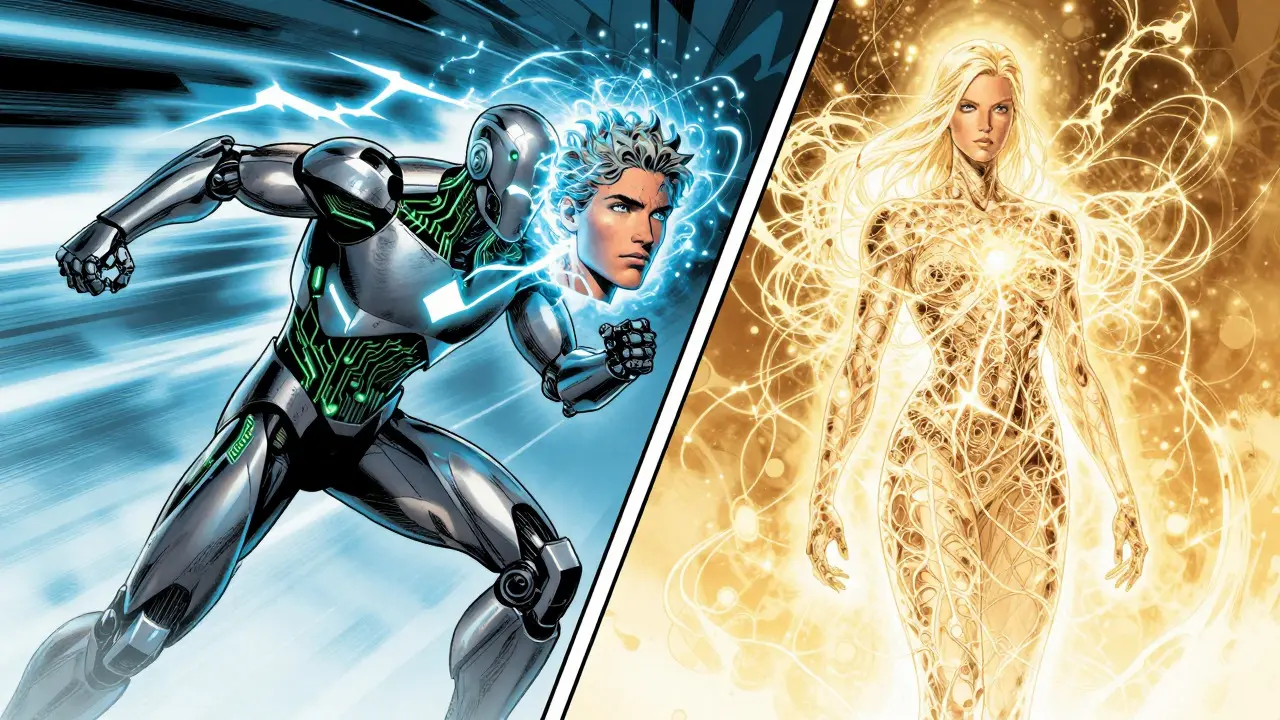
You’re staring at two screens. On the left, a Generative Adversarial Network (GAN) spits out a photorealistic face in milliseconds. On the right, a Diffusion Model takes nearly ten seconds to render a similar portrait, but the details-hair strands, skin texture, lighting-are uncannily perfect. Which one do you ship to production? The answer isn’t simple, and it depends entirely on whether you value raw speed or pristine quality.
As of August 2026, this debate has moved beyond academic papers into boardrooms and engineering stand-ups. GANs, introduced by Ian Goodfellow in 2014, dominated the first decade of deep learning image synthesis. But since Jonathan Ho’s 2020 breakthrough with Denoising Diffusion Probabilistic Models (DDPM), diffusion architectures have surged ahead in text-to-image tools like Midjourney and Stable Diffusion. Yet, GANs haven’t vanished. They still power real-time applications where latency is king. Let’s break down exactly where each architecture wins, loses, and why your hardware bill might look very different depending on which path you choose.
The Core Mechanics: Adversarial Games vs. Noise Removal
To understand the trade-offs, you have to grasp how these models actually create images. It’s not magic; it’s math, and the math dictates the cost.
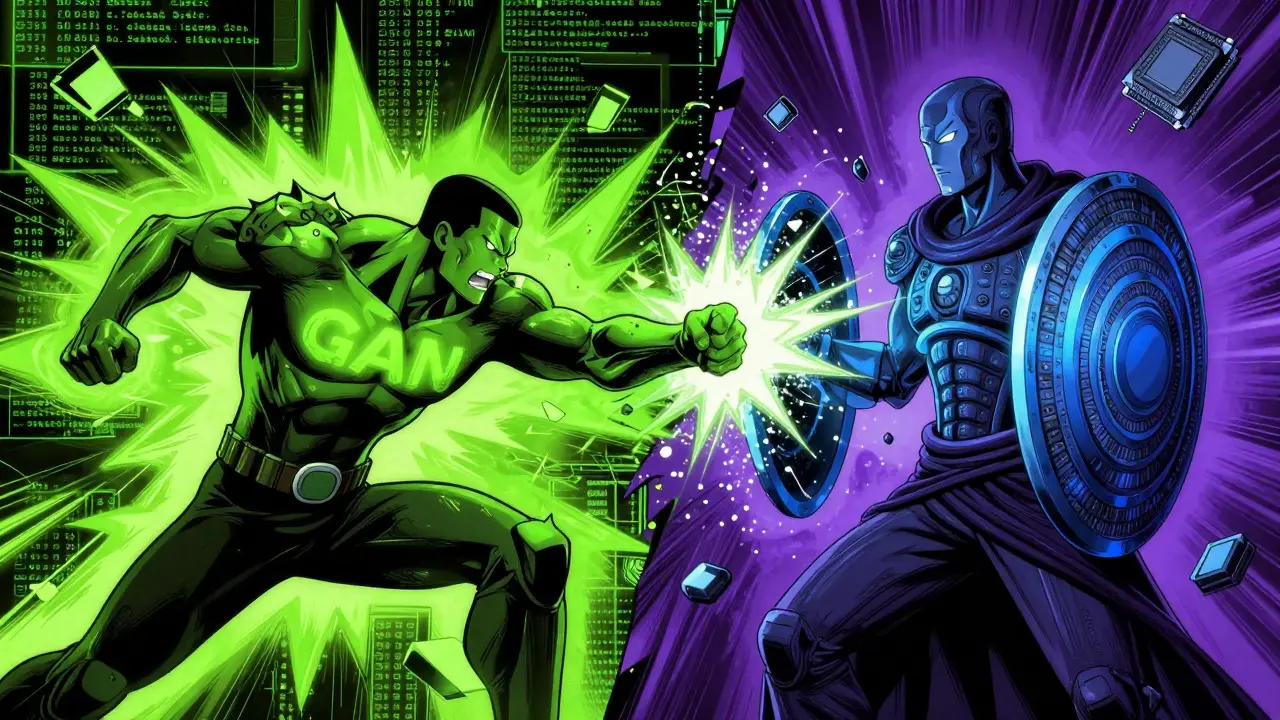
A GAN operates on a zero-sum game principle. It consists of two neural networks: a Generator and a Discriminator. The Generator creates fake images from random noise, trying to fool the Discriminator. The Discriminator, trained on real data, tries to spot the fakes. This adversarial training pushes both networks to improve until the Generator produces indistinguishable outputs. The beauty here is efficiency. Once trained, generating an image is a single forward pass through the Generator network. No loops, no iterations. Just input noise, output image.
Diffusion Models take a completely different approach rooted in thermodynamics. They learn to reverse a gradual noise-adding process. Imagine taking a clear photo and slowly adding Gaussian noise over 1,000 steps until it becomes pure static. The model learns to reverse this: starting with pure noise, it predicts what the previous step looked like, removing tiny amounts of noise iteratively until a clear image emerges. This iterative denoising is computationally heavy during inference because you have to run the network dozens or hundreds of times per image.
| Feature | GANs (e.g., StyleGAN3) | Diffusion Models (e.g., DDPM, SDXL) |
|---|---|---|
| Training Mechanism | Adversarial (Generator vs. Discriminator) | Denoising Score Matching / Variational Lower Bound |
| Inference Process | Single forward pass | Iterative denoising (20-100+ steps) |
| Mode Collapse Risk | High (can miss parts of data distribution) | Low (captures full distribution) |
| Hardware Requirement (Training) | 2-4 NVIDIA A100 GPUs | 8-16 NVIDIA A100 GPUs |
Speed: The Massive Gap That Still Matters
If you are building a live video filter or a real-time gaming asset generator, speed is non-negotiable. Here, GANs crush diffusion models. According to a 2024 benchmark by Aurora Solar, a standard GAN can generate 4,000 images in about 120 seconds. That’s roughly 0.03 seconds per image. Try that with a standard diffusion model. The same task took 48 hours. Yes, forty-eight hours. That’s a 1,440x difference in throughput.
Why such a huge gap? Because diffusion models require multiple passes. Even optimized versions like Latent Diffusion Models (used in Stable Diffusion) need 20 to 50 denoising steps to produce a high-quality result. Each step involves running the U-Net backbone. While techniques like Karras et al.’s EDM sampler have reduced this from 1,000 steps to around 20-30 for acceptable quality, you are still doing significantly more work than a GAN’s single pass.
However, the gap is closing. Google’s FastDPM release in early 2025 used knowledge distillation to cut diffusion inference time by 20x, bringing it closer to GAN territory without sacrificing much quality. If you’re deploying today, check if distilled variants meet your latency SLAs before dismissing diffusion entirely.
Quality and Diversity: Where Diffusion Shines
So, why did everyone switch to diffusion if it’s so slow? Because the quality ceiling is higher, and the failure modes are less catastrophic. GANs suffer from "mode collapse," a notorious issue where the generator finds one or two good-looking images and keeps reproducing them, ignoring the rest of the data distribution. Studies show GANs often cover only 68% of complex datasets like CIFAR-10, while diffusion models capture up to 92%.
This diversity matters for creative applications. If you ask a GAN to generate "a cat," you might get ten variations of a tabby cat, missing Siamese or Persian breeds entirely. A diffusion model will give you a wider variety because its probabilistic nature explores the latent space more thoroughly. In terms of metrics, diffusion models consistently win on Fréchet Inception Distance (FID), a standard measure of realism. State-of-the-art diffusion models hit FID scores of 1.70 on CIFAR-10, compared to 2.10 for StyleGAN2. Lower is better, meaning diffusion outputs are statistically closer to real human perception.
There is a nuance here, though. For specific tasks like super-resolution, the gap narrows. Research from May 2024 showed that when scaled appropriately, both architectures achieve nearly identical Peak Signal-to-Noise Ratio (PSNR) scores of 28.43 dB. So, don’t assume diffusion is always better; for narrow, well-defined tasks, a tuned GAN can be just as accurate.
Training Stability and Resource Costs
Ask any ML engineer who has tried to train a GAN from scratch. It’s painful. You spend weeks tuning hyperparameters, balancing learning rates between the generator and discriminator, and fighting instability. One wrong move, and your loss curves explode. Diffusion models are famously stable. Their training objective is straightforward regression: predict the noise added to an image. There’s no adversarial game to balance. As a result, diffusion models converge reliably, even with less expert tuning.
But stability comes at a price: compute. Training a high-resolution diffusion model typically requires 8-16 NVIDIA A100 GPUs with 80GB VRAM each. A comparable GAN setup might get away with 2-4 GPUs. For startups with limited cloud budgets, this hardware disparity is a major decision factor. However, maintenance costs tell a different story. Once deployed, GANs require 40% less ongoing maintenance because they are simpler to debug and monitor. Diffusion pipelines involve more moving parts-noise schedulers, guidance scales, and sampling algorithms-which can introduce subtle bugs that are hard to trace.
Controllability and Editing Capabilities
Can you edit the generated image after it’s created? With GANs, especially those using intermediate latent spaces like StyleGAN, you have precise control. You can manipulate attributes like age, gender, or hair color by moving points in the latent vector. This makes GANs superior for medical imaging or facial attribute manipulation where deterministic control is critical. Professor Aaron Courville noted in 2023 that GANs remain unmatched for applications requiring strict latent space controllability.
Diffusion models offer controllability through conditioning. You guide the generation process with text prompts or image masks. While powerful for creating new content from scratch, editing existing pixels is trickier. Techniques like inpainting exist, but they often regenerate large areas rather than tweaking specific features subtly. If your use case involves fine-grained, pixel-perfect edits based on semantic attributes, GANs still hold an edge.
Which Should You Choose?
Stop looking for a universal winner. It doesn’t exist. Use this decision tree:
- Choose GANs if: You need real-time generation (video games, live filters), have limited GPU budget, require precise attribute control, or are working on narrow domains with stable data distributions.
- Choose Diffusion Models if: You prioritize maximum visual fidelity, need high diversity in outputs, are doing text-to-image generation, or have the computational resources to handle slower inference.
The market reflects this split. Diffusion models dominate creative industries with 87% market share in digital art, while GANs retain 76% in real-time texture generation. By 2027, analysts predict diffusion will capture 75% of the broader generative AI market, but GANs will persist in latency-sensitive niches.
Frequently Asked Questions
Are diffusion models always better than GANs?
No. While diffusion models generally produce higher-quality and more diverse images, they are significantly slower and more resource-intensive to train and run. GANs are superior for real-time applications and scenarios requiring precise control over latent variables.
How much faster are GANs compared to diffusion models?
GANs can be up to 1,440x faster in batch generation benchmarks. A single GAN forward pass takes ~0.03 seconds, whereas diffusion models require 20-100 iterative steps, often taking several seconds per image depending on resolution and step count.
What is mode collapse in GANs?
Mode collapse occurs when a GAN generator produces a limited variety of outputs, failing to capture the full range of the training data. For example, it might only generate smiling faces and ignore neutral expressions. Diffusion models rarely suffer from this due to their probabilistic training method.
Do I need specialized hardware for diffusion models?
For training, yes. High-resolution diffusion models typically require multiple high-end GPUs (like NVIDIA A100s). For inference, consumer-grade GPUs (like RTX 4090) can handle optimized models like Stable Diffusion XL, though speeds will be slower than on enterprise hardware.
Can hybrid models combine the benefits of both?
Yes. Recent research shows 42% of top-tier AI papers explore hybrid architectures. These approaches often use diffusion for initial structure generation and GAN-like discriminators for refinement, aiming to balance speed and quality.

Kim Edwards
August 29, 2026 AT 12:50OH MY GOD the latency difference is absolutely SHATTERING my soul right now. I was literally hyperventilating reading about that 1,440x speed gap. It’s like watching a cheetah sprint past a sloth who thinks he’s doing his best. I just want to scream into the void because why do we even bother with diffusion if it takes FOREVER? The drama of waiting ten seconds for a face when GANs spit them out in milliseconds is too much for my heart to handle.
Dave Gibbeson
August 31, 2026 AT 05:39You’re missing the bigger picture here, Kim. Speed isn't everything if the output looks like garbage or suffers from mode collapse. Diffusion models give you stability and diversity that GANs simply cannot match without hours of painful hyperparameter tuning. If you're building a production system, reliability beats raw speed every single time. Don't let the flashy benchmarks fool you; robustness is what keeps your servers up at 3 AM. Focus on the quality ceiling, not just the inference loop count.
Courtney Wagstaff
September 1, 2026 AT 10:08honestly i love how this post breaks it down so chillly
it feels like choosing between a sports car and a tank both are cool but serve different vibes for me personally i’m all about that diffusion aesthetic because the details make my heart sing like little digital violins playing a symphony of pixels
GANs are fast but sometimes they feel a bit rushed like they didn’t have their morning coffee yet whereas diffusion models take their sweet time and deliver a masterpiece that smells like fresh rain and expensive perfume
i guess it depends on whether you need speed or soul right?
Joanna Mucha
September 2, 2026 AT 15:06The discourse surrounding these architectures often fails to acknowledge the ontological weight of the latent space itself. While the masses clamor for speed, they ignore the existential crisis inherent in adversarial training. GANs operate on a zero-sum game, a metaphor for modern capitalism where one entity must lose for another to win. Diffusion, conversely, embraces entropy and order, mirroring the natural decay and reconstruction of reality. To choose based solely on milliseconds is to reduce art to mere utility, ignoring the philosophical implications of noise as a creative medium. We are not just generating images; we are negotiating with chaos. Most engineers lack the intellectual depth to appreciate this nuance, preferring the brute force of computation over the elegance of thermodynamic principles. It is truly tragic that boardrooms prioritize efficiency over epistemological rigor.
Meagan Mueller
September 2, 2026 AT 22:19theyre hiding the real cost of gpu power from us
why do you think big tech pushes diffusion so hard its because they need to sell more hardware not because its actually better for everyone else
GANs were fine until they decided we needed to burn more electricity per image
wake up
Elisabeth Ballet
September 4, 2026 AT 00:35Listen up team! This is exactly the kind of clarity we need to stop the endless debate and start shipping product. You have two paths: go fast with GANs or go high-fidelity with Diffusion. Pick one and own it. Stop trying to have it both ways if you don't have the budget for hybrid solutions. Empower your engineering decisions by aligning them with your business goals, not just academic metrics. Let's move forward with confidence and stop wasting energy on indecision!
Bonnie Watt
September 5, 2026 AT 00:19Everyone is acting like these are totally separate worlds when clearly half of you don't understand basic probability. Joanna is right that people are shallow, but she's also annoyingly pretentious about it. Meagan has a point about the hardware costs though nobody wants to admit that running A100s is basically throwing money into a furnace. Dave is just being aggressive to hide the fact that he probably still uses StyleGAN2 for his side projects because he's afraid of change. It's all performative expertise anyway.