
You’ve probably seen the charts. They show Large Language Models are getting smarter every day. But have you ever stopped to ask how we actually know that? For the last few years, the answer has been a single number derived from a test called MMLU is Massive Multitask Language Understanding.. It’s the scorecard everyone uses to compare GPT-4, Claude, and Gemini. But here’s the uncomfortable truth: as these models get better, MMLU is becoming less useful. In fact, it might be lying to you about how capable an AI really is.
MMLU was designed to measure broad knowledge across 57 subjects, from elementary math to professional law. It worked wonders in 2020 when top models scored around 44%. Today, those same models score over 88%, nearing human expert levels. That sounds like success, right? Not necessarily. When a test becomes too easy, it stops measuring intelligence and starts measuring memorization. This article breaks down exactly what MMLU captures, where it falls short, and why the industry is already moving on to harder tests like MMLU-Pro is a more robust and challenging multi-task language understanding benchmark..
The Origin Story: Why MMLU Became the Gold Standard
To understand why MMLU matters, you need to look back at September 2020. Before this benchmark, evaluating AI was messy. Tests focused on narrow tasks like translating sentences or guessing the next word in a paragraph. They didn’t tell you if an AI could actually solve a physics problem or understand a legal contract.
Dan Hendrycks is a researcher who created the MMLU benchmark at UC Berkeley. and his team changed that. They built a massive dataset of 15,908 multiple-choice questions. These weren’t made-up questions. They were pulled from real standardized tests, college exams, and professional licensing materials. The goal was simple: create a static, comprehensive test that covered everything a human learns in 12 to 20 years of education.
The structure is straightforward. There are 57 distinct subjects divided into five difficulty tiers:
- Elementary: Basic arithmetic and science.
- Middle School: Geography, biology, and introductory math.
- High School: Calculus, advanced chemistry, literature, and history.
- College: Undergraduate-level specialized knowledge.
- Professional: Expert domains like medical diagnosis and legal reasoning.
When GPT-3 175B is the first major model evaluated on MMLU, scoring 43.9%. took the test, it scored 43.9%. Human experts score around 89.8%. That gap seemed insurmountable at the time. It gave researchers a clear target. Over the next four years, watching that score climb became the primary way the industry tracked progress. By 2024, Claude 3 Opus is an AI model that achieved 86.8% on MMLU. hit 86.8%, and GPT-4 is an AI model that achieved 86.4% on MMLU. followed closely with 86.4%. The benchmark had done its job: it showed us that AI was rapidly approaching human-level general knowledge.
What MMLU Actually Measures
If you’re using MMLU to evaluate a model, you need to know exactly what you’re buying. MMLU is excellent at measuring three specific things:
- Breadth of Knowledge: Does the model know facts across diverse fields? Can it switch from discussing quantum mechanics to analyzing Shakespeare without losing context?
- Exam-Style Problem Solving: Can the model pick the best answer from four options? This is crucial for enterprise use cases where AI assists professionals by summarizing documents or answering quick queries.
- Cross-Domain Generalization: Unlike older benchmarks that tested one skill at a time, MMLU tests multitasking. It proves a single model can handle many different types of intellectual work.
This makes MMLU incredibly valuable for initial screening. If a model scores below 70% on MMLU, you know it lacks the foundational knowledge needed for most professional tasks. It’s a reliable filter for basic competence.
However, MMLU relies on a few-shot prompting is a technique where examples are provided to the model before asking the question. approach. Typically, evaluators give the model five example questions and answers from a specific subject before asking the test question. This helps the model understand the format. While effective, this method measures how well the model follows patterns rather than how deeply it understands concepts.
The Cracks in the Foundation: What MMLU Misses
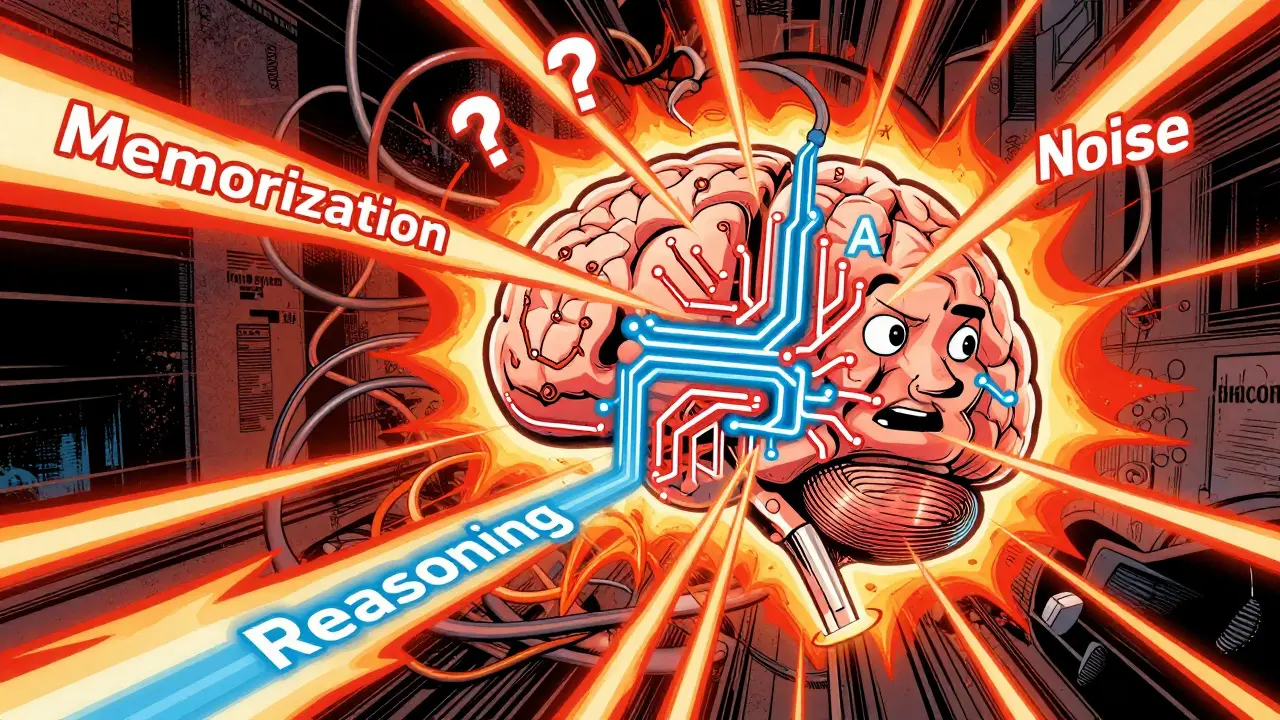
Here is where the story gets complicated. As models approached human scores, researchers started noticing problems. MMLU isn’t just measuring intelligence anymore; it’s measuring how well a model has memorized the internet. And since MMLU questions are public, the line between knowing something and having seen it before has blurred.
Data Contamination Because MMLU has been downloaded over 100 million times since its release, it’s likely present in the training data of almost every modern LLM. When a model sees a question during training, it doesn’t need to reason through it. It just needs to recall the answer. This means a high MMLU score no longer guarantees robust reasoning. It might just mean the model has a good memory for exam questions.
Question Errors In 2024, researchers released MMLU-Redux is a cleaned version of MMLU that removes erroneous questions.. They found that roughly 6.5% of the original MMLU questions contained errors. Some had ambiguous wording, others had mislabeled correct answers, and some options were logically flawed. This means the theoretical maximum score for a perfect model isn’t 100%. It’s closer to 93.5%. When modern models cluster around 88-90%, you can’t tell if they’re failing because they’re dumb or because the test question is broken.
Lack of Reasoning Depth MMLU is a multiple-choice test. It asks for the final answer, not the path to get there. A model can guess correctly without understanding why. It can also hallucinate a plausible-sounding explanation that leads to the wrong answer. MMLU doesn’t capture Chain-of-Thought is a reasoning process where the model explains its steps before answering. quality. It misses intermediate logic, calibration (knowing when it’s unsure), and safety alignment.

The Rise of MMLU-Pro and New Standards
The AI community didn’t sit idle while MMLU saturated. Recognizing the limitations, researchers at the University of Waterloo and other institutions developed successors. The most prominent is MMLU-Pro is a harder benchmark focusing on proficient-level reasoning tasks..
MMLU-Pro strips away the easier questions and focuses on 14 difficult domains like mathematics, physics, and law. It uses 5-shot Chain-of-Thought prompting, forcing the model to show its work. The results are starkly different. On original MMLU, GPT-4o is an AI model that scores ~88% on MMLU but only 72.6% on MMLU-Pro. scores around 88%. On MMLU-Pro, that same model drops to 72.6%. This 15-point gap reveals the truth: models are great at recalling facts, but still struggle with complex, multi-step reasoning.
By early 2026, top models like Google Gemini 3 Pro is an AI model achieving ~90.1% on MMLU-Pro. and Anthropic Claude Opus 4.5 is an AI model achieving ~89.5% on MMLU-Pro. are pushing MMLU-Pro scores toward 90%. But even these numbers show that reasoning remains the hard barrier. MMLU-Pro is now the better indicator of true capability for frontier models.
| Model | MMLU Score (General Knowledge) | MMLU-Pro Score (Reasoning) | Gap |
|---|---|---|---|
| GPT-3 175B (2020) | 43.9% | N/A | - |
| GPT-4 (2023) | 86.4% | ~70% | ~16% |
| Claude 3 Opus (2024) | 86.8% | ~75% | ~12% |
| Gemini 3 Pro (2026) | >90% | 90.1% | <1% |
How to Interpret Scores in 2026
If you’re building an AI application or choosing a provider today, don’t just look at the headline MMLU number. Here is a practical checklist for evaluating LLM capabilities:
- Check the Date: MMLU scores from 2020-2022 are historical artifacts. They don’t reflect current capabilities. Look for evaluations from 2024-2026.
- Look for MMLU-Pro: If a vendor only publishes MMLU scores, be skeptical. Ask for MMLU-Pro or BIG-bench results. These tests are harder to cheat via memorization.
- Analyze Subject Breakdowns: A high average can hide weak spots. Check performance on Professional Law or Medicine specifically if your use case requires it. Early studies showed models performed near-randomly on moral and legal scenarios despite high averages.
- Consider Contamination: Assume any model trained after 2021 has seen MMLU questions. Treat small differences (e.g., 88% vs 89%) as statistically insignificant unless validated on unseen data.
- Test Real Tasks: Benchmarks are proxies. Always run your own internal tests with your specific data and workflows. No benchmark perfectly predicts real-world utility.
The shift from MMLU to MMLU-Pro mirrors the broader evolution of AI. We moved from teaching machines to read to teaching them to think. MMLU proved they could read. Now we need to prove they can think.
What is the MMLU benchmark used for?
MMLU is used to evaluate the general knowledge and academic proficiency of Large Language Models. It tests performance across 57 subjects ranging from elementary school to professional level, providing a standardized metric to compare different AI systems.
Why is MMLU considered flawed in 2026?
MMLU is considered flawed because of data contamination (models memorizing answers from training data) and a 6.5% error rate in the questions themselves. Additionally, it fails to measure complex reasoning processes, focusing only on final answer accuracy.
What is the difference between MMLU and MMLU-Pro?
MMLU-Pro is a harder, more rigorous version of the original benchmark. It focuses on proficient-level reasoning tasks, uses Chain-of-Thought prompting, and filters out easy questions. Models typically score 15-30 percentage points lower on MMLU-Pro than on original MMLU.
Is a higher MMLU score always better?
Not necessarily. A high MMLU score indicates strong factual recall and pattern matching, but it doesn't guarantee safety, ethical reasoning, or the ability to solve novel problems. You should also check performance on reasoning-specific benchmarks like MMLU-Pro.
Who created the MMLU benchmark?
MMLU was created by Dan Hendrycks and his research team at the University of California, Berkeley. It was released in September 2020 to provide a comprehensive evaluation standard for language models.