Imagine you receive a photo from your cousin showing them on vacation. It looks real. But what if it wasn’t? With today’s generative AI, that photo could be entirely fabricated. Now imagine trying to prove who created it, when, and whether the data behind it was tampered with. This is where the story gets interesting.
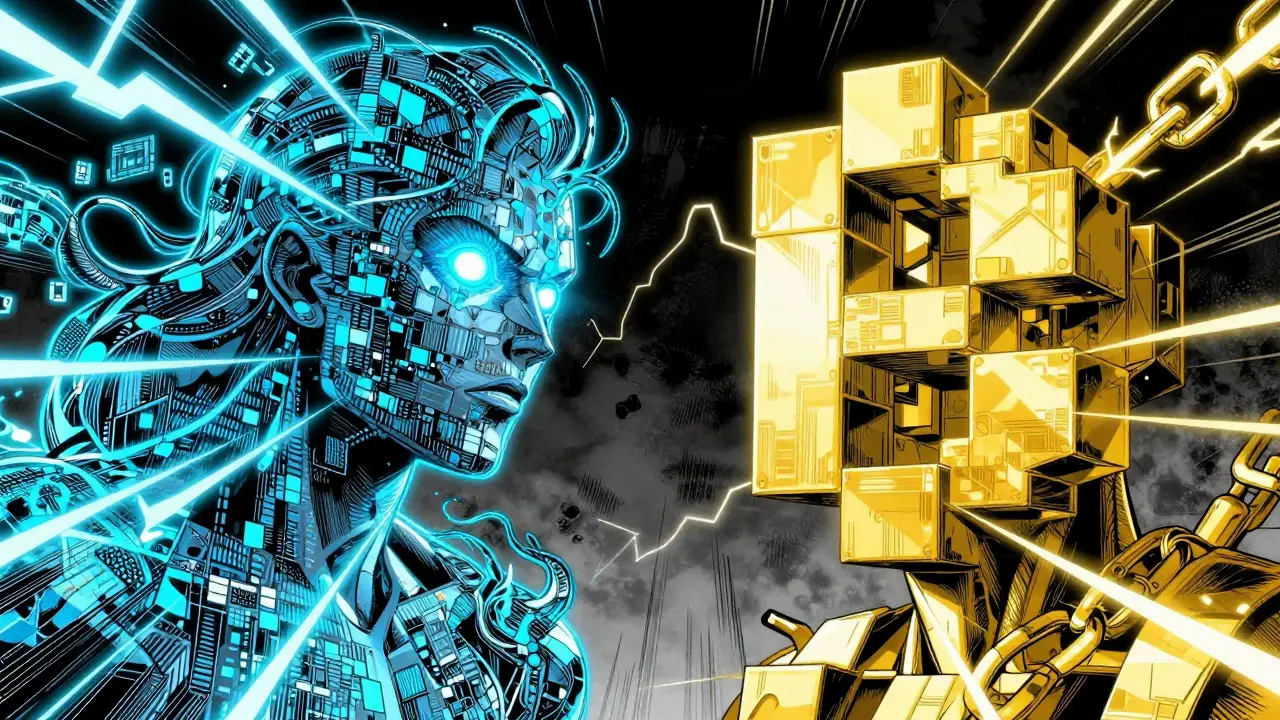
We are witnessing a collision of two massive forces: Generative AI, which creates content at lightning speed, and Blockchain, which provides an unchangeable record of truth. When you add Cryptography into the mix-the math that keeps secrets secret-you get a powerful new framework for security and privacy. This isn't just tech jargon; it’s the foundation for trusting digital information in 2026 and beyond.
Why We Need This Convergence
Let’s look at the problem first. Generative AI models are incredibly smart but often act like black boxes. You put data in, you get an answer out, but you rarely know exactly how the model arrived at that decision. In high-stakes fields like healthcare or finance, this lack of transparency is risky. If an AI denies a loan or misdiagnoses a patient, who is accountable?
On the other side, blockchain has its own headaches. While it’s great at recording transactions, it can be slow and expensive to scale. Plus, putting everything on a public ledger raises privacy concerns. If medical records are stored on a blockchain, how do we keep them private while still verifying their authenticity?
The convergence solves both problems. According to research published in early 2024 by arXiv (paper ID: 2401.15625), integrating generative AI with blockchain addresses four critical gaps: scalability, security, privacy, and interoperability. Essentially, blockchain provides the immutable audit trail that AI lacks, while AI optimizes the heavy computational loads that blockchain struggles with.
How It Works: The Technical Backbone
You don’t need to be a mathematician to understand the core concepts, but knowing the tools helps. This integration relies on three main pillars:
- Immutable Logging: Every time an AI makes a significant decision or generates content, a cryptographic hash (a unique digital fingerprint) is recorded on a blockchain. Because blockchains cannot be altered retroactively, this creates a permanent proof of origin.
- Homomorphic Encryption: This allows computations to be performed on encrypted data without decrypting it first. Imagine analyzing sensitive patient data to train an AI model without ever seeing the actual names or IDs. The data stays locked, but the insights come out.
- Federated Learning: Instead of sending all your private data to a central server, the AI model travels to the data. Your device trains locally, and only the learned updates are shared. This keeps raw data private while improving the global model.
A practical example is Prove AI, launched on AWS infrastructure in late 2024. It uses a hybrid blockchain architecture to log AI training datasets, model metadata, and prompt sessions. By using AWS Key Management Service (KMS), they generate key pairs to sign these transactions securely. This means you can verify that a specific AI output came from a verified, untampered model version.
Security Gains: Faster and Stronger
Does adding AI actually make blockchain more secure? The numbers suggest yes. IBM reported in 2024 that AI-enhanced blockchain networks can process transactions up to 37% faster while maintaining strict cryptographic standards. How? AI algorithms predict congestion and optimize transaction routing before bottlenecks occur.
Consider smart contracts-self-executing code on the blockchain. Traditionally, developers manually review these for bugs, which is slow and error-prone. Michael Johnson, Chief Blockchain Strategist at AWS, noted in December 2024 that AI agents can now analyze smart contracts for vulnerabilities like reentrancy attacks in real-time. This approach improved vulnerability detection speed by 65% compared to manual reviews.
However, there is a catch. Integrating complex systems creates new attack surfaces. Elena Rodriguez, a security researcher speaking at DEF CON 32 in August 2024, warned that improper implementation can lead to side-channel vulnerabilities. In February 2024, a flawed Generative Adversarial Network (GAN) used in a blockchain key management system exposed 12,000 wallets. The lesson? The technology is powerful, but execution must be precise.

Privacy Preservation in the Age of Data
Privacy is no longer about hiding; it’s about controlling access. One of the most promising applications here is Zero-Knowledge Proofs (ZKPs). ZKPs allow one party to prove to another that a statement is true without revealing any information beyond the validity of the statement itself.
In the context of AI and blockchain, this is revolutionary. For instance, a company might want to prove their AI model meets regulatory fairness standards without exposing their proprietary training data. Using ZKPs, they can generate a mathematical proof of compliance. The verifier checks the proof against the blockchain record, confirming integrity without ever accessing the sensitive dataset.
This also applies to intellectual property. As AWS highlighted in their 2024 case study, datasets with copyright information can be tracked and traced back to their source. If an artist’s work is stolen and used to train a bot, the cryptographic signature on the blockchain serves as undeniable evidence of infringement. This shifts the burden of proof from the victim to the infringer.
| Feature | Traditional AI | Traditional Blockchain | Converged AI-Blockchain |
|---|---|---|---|
| Auditability | Low (Black Box) | High (Public Ledger) | Very High (Verified Decisions) |
| Scalability | High | Low/Medium | Improved (+40% via AI optimization) |
| Privacy | Variable | Pseudonymous | Enhanced (via Homomorphic Encryption/ZKP) |
| Computational Cost | High | Medium | Higher (+15-20% overhead) |
Real-World Successes and Failures
It’s easy to talk theory, but let’s look at what happened when companies tried this in the wild.
On the success side, MedChain AI launched in Q3 2024. They implemented blockchain-verified AI diagnostics for hospitals. By anchoring diagnostic reports to a blockchain, they ensured that once a doctor reviewed an AI suggestion, the interaction was permanently recorded. Their November 2024 whitepaper claimed an 89% reduction in medical record fraud. Why? Because altering a past diagnosis would require rewriting the entire chain, which is computationally impossible in practice.
Then there’s the cautionary tale of VeriTrust, a FinTech startup. In January 2024, they launched a generative AI model for transaction verification. They thought their cryptographic checks were solid. However, hackers used a sophisticated adversarial attack-feeding the AI subtly manipulated data-to bypass the security layers. The result? A $2.3 million loss. Their post-mortem report revealed that their model hadn’t been trained to recognize these specific edge cases. This highlights a crucial point: AI models drift over time. Without continuous monitoring on the blockchain, security degrades.

Implementation Challenges and Solutions
If you’re thinking about building this, brace yourself. The learning curve is steep. AWS estimates it takes 120-150 hours of specialized training to properly integrate these systems. The biggest hurdles aren’t theoretical; they are practical.
- Key Management: Cited by 78% of developers in a Stack Overflow survey (Nov 2024) as the hardest part. If you lose your private keys, your data is gone forever. Solutions involve using GANs for secret key sharing schemes, which can reduce recovery time from days to hours, as seen in GitHub repositories like 'Blockchain-AI-Integration'.
- Model Drift: Reported by 63% of enterprise implementations. AI models change behavior as data changes. You need automated triggers on the blockchain to alert you when performance drops below a threshold.
- Latency: Running heavy crypto operations alongside AI inference adds load. Tribe AI found that in low-bandwidth supply chain environments, this caused unacceptable delays. The fix? Use permissioned blockchain layers for sensitive processing and only anchor hashes to public chains periodically.
A helpful heuristic from Tribe AI’s 2025 framework is simple: "Develop accurate models, knowing blockchain tracks lineage." Don’t treat the blockchain as an afterthought. Design your AI data flow with immutability in mind from day one.
Regulatory Pressure and Market Growth
Technology doesn’t exist in a vacuum. Regulations are pushing this adoption forward. The EU’s AI Act, effective February 2025, mandates verifiable provenance for AI-generated content in commercial applications. If you sell AI art or use AI for hiring, you must prove where the data came from. Blockchain is currently the only scalable way to meet this requirement.
The market is responding. Gartner valued the global AI-blockchain integration market at $1.7 billion in Q3 2024, projecting growth to $8.9 billion by 2027. Fortune 500 companies are taking notice, with 43% piloting such projects by late 2024. Finance leads the pack (38% of implementations), followed by healthcare (22%) and supply chain (19%).
Looking ahead, the W3C’s Verifiable AI Working Group plans to release a standard for blockchain-based AI content authentication in mid-2025. Meanwhile, the Ethereum Foundation allocated $4.2 million in late 2024 to fund research into AI-enhanced consensus mechanisms. This isn’t a passing trend; it’s becoming the infrastructure layer for trustworthy computing.
What Comes Next?
We are moving toward "permissionless verification." Equilibrium’s 2024 whitepaper describes a future where signatures and hashes are stored on decentralized blockchains, allowing anyone to verify the integrity of an AI output without trusting a central authority. This democratizes trust.
For businesses, the advice is clear: start small. Audit your current AI processes. Identify where transparency is lacking. Then, explore lightweight integrations, such as hashing model outputs to a testnet. Don’t try to boil the ocean. Focus on high-value, high-risk areas like IP protection or financial auditing first.
The convergence of generative AI, blockchain, and cryptography is not just about cooler tech. It’s about restoring faith in digital information. In a world flooded with deepfakes and opaque algorithms, the ability to say "this is true, and here is the proof" will be the most valuable asset you have.
What is the main benefit of combining Generative AI with Blockchain?
The primary benefit is enhanced trust and accountability. Blockchain provides an immutable audit trail for AI decisions, solving the "black box" problem of generative AI, while AI improves blockchain's scalability and security through optimized processing and threat detection.
How does cryptography protect privacy in AI-Blockchain systems?
Techniques like Homomorphic Encryption allow data to be processed while remaining encrypted, and Zero-Knowledge Proofs (ZKPs) enable verification of data integrity without exposing the underlying sensitive information. This ensures privacy is maintained even during analysis.
Is this technology ready for enterprise use in 2026?
Yes, but with caveats. Major players like AWS and IBM offer mature solutions, and regulations like the EU AI Act drive adoption. However, implementation requires specialized expertise due to challenges in key management and model drift. It is best suited for high-stakes sectors like finance and healthcare initially.
What are the risks of integrating AI and Blockchain?
Risks include increased computational overhead (15-20%), potential side-channel vulnerabilities if cryptographic implementations are flawed, and adversarial attacks that can trick AI models into bypassing security checks. Proper testing and continuous monitoring are essential.
How does this help with Intellectual Property (IP) protection?
By cryptographically signing and timestamping creative works on a blockchain, creators can prove ownership and origin. If AI-generated content infringes on this IP, the blockchain record serves as undeniable legal evidence of prior existence and authorship.