
Imagine an AI that doesn't just read your email but also sees the messy whiteboard behind you, hears the frustration in your voice, and then physically moves a file to the correct folder. That isn't science fiction anymore; it is the reality of Multimodal Agents. These systems are changing how we interact with technology by processing text, images, audio, and video simultaneously. Unlike older AI tools that only handled one type of data at a time, these agents build a complete picture of their environment to make smarter decisions.
What Makes an Agent "Multimodal"?
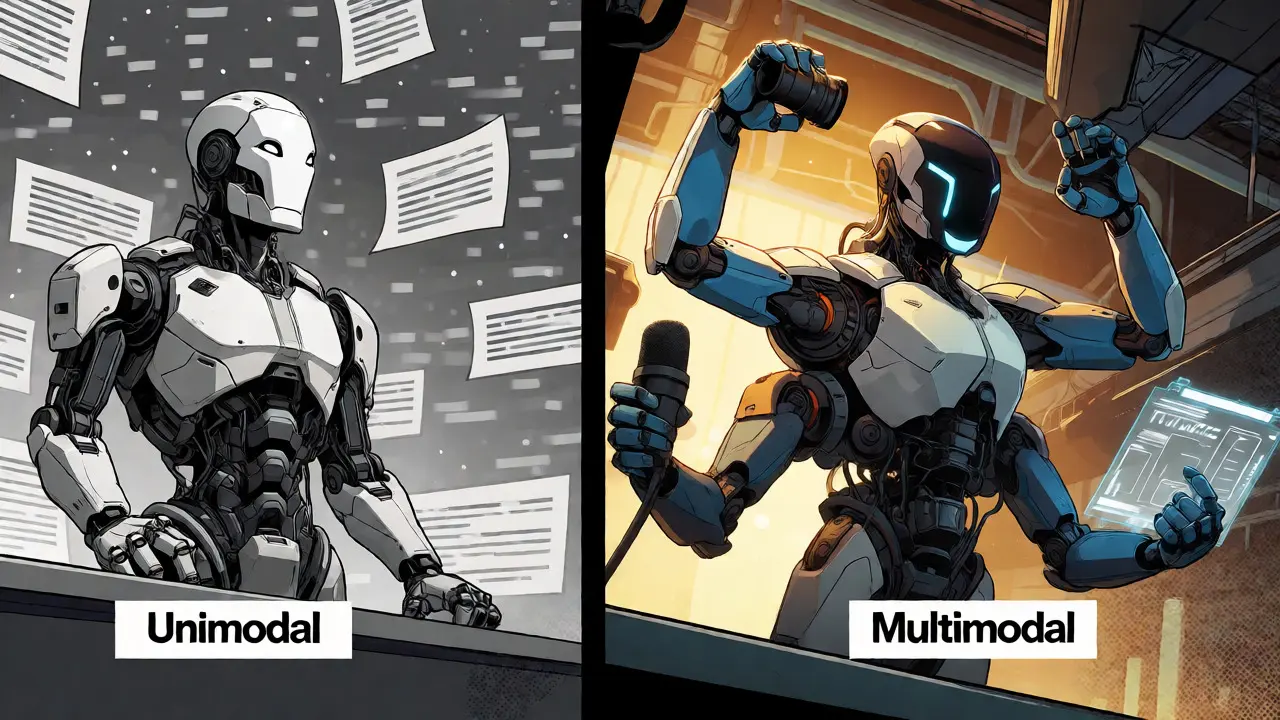
A standard chatbot like early versions of ChatGPT was unimodal. You typed text, it gave back text. If you wanted it to analyze a photo, you needed a separate tool for vision and another for language. Multimodal agents merge these capabilities into a single brain. They use integrated systems to process diverse inputs like visual data from cameras, sound from microphones, and even sensor readings from robotics arms.
The core difference lies in context. A unimodal model might read a caption saying "cat on mat." A multimodal agent looks at the image, notices the cat is actually sleeping on a laptop keyboard, and understands why the user can't work right now. This ability to synthesize information across different senses allows the AI to perform complex tasks that require real-world understanding. For example, Google’s Palm-e, an early embodied model released in May 2023, demonstrated this by using RGB cameras and tactile sensors to manipulate objects with 92.1% accuracy. It wasn't just following instructions; it was seeing, feeling, and acting based on what it perceived.
The Architecture Behind Seeing and Hearing
To understand how these agents work, you need to look at their four main components. Think of them as the body parts of a digital organism.
- Perception Modules: These are the eyes and ears. They use specialized neural networks to interpret raw data-turning pixels into object recognition or audio waves into speech transcripts.
- Planning Systems: This is the brain's strategy center. It breaks down big goals into smaller steps. If the goal is "clean the kitchen," the planner decides whether to start with dishes or counters.
- Action Components: These are the hands. They execute the plan by using tools, moving robots, or sending commands to other software.
- Memory Systems: This stores past interactions. The agent remembers that you prefer coffee at 9 AM, not 10 AM, so it adjusts its behavior over time.
Technically, these systems fuse data in three ways. Early fusion combines all data types before processing them together. Mid fusion processes some data separately before combining them. Late fusion handles each modality independently and merges the results at the end. Most modern agents, like OpenAI’s GPT-4o (released May 13, 2024), use transformer architectures with cross-attention mechanisms. This lets the model weigh the importance of a visual cue against a spoken word dynamically.
Why Multimodal Beats Unimodal in the Real World
You might ask, "Why bother with the extra complexity?" The answer is accuracy in messy situations. In controlled environments, simple text-based AI works fine. But real life is noisy and chaotic. According to benchmarks from Google Cloud in 2024, multimodal agents achieved 37.2% higher accuracy in complex tasks compared to single-modality systems when dealing with combined text and images.
Consider customer service. A voice-only bot might miss sarcasm. A text-only bot misses facial expressions. A multimodal agent analyzes tone, facial cues, and spoken words simultaneously. Kellton Tech’s analysis in March 2025 found that such agents outperformed unimodal systems by 42.7% in interpreting customer sentiment. This leads to faster resolutions and happier users.
| Feature | Unimodal AI | Multimodal AI |
|---|---|---|
| Input Types | Text only | Text, Image, Audio, Video, Sensors |
| Context Awareness | Low (limited to text) | High (holistic view) |
| Computational Cost | Low | High (approx. 3.2x higher) |
| Response Latency | Fast (~190ms) | Slower (~850ms average) |
| Best Use Case | Translation, Summarization | Robotics, Healthcare, Customer Service |
However, there are trade-offs. Multimodal agents are heavier. They require more computing power and have longer response times. NVIDIA’s 2025 benchmarks show that real-time processing often needs at least 32GB of VRAM. While edge devices like Meta’s Llama-3-Multimodal can run on 8GB, they sacrifice some capability. If you need instant replies for simple queries, stick to unimodal. If you need deep understanding, go multimodal.
Real-World Applications That Actually Work
Where are these agents making money today? Healthcare and manufacturing lead the pack. In healthcare, doctors deal with X-rays, patient notes, and verbal descriptions. A multimodal agent can ingest all three to suggest a diagnosis. Mayo Clinic’s 2024 pilot showed a 28.4% improvement in diagnostic speed. The AI didn't replace the doctor; it helped them connect dots between visual scans and written history faster.
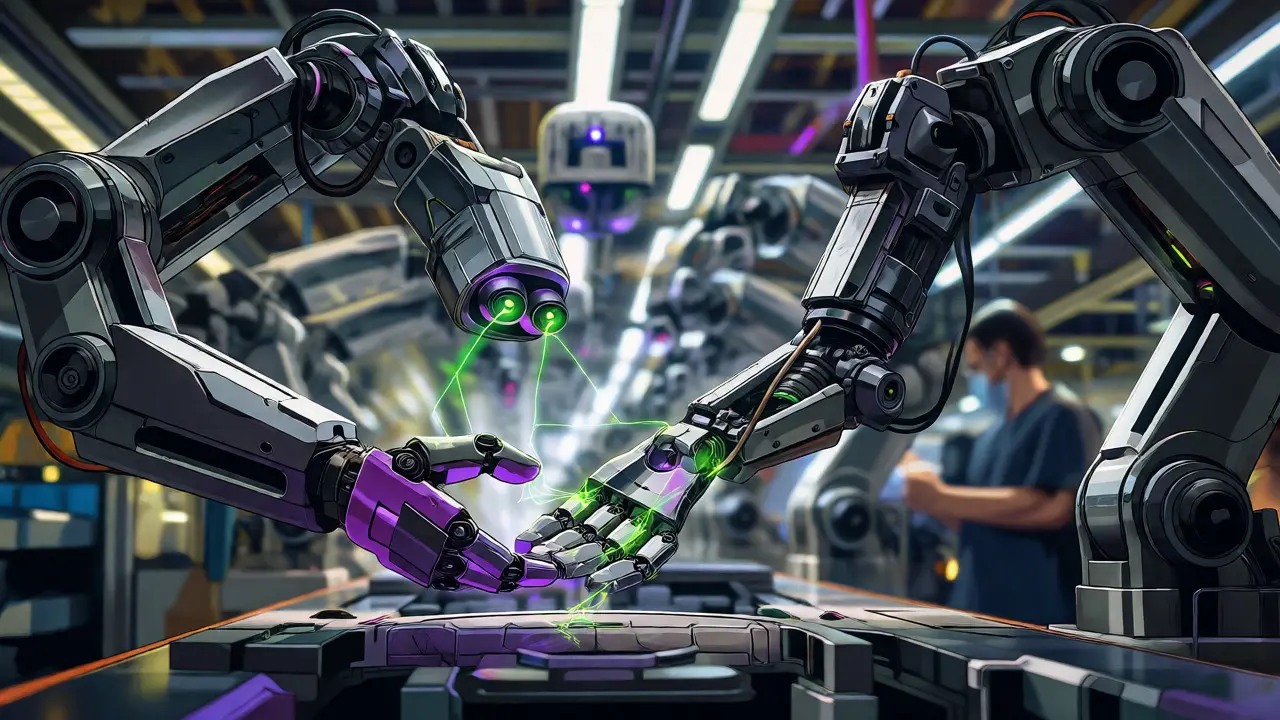
In manufacturing, BMW implemented robotic multimodal agents in Munich assembly lines in February 2025. These robots used cameras and force sensors to inspect car parts. The result? A 52.3% reduction in quality inspection errors. The robots could "see" a defect and "feel" if a part was loose, actions impossible for pure software.
But it’s not always smooth sailing. A major US retailer spent $2.4 million on a multimodal customer service project and abandoned it in late 2024. Why? The store environment was too noisy. Background chatter confused the audio input, leading to a 68.7% failure rate. This highlights a critical lesson: multimodal agents struggle when modalities conflict. If the camera says "empty shelf" but the inventory system says "stock available," the agent may freeze or hallucinate a solution.
Implementation Challenges and Costs
Adopting this tech isn't cheap or easy. Gartner predicts mainstream enterprise adoption by 2028, but right now, integration is hard. Forrester reports that 68.3% of enterprises cite integration complexity with legacy systems as their biggest barrier. You aren't just installing software; you're wiring up cameras, microphones, and sensors to a central AI brain.
Expect high initial costs. Enterprise contracts average $287,500 annually, according to 451 Research. Plus, you need skilled engineers. A survey of developers on Stack Overflow in December 2025 revealed it takes about 4.7 months to reach production-ready proficiency. You need expertise in computer vision (OpenCV, TensorFlow) and speech processing (Whisper). Documentation quality varies, too. Google’s docs score well (4.3/5), but many enterprise-specific tools lag behind (2.9/5).
Another hurdle is reliability. Dr. Yann LeCun from Meta warned in 2025 that current agents are brittle. When faced with unusual combinations of inputs-out-of-distribution data-their failure rates exceed 41%. If you deploy these agents, you must have fallback protocols. Using confidence thresholding helps: if the multimodal confidence drops below 75%, switch to a simpler, safer unimodal process.
The Future of Embodied Intelligence
Despite the hurdles, the trajectory is clear. The market for multimodal agents hit $14.3 billion in 2025, growing at nearly 60% per year. Experts like Dr. Fei-Fei Li argue these agents are the bridge to Artificial General Intelligence (AGI). By interacting with the physical world, they learn cause and effect in ways pure text models cannot.
Looking ahead, expect lower costs and better robustness. Stanford’s AI Index Report targets a 60% reduction in computational requirements by Q3 2026. This means multimodal agents will soon run on cheaper hardware, opening doors for small businesses. By 2028, McKinsey predicts 75% of enterprise AI interactions will involve multiple modalities. We are moving from typing prompts to having conversations with intelligent systems that see us, hear us, and act on our behalf.
What is the main difference between multimodal AI and regular AI?
Regular AI typically processes one type of data, like text only. Multimodal AI processes and integrates multiple types of data simultaneously, such as text, images, audio, and video. This allows it to understand context better, similar to how humans use sight and hearing together to comprehend a situation.
Are multimodal agents expensive to implement?
Yes, they are generally more expensive than unimodal systems. Average enterprise contracts cost around $287,500 annually. Additionally, they require significant computational resources, often needing 32GB of VRAM for real-time processing, which increases hardware costs. Implementation also requires specialized engineering talent, adding to the total cost of ownership.
Can multimodal agents work offline?
Some can, but with limitations. Edge-optimized models like Meta's Llama-3-Multimodal can run on devices with 8GB of VRAM without cloud connectivity. However, most high-performance multimodal agents still rely on cloud infrastructure for heavy lifting due to the intense computational power required to process video and audio streams in real-time.
What are common failures of multimodal agents?
Common failures include high error rates when sensory inputs conflict (e.g., audio says "yes" but visuals show shaking head "no"). They also struggle with noisy environments, where background sounds interfere with speech recognition. Failure rates can exceed 41% when encountering data that differs significantly from their training set.
Which industries benefit most from multimodal agents?
Healthcare, manufacturing, and financial services lead adoption. Healthcare uses them for diagnostics combining scans and notes. Manufacturing uses them for robotic quality control. Financial services use them for analyzing customer sentiment through voice and video during support calls. These sectors benefit because their workflows inherently involve multiple data types.