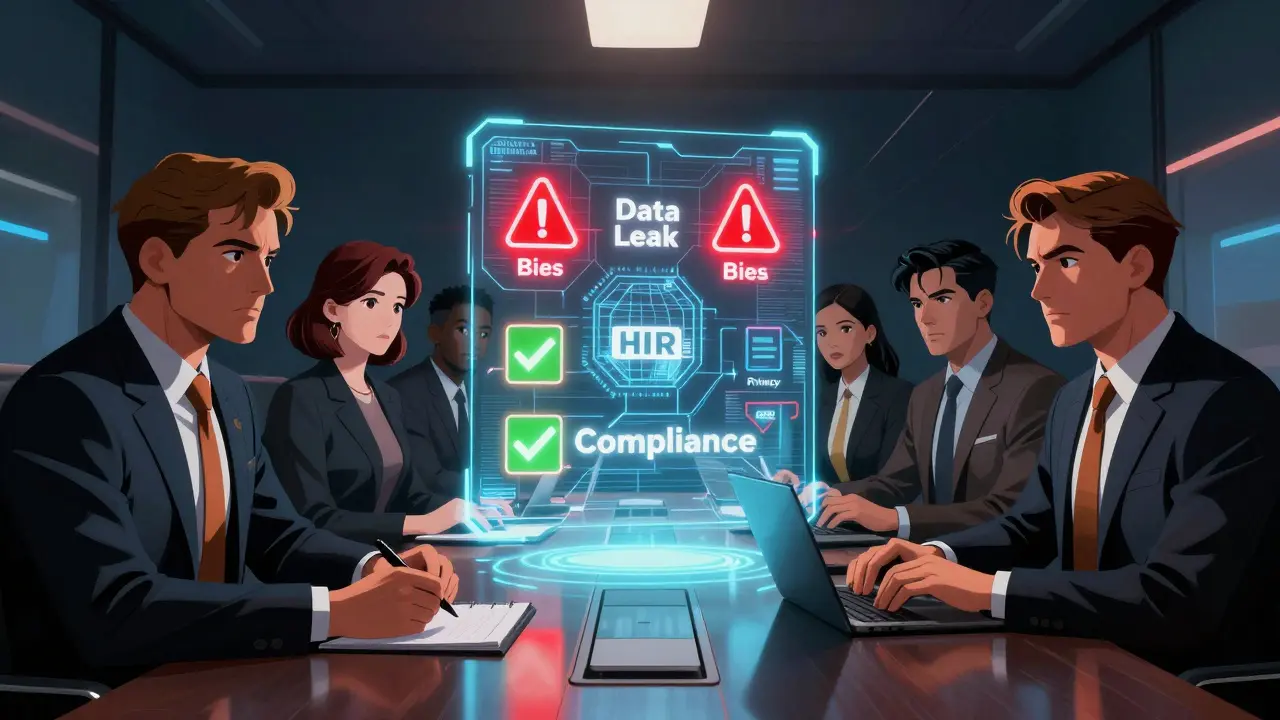
Imagine launching a powerful new Large Language Model that can summarize legal contracts or draft marketing copy in seconds. It sounds like a win until the model starts leaking sensitive customer data or giving biased hiring recommendations. You didn't plan for this because your IT team built it, but your Legal and HR teams never saw it coming. This is exactly why companies are scrambling to form structured governance bodies comprising representatives from multiple organizational departments tasked with overseeing the responsible development, deployment, and monitoring of Large Language Models (LLMs) and other AI systems.
We call these groups Cross-Functional Committees for Ethical Large Language Model Use. They aren't just another meeting on your calendar. They are the safety net that keeps your innovation from becoming a liability. In 2024, OneTrust found that organizations using these committees accelerated their AI adoption by 37% while cutting rework by 28%. That’s not slowing down progress; that’s steering it safely.
The Anatomy of an Effective AI Governance Committee
So, who actually sits at the table? If you just grab five engineers, you’ll miss half the risks. According to Truyo’s April 2025 analysis of 127 enterprise implementations, the most effective committees have between 6 and 12 members. But more importantly, they include specific roles. Every single one of those high-performing committees had Legal representation. Ethics and Compliance followed closely at 92%, and Privacy experts were present in 88% of cases.
- Legal: Handles regulatory compliance and liability.
- Ethics and Compliance: Ensures alignment with company values and external standards.
- Privacy: Protects personal data and ensures consent.
- Information Security: Guards against cyber threats and data leaks.
- R&D and Product Management: Provides technical context and feasibility checks.
- Human Resources: Addresses workforce impact and bias in hiring tools.
OneTrust recommends a tiered structure to keep things moving. A central committee meets bi-weekly to set strategy, while smaller working groups meet weekly to review specific use cases. This prevents bottlenecks. Business owners and data stewards feed evidence into these reviews, ensuring decisions are based on real-world context, not just theoretical fears.
Why Silos Fail: The 'New Triad' Approach
Traditional IT governance structures often fail when applied to AI. Why? Because AI risk isn't just a tech problem. ISACA’s February 2025 research highlights a "New Triad" approach that integrates Privacy, Cybersecurity, and Legal teams as the core foundation. Organizations using this model experienced 42% fewer governance failures compared to those sticking to old-school IT oversight.
Think about it. An engineer might see a code vulnerability. A privacy officer sees a GDPR violation. A lawyer sees a potential lawsuit. When these three talk *before* the model goes live, they catch issues that any single department would miss. Dr. Rumman Chowdhury, CEO of Humane Intelligence, puts it bluntly: "AI governance committees must move beyond checklist compliance to become innovation accelerators that bake ethics into the product development lifecycle from inception."
| Model Type | Core Members | Governance Failure Rate | Innovation Velocity |
|---|---|---|---|
| Traditional IT Governance | IT, Engineering | Higher (Baseline) | Slower (Gatekeeper mindset) |
| New Triad (ISACA) | Privacy, Cybersecurity, Legal | 42% Lower | Higher (Strategic enabler) |
| Compliance-Only | Legal, Compliance | Moderate | Low (28% of balanced models) |
Thompson Hine’s June 2025 analysis adds a crucial warning: committees focused exclusively on compliance achieve only 28% of the innovation velocity of those that balance compliance with strategic enablement. Your goal isn't to say "no." It's to say "yes, and here’s how we do it safely."
Setting Clear Accountability with RACI Matrices
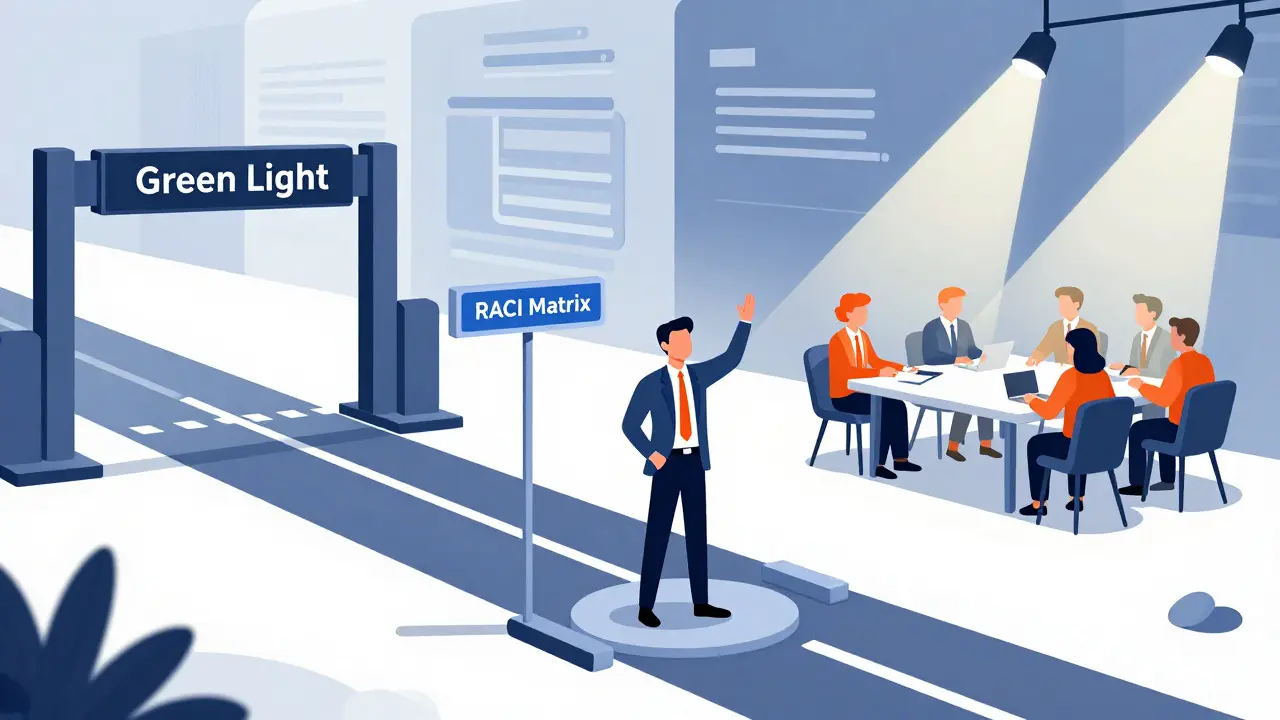
A common pitfall? Everyone thinks someone else is responsible. When a bias issue pops up in a hiring tool, does HR fix it? Does Legal assess the risk? Does Engineering patch the model? Without clarity, nothing gets done. Fisher Phillips’ March 2025 framework shows that 76% of effective implementations use a RACI matrix. This defines who is Responsible, Accountable, Consulted, and Informed for every decision point.
Palo Alto Networks calls the RACI matrix "the single most effective tool for clarifying accountability in AI projects," noting it reduces ambiguity by 63% when implemented correctly. Here’s how it looks in practice:
- Responsible: The person doing the work (e.g., Data Scientist training the model).
- Accountable: The executive sponsor who signs off (e.g., CIO or Chief Ethics Officer).
- Consulted: Subject matter experts who provide input (e.g., Legal, Privacy).
- Informed: Stakeholders who need updates (e.g., Marketing, Sales).
Fisher Phillips also notes that 89% of successful programs assign a single executive sponsor. Having one clear leader prevents the "too many cooks" problem. Additionally, 68% require documented sign-offs at each stage of the AI development lifecycle. This documentation isn't bureaucracy; it's your insurance policy. Fisher Phillips found that organizations documenting every governance decision reduce regulatory penalty risk by 68%.
Operationalizing Reviews: Checkpoints and Artifacts
You can’t govern what you don’t measure. Effective committees establish shared checkpoints at critical stages. ISACA identifies three key moments where most issues arise:
- Data Collection: Where 83% of bias issues originate.
- Model Training: Where 71% of security vulnerabilities are introduced.
- Pre-Deployment Review: Where 65% of ethical concerns are identified.
To manage these, 76% of organizations have adapted AI Impact Assessments from existing privacy frameworks. These assessments now include LLM-specific metrics like model explainability, data adequacy verification, and bias detection protocols. Palo Alto Networks reports that 89% of top-tier committees use risk-based categorization (low/medium/high). Low-risk uses might get approved by a working group automatically, while high-risk applications go to the full committee. This tiered approach keeps the process agile.
Real-World Challenges and User Feedback
It’s not all smooth sailing. Implementing these committees is hard. On Reddit’s r/AILaw forum, a senior AI ethics specialist (u/AI_Governance_Pro) shared that getting security to collaborate required an executive mandate because they initially saw AI governance as outside their scope. This is a common friction point. Engineering teams face delivery pressures, while governance teams focus on risk. Bridging that gap requires patience and clear incentives.
Truyo’s survey found that 63% of respondents cited "difficulty getting consistent participation from all required functions" as the top challenge. And if you don’t define clear decision gates, your committee becomes a bottleneck. One technology manager on LinkedIn noted spending three months debating minor issues that could have been handled at a working group level. The lesson? Define your escalation paths clearly. VerityAI documented that 41% of committees fail to establish effective escalation processes, leading to incidents like a major bank’s LLM hiring tool exhibiting gender bias for six months because HR and Legal couldn’t agree on who owned the fix.
Market Context and Future Trends
The pressure to act is mounting. The global AI governance market is projected to reach $1.24 billion by 2026, growing at a 34.7% CAGR (Gartner, May 2025). Regulatory drivers like the EU AI Act (effective February 2026) and US Executive Order 14110 are forcing companies’ hands. As of Q1 2025, 68% of Fortune 500 companies have formal AI governance committees, up from just 22% in January 2023 (Forrester).
Healthcare leads adoption at 82% due to strict HIPAA requirements, followed by financial services at 76%. By 2027, Gartner predicts 95% of enterprises with significant AI investments will have formal cross-functional governance structures. Failure to implement is becoming a material risk factor. In Q1 2025 alone, 14 shareholder resolutions were filed specifically addressing AI governance gaps (PwC, June 2025).
Looking ahead, we’re seeing greater integration with board-level oversight. 41% of S&P 500 companies now include AI governance in their primary risk committee charters (NACD, October 2024). Automation is also playing a bigger role. OneTrust notes that AI governance platforms can handle 72% of low-risk use case approvals without committee intervention, freeing up humans to focus on complex, high-stakes decisions.
How long does it take to establish an effective AI governance committee?
OneTrust recommends a 12-16 week timeline. This includes 2 weeks for stakeholder identification, 4 weeks for charter development, 3 weeks for role definition, 4 weeks for process design, and 3-4 weeks for training and rollout. Rushing this process often leads to unclear roles and ineffective operations.
What is the 'New Triad' in AI governance?
The 'New Triad' is a governance model identified by ISACA that integrates Privacy, Cybersecurity, and Legal teams as the core foundation of AI oversight. This approach has shown 42% fewer governance failures compared to traditional IT-led structures because it addresses the multifaceted nature of AI risk from the start.
Why is a RACI matrix important for LLM projects?
A RACI matrix clarifies who is Responsible, Accountable, Consulted, and Informed for each decision. Palo Alto Networks reports it reduces ambiguity by 63%. Without it, critical issues often fall through the cracks because departments assume someone else is handling them.
How can I prevent my AI committee from becoming a bottleneck?
Use a tiered review process. Categorize AI applications by risk (low/medium/high). Allow automated or working-group approvals for low-risk uses, reserving full committee time for high-stakes deployments. Also, ensure you have a single executive sponsor to drive decisions quickly.
What are the biggest challenges in implementing cross-functional AI committees?
The top challenge is getting consistent participation from all required functions, especially engineering teams under delivery pressure. Other issues include defining clear escalation paths and balancing compliance needs with innovation velocity. Executive sponsorship is critical to overcoming these hurdles.



Caitlin Donehue
June 25, 2026 AT 11:36I've been watching this space for a while and honestly it's just fascinating to see how the rubber meets the road with these committees. Most people think AI governance is just a buzzword but seeing the actual stats about reduced rework makes it click.
Saranya M.L.
June 26, 2026 AT 12:21The fundamental flaw in most Western-centric governance models is the assumption that 'ethics' is a universal constant rather than a culturally relative construct. You cite OneTrust and Truyo as if their methodologies are gospel, yet they fail to account for the nuanced regulatory landscapes of emerging economies where data sovereignty is treated with far more gravity than mere compliance checkboxes. The 'New Triad' approach is quaintly simplistic when applied to jurisdictions where privacy is not just a legal right but a constitutional imperative. Furthermore, the suggestion that Legal and Privacy teams can simply 'integrate' ignores the inherent power dynamics that often render such cross-functional dialogue performative at best. We need a decolonized approach to AI ethics that doesn't just mimic Silicon Valley's risk mitigation strategies but actively challenges the epistemic violence embedded in training data from the Global South. Until then, these committees are merely theater for shareholders who care more about velocity than veracity.
om gman
June 27, 2026 AT 08:31oh great another article telling us we need more meetings to save us from ourselves
like seriously do you really think adding a lawyer and a privacy officer to the table stops the engineers from shipping buggy code because the deadline is next tuesday? no one gives a damn about your raci matrix when the ceo wants the demo ready for investors
Oskar Falkenberg
June 27, 2026 AT 19:15I totally get the frustration there, om gman, because I have sat through so many of those endless committee meetings myself and it feels like nothing gets done but here is the thing i have found over the years working in tech support and project management is that if you dont have someone explicitly assigned to catch the ethical slip ups then you end up with a massive headache later on down the line when something goes wrong and everyone starts pointing fingers at each other instead of fixing the problem which is why having that clear accountability structure even if it feels bureaucratic at first actually saves everyone a lot of stress in the long run because you know exactly who needs to sign off on what and it prevents that chaotic situation where assumptions are made and things fall through the cracks which happens way too often in agile environments without proper guardrails
Jeanne Abrahams
June 28, 2026 AT 17:51You Americans and your obsession with 'governance' as if it's a magic wand. Down here in Cape Town, we deal with load shedding before we worry about LLM bias. But I will admit, the part about HR being involved is crucial because if your hiring tool is discriminating against local talent due to some skewed dataset from California, you're going to find out pretty quickly that your 'innovation' isn't very innovative in practice. Just don't expect us to adopt your frameworks wholesale without adapting them to our reality.
Bineesh Mathew
June 29, 2026 AT 08:19The moral decay of modern enterprise is laid bare in this sterile discussion of 'risk mitigation.' To reduce human dignity to a checkbox in a RACI matrix is an affront to the soul. We speak of 'bias' as if it were a software bug to be patched, ignoring the profound philosophical implications of entrusting judgment to algorithms trained on the aggregated sins of history. The 'New Triad' is a triad of silence, where the voices of the marginalized are drowned out by the clatter of corporate liability shields. True ethics cannot be governed; it must be cultivated in the hearts of those who build, not enforced by committees that meet bi-weekly to nod solemnly at spreadsheets. This is not safety; it is spiritual anesthesia.
Stephanie Frank
June 30, 2026 AT 23:49Look, let's cut the fluff. The real issue isn't the committee structure, it's that companies are using these committees as a PR shield. They slap a 'Chief Ethics Officer' title on someone with zero authority and call it a day. The stats about 37% faster adoption are likely cherry-picked from companies that already had good processes. For the rest of us, it's just another layer of bureaucracy that slows down deployment while doing absolutely nothing to prevent catastrophic failures. I've seen committees rubber-stamp dangerous models because the business pressure was too high. It's a facade.
Patrick Dorion
July 2, 2026 AT 00:40It's interesting to consider the philosophical underpinnings of why we feel the need to institutionalize ethics in this way. Perhaps it stems from a collective anxiety about losing control over the tools we create. From a practical standpoint though, the RACI model is sound because it forces clarity. When roles are ambiguous, responsibility diffuses and nobody takes ownership. I've worked with teams where the lack of clear accountability led to disaster, so having a designated 'Accountable' person is key. It's not about stifling innovation but ensuring that innovation has a foundation of trust. Without that trust, users will eventually reject the technology regardless of its capabilities.
Marissa Haque
July 3, 2026 AT 17:35This is such a vital conversation!! I mean, come on, how many times have we heard horror stories about AI leaking data or being biased?! It's terrifying! And I love the idea of the 'New Triad' because it really shows that we need to break down silos!!! If Legal and Security aren't talking to Engineering from day one, we are setting ourselves up for failure!!! Let's hope more companies take this seriously before it's too late!!!
Keith Barker
July 4, 2026 AT 20:57the concept of governance is inherently flawed because it assumes predictability in systems that are fundamentally probabilistic
we try to cage chaos with rules but chaos always escapes
the committee is just a ritual to soothe our fears