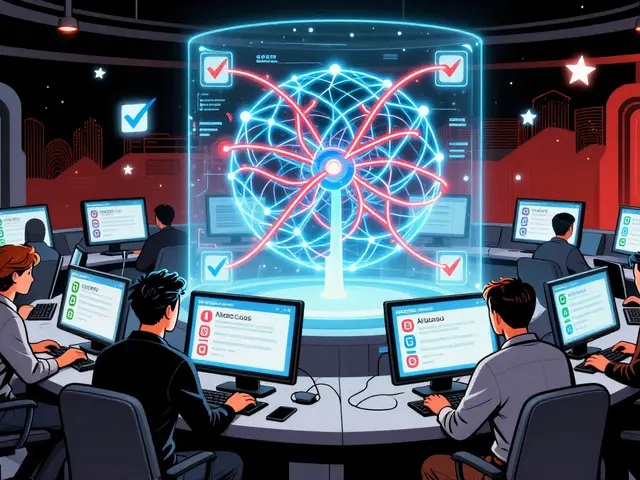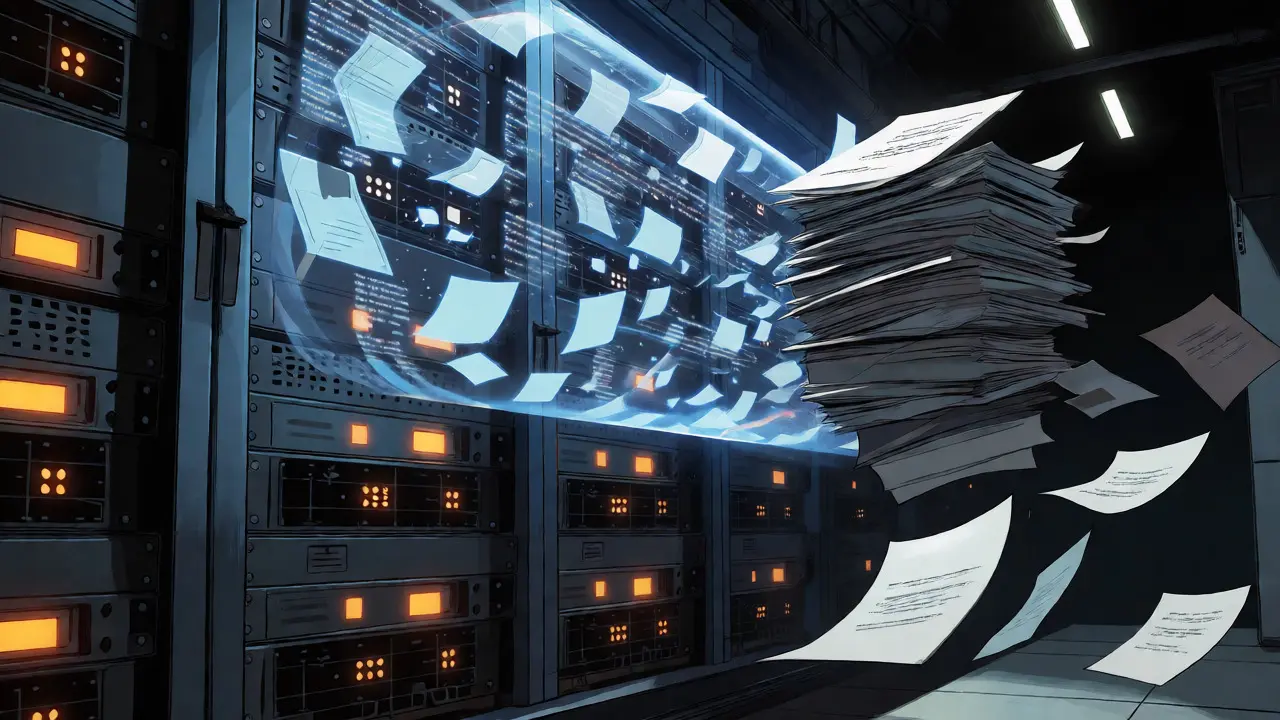
You paste a 50-page PDF into your favorite AI chatbot, ask it to summarize the key risks, and get back a response that completely ignores page 42. Or maybe you're debugging code, and the model suddenly forgets the function definition you pasted ten messages ago. It feels like the AI has amnesia. But it’s not forgetting; it’s running out of room.
This "room" is called the Context Window. It is the maximum amount of text-measured in tokens-that a Large Language Model (LLM) can process at one time. Think of it as the model's working memory. If the information doesn't fit inside this window, the model literally cannot see it. Understanding how this mechanism works explains why some AIs handle entire books while others struggle with a single long email thread. It also reveals why bigger isn't always better.
The Transformer Bottleneck: Why Size Matters
To understand the limit, you have to look under the hood. Modern LLMs rely on the Transformer architecture, introduced in the seminal 2017 paper "Attention is All You Need." The core innovation here was the self-attention mechanism. This allows the model to weigh the relevance of every word against every other word in the input sequence simultaneously.
Here is the catch: this attention calculation scales quadratically. If you double the length of your input, the computational work required increases by four times. This is known as O(n²) complexity. When a model processes 1,000 tokens, it calculates 1,000,000 relationships. When it processes 10,000 tokens, it calculates 100,000,000 relationships. This isn't just a minor inconvenience; it hits hard limits on GPU memory and processing speed.
Because of this quadratic scaling, expanding the context window isn't free. It requires massive amounts of Video RAM (VRAM). For instance, running a 7-billion parameter model with a 32,000-token context might require around 24GB of VRAM just for inference. Push that to 128,000 tokens, and the memory requirements skyrocket, often making local execution impossible without specialized hardware.
Tokens vs. Words: Measuring the Invisible Limit
Users often try to estimate their usage by counting words, but LLMs don't read words. They read tokens. A token is a piece of text, which can be a whole word, part of a word, or even a space. On average, one English word equals about 1.3 tokens, though this varies by language and model tokenizer.
When you hit the limit, the system usually employs a sliding window strategy. As new text comes in, the oldest tokens drop off the left side of the window. Imagine a conveyor belt moving through a fixed-size box. Once an item leaves the box, the model loses access to it entirely. This is why long conversations often degrade over time. The initial instructions or early context clues fall off the belt, leaving the model confused about the original premise.
Different models offer vastly different capacities. As of late 2024 and early 2025 trends, here is how the major players compare:
| Model Family | Max Context Window | Approximate Page Capacity* | Primary Trade-off |
|---|---|---|---|
| GPT-4 Turbo | 128,000 tokens | ~300 pages | Higher cost per token |
| Claude 3.7 Sonnet | 200,000 tokens | ~500 pages | Latency on very long inputs |
| Gemini 1.5 Pro | 1,000,000 tokens | ~2,500 pages | Accuracy drops on middle-of-doc content |
| Llama 3 (Open Source) | 8,000 - 128,000 tokens | 20 - 300 pages | Hardware intensive for larger windows |
*Assumes standard single-spaced formatting. Actual capacity depends on code density or table structures.
The "Lost in the Middle" Problem
Having a huge context window doesn't guarantee perfect recall. Researchers have identified a phenomenon known as the "lost in the middle" problem. Models tend to pay the most attention to the beginning of the prompt (primacy bias) and the end of the prompt (recency bias). Information buried deep in the middle of a 100,000-token document often gets ignored.
For example, if you ask Gemini 1.5 Pro to find a specific clause in a 1,000-page contract, it might successfully retrieve details from page 5 or page 995. However, if that clause is on page 500, the model might miss it or hallucinate its location. This happens because the self-attention weights become diluted across such a vast sequence. The signal-to-noise ratio drops as the distance between relevant tokens increases.
Practical testing shows that accuracy can decrease by up to 15% when context exceeds half the maximum window size, even in top-tier models. This means that simply throwing more data at the model isn't always the smartest move. Curating what goes into the window is often more effective than maximizing its usage.

Why Long Documents Break Coding Assistants
Coding tasks are particularly sensitive to context limits. Codebases are highly interconnected. A variable defined in file A might be used in file Z. Early coding assistants with small windows (like the original GPT-2's 2,048 tokens) struggled immensely with this. Developers had to manually copy-paste snippets, breaking the flow.
Modern tools like Cursor or GitHub Copilot use techniques to mitigate this, but they still face physical limits. Surveys indicate that nearly 80% of professional developers using medium-sized codebases (10k-50k lines) hit context limits regularly. When the window fills up, the assistant stops seeing the imports or type definitions needed to write correct code. It starts guessing, leading to subtle bugs.
To combat this, many systems now use Retrieval-Augmented Generation (RAG). Instead of stuffing the entire codebase into the context window, RAG systems search for only the most relevant chunks of code based on your query. These smaller, highly relevant snippets are then inserted into the context window. This keeps the window light and focused, improving both speed and accuracy.
Cost and Latency: The Hidden Price of Big Windows
Bigger windows come with bigger bills. Pricing for API access is typically charged per million tokens. Processing a 100,000-token request costs significantly more than a 1,000-token request, not just linearly, but because of the increased compute load. Furthermore, latency increases. Waiting 4 seconds for a response versus 1 second makes a big difference in user experience.
There is also an efficiency paradox. Some studies suggest that models produce more irrelevant or "fluff" content when forced to process contexts near their maximum capacity. One analysis noted a 22% increase in irrelevant content when documents exceeded 50% of the max window. The model struggles to filter noise effectively when everything is competing for attention.
Therefore, the best practice isn't always to use the largest available window. It is to use the smallest window that captures sufficient context. If you can solve the problem with 4,000 well-chosen tokens rather than 100,000 raw ones, you will likely get a faster, cheaper, and more accurate answer.

Strategies for Managing Limited Memory
If you are building applications or just trying to get better results from chatbots, you need to manage the context actively. Here are three proven strategies:
- Summarization Chains: Before asking a complex question, ask the model to summarize previous turns or sections of a document. Feed this summary into the next step. This compresses history into dense, high-value tokens.
- Sliding Window with Overlap: If you must process a long stream, keep a buffer of recent tokens and a static block of initial instructions. Discard the middle layers of old conversation that are no longer relevant.
- External Vector Stores: Use a database to store embeddings of your documents. Only retrieve the top 5-7 most similar passages to inject into the prompt. This is the core of modern RAG pipelines.
Tools like MemGPT have emerged to automate this. They treat the LLM's context window like computer RAM and external storage like disk space, swapping information in and out automatically. While promising, these systems add complexity and potential points of failure.
The Future: Beyond Transformers?
Will context windows keep growing? Yes, but perhaps not forever via transformers alone. Innovations like Mixture-of-Depths and State Space Models (SSMs) aim to break the O(n²) barrier. SSMs, for example, scale linearly with sequence length, theoretically allowing for infinite context. However, as of 2026, transformers still dominate due to their superior reasoning capabilities.
We are seeing a shift toward "intelligent context management." Rather than just brute-forcing larger windows, the industry is focusing on smarter attention mechanisms that can selectively ignore irrelevant parts of a long document. Google's research into focal attention and hierarchical memory suggests the future lies in quality of attention, not just quantity of tokens.
For now, understanding the constraints of your specific model is crucial. Check the documentation for your chosen LLM. Know whether it suffers from the "lost in the middle" effect. Test how it handles edge cases. By respecting the limits of the context window, you stop fighting the model and start working with it.
What happens when my text exceeds the context window?
Most interfaces will either truncate the input, cutting off the beginning or end, or throw an error preventing the request. In conversational AI, older messages may be dropped from the active memory, causing the model to lose track of earlier context.
Are tokens the same as words?
No. Tokens are subword units. Common words are usually one token, but rare words or punctuation may split into multiple tokens. On average, 1,000 tokens equal roughly 750 English words, but this varies by language and tokenizer.
Does a larger context window always mean better performance?
Not necessarily. Larger windows can introduce noise, increase latency, and raise costs. Additionally, models often struggle to attend to information in the middle of very long contexts (the "lost in the middle" phenomenon), so precise curation often beats raw size.
How does RAG help with context limits?
Retrieval-Augmented Generation (RAG) searches an external database for relevant information and inserts only those specific snippets into the context window. This allows the model to access knowledge beyond its immediate memory without filling the entire window with irrelevant text.
Why do coding assistants fail with large projects?
Codebases have complex dependencies. If the definition of a function falls out of the context window, the assistant cannot see it. This leads to hallucinations where the model invents parameters or types that don't exist in the actual code.