
You might think that for a computer to understand language, it needs a massive dictionary and a strict set of grammar rules programmed by humans. But modern Large Language Models (LLMs) don't work that way. They learn the nuances of language-both its structure (syntax) and its meaning (semantics)-by watching billions of sentences unfold without any human labels telling them what's right or wrong. This process is called self-supervision. It’s essentially the AI equivalent of learning to read by reading, not by studying a textbook.
The magic trick behind this isn't just having more data; it's the architecture. Specifically, the Attention Mechanism, introduced in the landmark 2017 paper "Attention Is All You Need," allows these models to dynamically decide which words matter most when processing a sentence. Unlike older systems that processed words one by one like a tape recorder, attention lets the model look at the whole picture at once. This shift changed everything about how we build AI that understands us.
The Core Engine: How Self-Supervision Works
Self-supervision sounds complex, but the concept is surprisingly simple. Imagine you’re trying to guess the last word of a sentence before you see it. If I say, "The sky is blue and the grass is...", you instantly know the next word is likely "green." You didn't need someone to label "green" as the correct answer; your brain inferred it from context. LLMs do exactly this, but on a massive scale.
During training, the model is fed huge chunks of text with some words randomly hidden. The model tries to predict those hidden words based on the surrounding context. If it gets it wrong, it adjusts its internal parameters slightly. Over trillions of tokens, the model learns statistical patterns so deep that they mimic understanding. It learns that "bank" usually relates to "money" if near "river" or "deposit," but to "river" if near "water" or "flow." This is how it captures semantics-the meaning of words in context-without ever being explicitly taught definitions.
This approach solves the biggest bottleneck in traditional Natural Language Processing (NLP): the need for labeled data. Labeling data is expensive and slow. Self-supervision lets models leverage the vast, unlabeled internet, turning raw text into a learning signal. The result is a system that doesn't just memorize phrases but grasps the underlying logic of language.
Attention Mechanisms: The Brain’s Spotlight
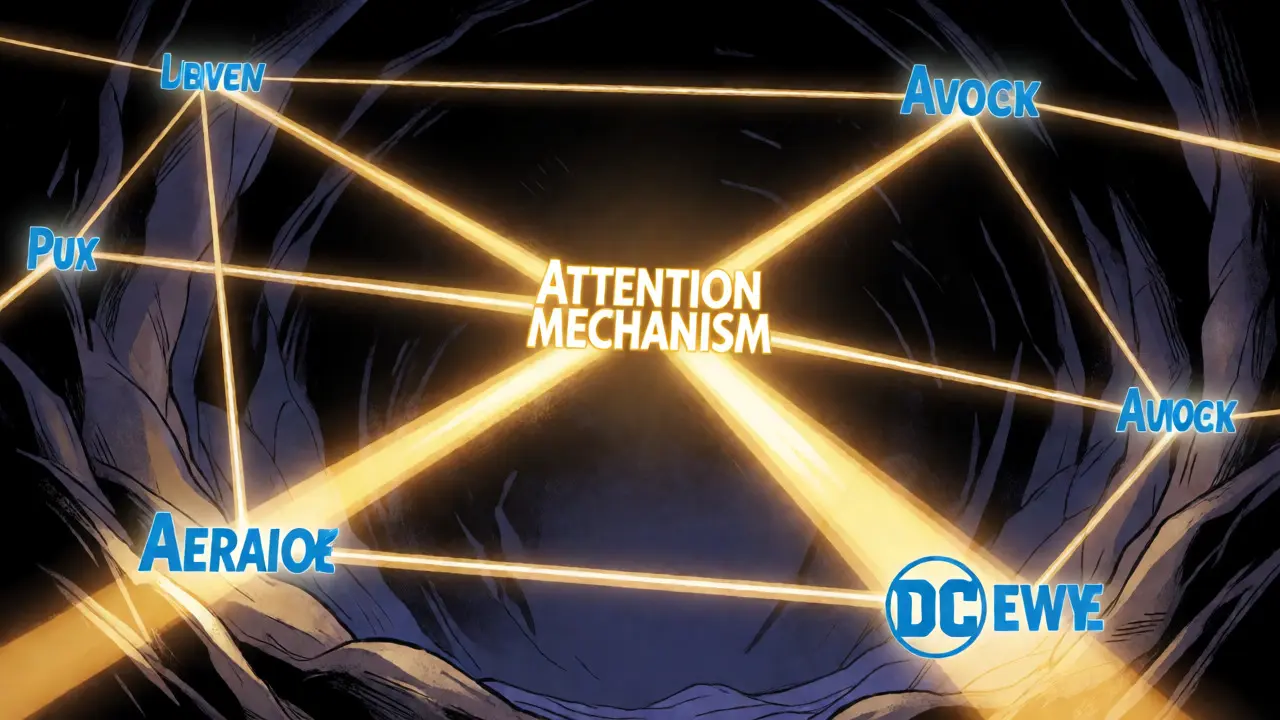
If self-supervision provides the fuel, the Attention Mechanism is the engine. In older Recurrent Neural Networks (RNNs), information flowed sequentially. By the time an RNN reached the end of a long paragraph, it often forgot the beginning. Attention fixes this by allowing every word in a sequence to "attend" to every other word simultaneously.
Think of it like a spotlight in a dark room. When the model processes the word "it" in a sentence, the attention mechanism shines a light on all previous words to figure out what "it" refers to. Does "it" refer to the "cat" mentioned three sentences ago, or the "toy" mentioned two words back? The model calculates a score for each potential reference, assigning higher weights to the most relevant ones. This dynamic weighting is crucial for capturing syntax-the grammatical structure-and resolving ambiguities.
| Feature | Traditional NLP (RNNs/LSTMs) | Attention-Based LLMs |
|---|---|---|
| Processing Order | Sequential (left-to-right) | Parallel (all words at once) |
| Context Handling | Forgets distant context | Maintains long-range dependencies |
| Learning Method | Often supervised (needs labels) | Self-supervised (predicts masked words) |
| Ambiguity Resolution | Static word vectors | Dynamic contextual embeddings |
The technical heart of this process involves three components: Query, Key, and Value vectors. When the model looks at a word, it creates a "Query" vector-a question asking, "Who am I related to?" It compares this query against "Key" vectors (labels) of all other words. High similarity between a Query and a Key means those words are related. The model then retrieves the "Value" vector-the actual information-from those highly related words. This weighted sum of values becomes the new representation of the original word, now enriched with context.
Capturing Syntax and Semantics Together
One of the most fascinating discoveries in recent research is that LLMs don't strictly separate syntax from semantics. In human linguistics, we often treat grammar and meaning as distinct layers. But inside a transformer model, they are deeply intertwined. Studies examining "syntax-specialized" attention heads in models like BERT and GPT-2 found that even heads designed to track grammatical relationships are influenced by semantic plausibility.
For example, consider the phrase "The cat sat on the box." A syntax-focused head knows that "on" connects "sat" to "box." However, if you change the sentence to "The cat sat on the moon," the model’s attention patterns shift. While the syntax remains identical (prepositional phrase), the semantic oddity alters how strongly the model attends to certain connections. This mirrors human cognition, where our understanding of grammar is constantly modulated by whether something makes sense in the real world.
This integration explains why LLMs can handle ambiguous language so well. They aren't just parsing trees; they're building a probabilistic map of how concepts relate. When an LLM performs Semantic Role Labeling (SRL)-identifying who did what to whom-it often outperforms traditional supervised models in few-shot scenarios. Interestingly, this capability doesn't always scale linearly with model size. Sometimes, a smaller model trained with better architectural choices or clearer instructions captures semantics more effectively than a larger, poorly tuned giant.
The Challenge of Position: Why Word Order Matters
Here’s a catch: the basic attention mechanism is order-blind. Mathematically, if you shuffle the words in a sentence, the raw attention scores between pairs of words remain similar unless you tell the model where each word sits. But word order is critical for syntax. "Dog bites man" is very different from "Man bites dog." To fix this, engineers inject positional information into the model.
Early methods used fixed sinusoidal encodings, adding a unique numerical pattern to each word based on its position. More recently, techniques like Rotary Position Embedding (RoPE) have become standard. RoPE rotates the query and key vectors based on their relative distance, allowing the model to naturally encode relative positions. This helps the model understand that the verb usually comes after the subject, regardless of how far apart they are in the sentence.
Newer innovations push this further. For instance, PaTH Attention, developed by researchers at MIT-IBM, treats intermediate words as paths made of small transformations. Instead of just marking absolute position, it uses data-dependent reflections to adjust how information flows. This helps models track commands over thousands of tokens, improving performance in tasks that require remembering instructions from pages ago. These advancements show that capturing syntax isn't just about grammar rules; it's about encoding the temporal flow of language.

Real-World Implications and Limitations
So, why does this matter for you? If you're building applications using APIs like OpenAI or Anthropic, understanding this helps you prompt better. Since LLMs rely on self-supervised patterns, they excel when given clear context. Ambiguous prompts fail because the model has too many equally plausible semantic paths to choose from. Providing examples (few-shot prompting) narrows down these paths, guiding the attention mechanism toward the desired interpretation.
However, limitations exist. Because these models learn from statistics, they can hallucinate facts. They prioritize syntactic fluency and semantic coherence over factual accuracy. A sentence can be grammatically perfect and semantically smooth while being completely false. This happens because the model predicts the next token based on probability, not truth verification. Recognizing this distinction helps users trust the output appropriately-using LLMs for drafting, summarization, and coding assistance rather than as authoritative fact-checkers.
What is self-supervised learning in LLMs?
Self-supervised learning is a training method where the model generates its own labels from the input data. For LLMs, this typically involves masking random words in a sentence and training the model to predict them. This allows the model to learn language structures and meanings from vast amounts of unlabeled text without human intervention.
How does the attention mechanism help capture syntax?
The attention mechanism allows the model to assign dynamic weights to different words in a sequence based on their relevance to each other. This enables the model to identify grammatical relationships, such as subject-verb agreement or prepositional phrases, even when words are far apart in a sentence, effectively capturing syntactic structure.
Do LLMs understand semantics separately from syntax?
Research suggests that LLMs integrate syntax and semantics rather than keeping them separate. Attention heads specialized for syntactic tasks are often influenced by semantic plausibility. This means the model's understanding of grammar is modulated by whether the sentence makes logical sense, mirroring human language processing.
Why is positional encoding necessary for LLMs?
Basic attention mechanisms are permutation-invariant, meaning they don't inherently recognize word order. Positional encoding adds information about where each word appears in the sequence, allowing the model to distinguish between sentences like "dog bites man" and "man bites dog," which have different meanings despite using the same words.
Can smaller models capture semantics as well as large ones?
Not necessarily proportional to size. Studies show that semantic role labeling performance varies based on architecture and training efficiency, not just parameter count. Some mid-sized models trained with advanced techniques like PaTH Attention can outperform larger models on specific reasoning and recall tasks.
Next Steps for Developers and Researchers
If you want to dive deeper, start by experimenting with fine-tuning open-source models like Llama 3 or Mistral. Observe how changing the context window affects the model's ability to maintain syntactic consistency in long documents. Pay attention to how positional encoding schemes impact performance on tasks requiring multi-step reasoning. The field is moving fast, with new attention variants emerging monthly, promising even better integration of syntax and semantics in the years to come.