You might think the Transformer is still king, but by 2025, it’s hardly alone. The original architecture from 2017 has evolved into a diverse family of models that prioritize speed, context length, and parameter efficiency over raw attention power. If you’re building or deploying Large Language Models (LLMs) today, sticking to the vanilla design means leaving massive performance gains on the table. We are seeing a shift where attention mechanisms are being optimized, sparsified, or even replaced entirely by state-space models. This isn't just academic tweaking; these changes allow models to handle million-token contexts and run on hardware that would have choked a year ago.
The Standardized "Modern" Core Stack
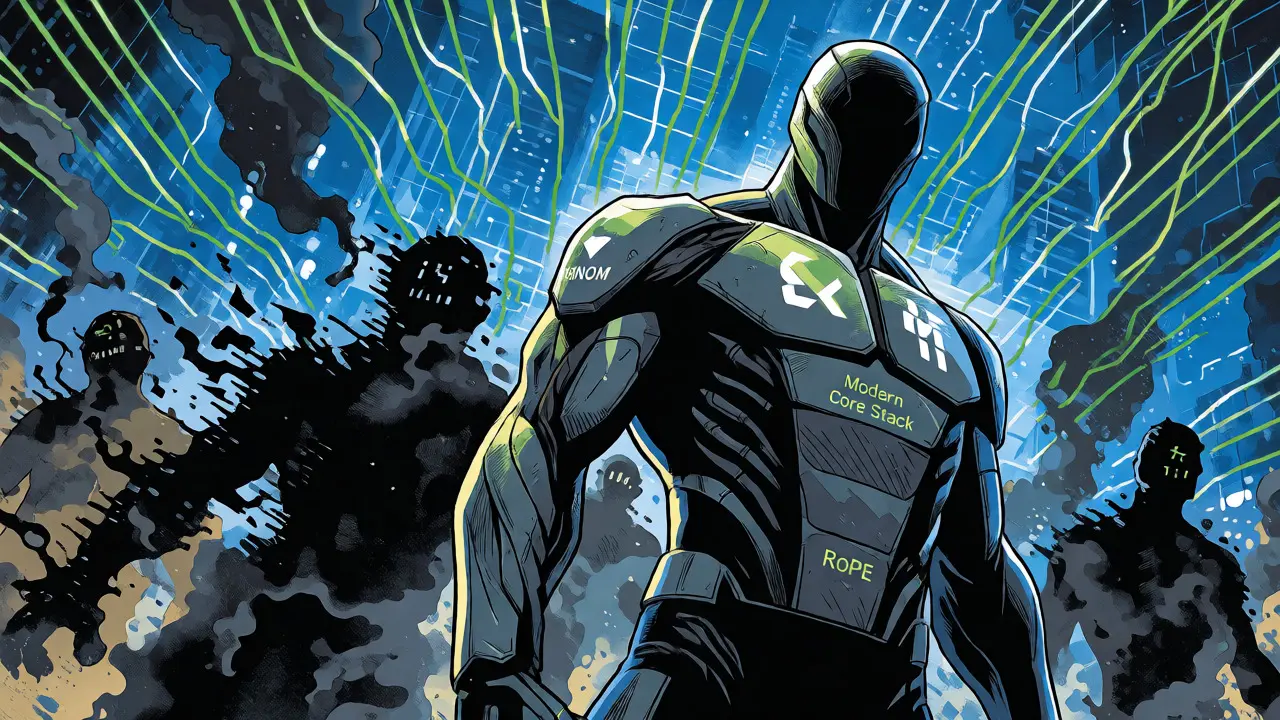
Before diving into the exotic variants, it helps to understand what most high-performing models actually look like under the hood in 2025. A survey of over 50 open-weight decoder-only models reveals a de facto standard stack that dominates the landscape. It’s not the messy experimental code from early 2020 anymore. Today’s baseline includes pre-normalization using RMSNorm instead of LayerNorm, rotary position embeddings (RoPE) for better long-range understanding, and SwiGLU activations with an expansion ratio of roughly 2.67x.
Crucially, bias terms have been stripped from almost all linear layers. Why? They add little value but consume memory and compute cycles. Instead, efficiency comes from Grouped Query Attention (GQA). In this setup, multiple query heads share fewer key-value heads. For instance, a model might use 32 query heads but only 8 key-value heads. This 4:1 ratio drastically cuts down memory usage during inference without sacrificing quality. If you aren’t using GQA or its multi-query variant (MQA), your model is likely inefficient compared to current standards.
FlashAttention-3 and Hardware Optimization
Architecture doesn’t exist in a vacuum; it needs to talk to the GPU. Enter FlashAttention-3. Released as the successor to FlashAttention-2, this kernel is specifically tuned for NVIDIA H100 GPUs. It’s not just about making things faster; it’s about numerical stability and maximizing hardware utilization. On H100s, FlashAttention-3 achieves up to 740 tera-FLOPS in FP16 precision, which translates to about 75% of the theoretical maximum FLOPS for attention workloads. That’s a huge jump from previous implementations.
What makes it special for 2025 architectures is its optimization for Grouped Query Attention. While FlashAttention-2 gave modest gains for standard multi-head attention, FlashAttention-3 delivers 20-30% additional speedups specifically when KV heads are shared, which is exactly how modern models like LLaMA-2-70B are structured. Furthermore, in FP8 precision, it can reach nearly 1.2 peta-FLOPS while reducing numerical error by 2.6 times compared to baseline FP8 implementations. If you are training models with sequence lengths exceeding 8,192 tokens, skipping this kernel is essentially throwing money away.
Sparse Mixture-of-Experts (MoE)
If dense transformers hit a wall regarding parameter count versus compute cost, Sparse Mixture-of-Experts (MoE) breaks through it. MoE models expand the width of the network-adding billions of parameters-but keep the per-token computation low by activating only a small subset of experts for each token. Typically, 2 out of dozens of experts are active per layer. This allows models like Gemini 2.5 Pro to support context windows up to 1 million tokens while maintaining reasonable latency.
The challenge with MoE isn’t the math; it’s the routing. You need robust load balancing to ensure that no single expert gets overwhelmed while others sit idle. Poor routing leads to training instability and wasted capacity. However, when done right, MoE offers a way to scale effective parameter counts into the hundreds of billions without requiring proportional increases in FLOPs per token. It’s the go-to choice for frontier-scale proprietary models that need both breadth of knowledge and depth of reasoning.
| Variant Type | Key Mechanism | Complexity | Best Use Case | Representative Model |
|---|---|---|---|---|
| Dense + GQA | Shared Key-Value Heads | O(n²) optimized | General purpose, fine-tuning | LLaMA-2/3 |
| Sparse MoE | Dynamic Expert Routing | O(n) per token* | Frontier scale, massive context | Gemini 2.5 Pro |
| Selective SSM | Input-dependent gating | O(n) | Long sequences, high throughput | Mamba / Mamba-2 |
| RNN-Hybrid | Linear Attention / Recurrence | O(1) inference | Low-latency, constrained hardware | RWKV-7 |

The Rise of State-Space Models: Mamba
Perhaps the biggest disruptor in the last two years is the Selective State Space Model (SSM), popularized by Mamba. Unlike Transformers, which rely on quadratic attention, Mamba operates in linear time O(n). But here’s the kicker: it’s not just fast; it’s smart. The "selective" part means the model decides what information to remember and forget based on the input content, similar to how humans focus on relevant details.
Benchmarks show that a 3-billion-parameter Mamba model can match the performance of a 6-billion-parameter Transformer. That’s a 2x parameter-efficiency gain. With Mamba-2, introduced in mid-2024, the concept of "State Space Duality" emerged, showing that SSMs and attention are mathematically related. Mamba-2 simplifies the internal matrices, reducing parameter count further while speeding up algorithms by 2-8x. For tasks involving extremely long sequences-like analyzing entire books or genomic data-Mamba offers a compelling alternative to attention-based models, delivering up to 5x higher inference throughput.
RWKV: The RNN Comeback
While Mamba replaces attention with state spaces, RWKV (Receptance Weighted Key Value) bridges the gap between Transformers and Recurrent Neural Networks (RNNs). It can be trained in parallel like a Transformer but runs with constant memory and compute per token during inference, like an RNN. This makes it incredibly attractive for deployment on devices with limited RAM.
RWKV has scaled to 14 billion parameters, proving that recurrent architectures can compete with Transformers at scale. Recent implementations, such as PRWKV-7, replace the attention mechanism in Microsoft’s Phi-4 architecture with RWKV blocks. The result? A 16.3-billion-parameter model that retains instruct capabilities but benefits from linear-time inference. In specialized domains like time-series forecasting, RWKV-based models have shown performance improvements ranging from 1.13x to 43.3x over Transformer baselines, often with significantly less training time.

Practical Implementation Challenges
Adopting these variants isn’t just about swapping code. Each comes with specific engineering hurdles. Using FlashAttention-3 requires integrating vendor-specific CUDA kernels and carefully managing mixed-precision modes (FP16/FP8) to avoid numerical instability. MoE models demand rigorous monitoring of expert load balancing; if one expert handles more than 50% of tokens, your training will suffer.
For Mamba and RWKV, the challenge lies in kernel availability and community support. While libraries like `state-spaces/mamba` on GitHub provide reference implementations, they may not be as battle-tested as PyTorch’s native attention modules. You must verify that reported speedups translate to your specific batch sizes and sequence lengths. Always benchmark end-to-end latency, not just theoretical FLOPS, because memory bandwidth bottlenecks can negate algorithmic advantages.
Key Takeaways
- Standardize Your Core: Use RMSNorm, RoPE, SwiGLU, and GQA for any new dense transformer project.
- Optimize Kernels: Implement FlashAttention-3 for significant speedups on H100 GPUs, especially with GQA.
- Consider MoE for Scale: If you need massive parameter counts without massive compute costs, sparse MoE is the proven path.
- Evaluate SSMs for Length: For million-token contexts or high-throughput needs, test Mamba or RWKV against traditional attention.
- Monitor Deployment Costs: Linear-time models (Mamba/RWKV) offer constant memory inference, crucial for edge or low-RAM environments.
Why is Grouped Query Attention (GQA) preferred over Multi-Head Attention?
GQA reduces memory usage and improves cache reuse by sharing key-value projections across multiple query heads. This lowers the computational overhead during inference without significantly impacting model quality, making it essential for handling longer context windows efficiently.
Is Mamba better than Transformers for all tasks?
Not necessarily. Mamba excels in tasks requiring very long sequences or high throughput due to its linear complexity. However, Transformers remain dominant in many general-purpose NLP benchmarks and have more mature tooling. Mamba is best suited for scenarios where sequence length or inference speed is the primary bottleneck.
What is the main advantage of Sparse Mixture-of-Experts?
MoE allows models to have a vast number of parameters (increasing knowledge capacity) while keeping the active computation per token low. By activating only a few experts per token, it decouples model size from inference cost, enabling larger, smarter models that run at speeds comparable to smaller dense models.
How does FlashAttention-3 improve upon FlashAttention-2?
FlashAttention-3 is specifically optimized for modern GPUs like the NVIDIA H100 and architectures using Grouped Query Attention. It offers 1.5-2.0x speedups over FlashAttention-2 in FP16 and provides better numerical stability in FP8, achieving higher hardware utilization rates.
Can RWKV replace Transformers in production?
Yes, in specific cases. RWKV offers constant-memory inference, which is ideal for real-time applications and edge devices. Models like PRWKV-7 demonstrate that RWKV can serve as a drop-in replacement for attention in existing architectures, providing competitive performance with lower deployment costs.