
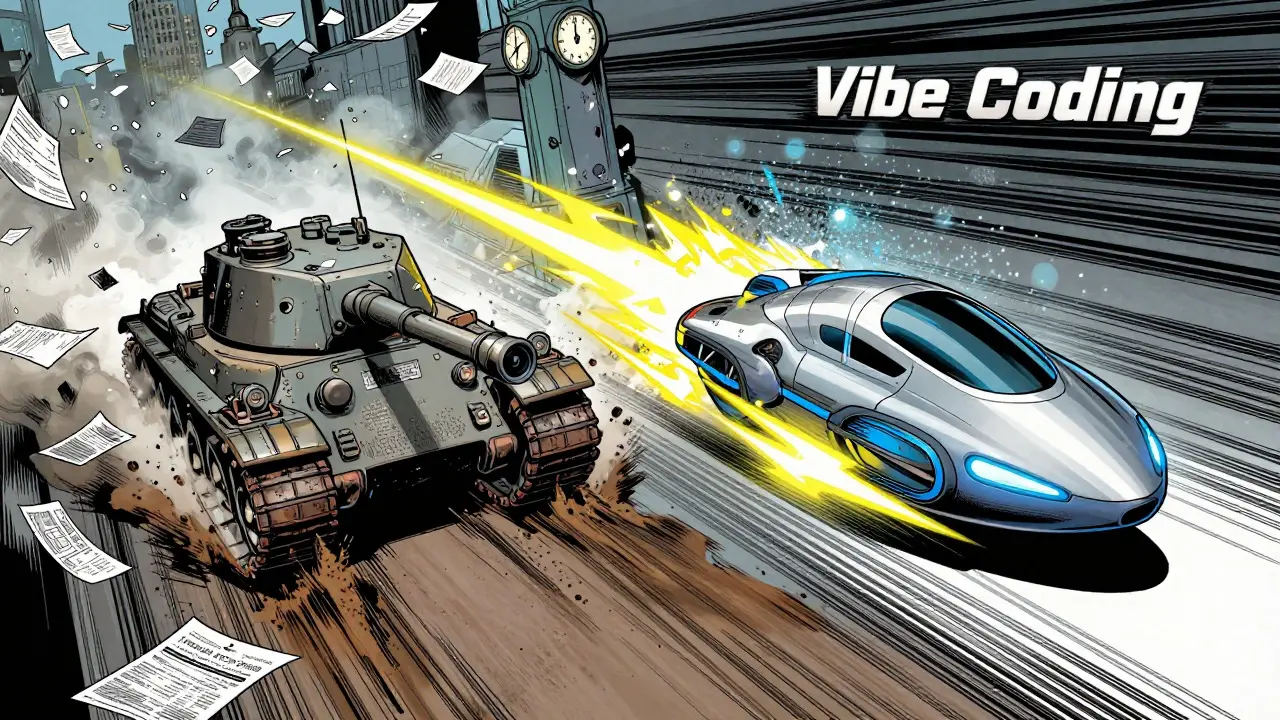
Imagine explaining a complex user flow to an AI and watching a working prototype appear in minutes. That is the reality of vibe coding, a prompt-driven development method where natural language instructions generate functional code without manual syntax writing. For product managers, this shift changes everything. You no longer wait weeks for engineering resources to validate a hypothesis. Instead, you build, test, and iterate in days. This approach directly attacks the biggest bottleneck in modern software development: the long gap between an idea and real user feedback.
Key Takeaways
- Vibe coding allows non-technical stakeholders to create working prototypes using plain English prompts and generative AI tools.
- This method can reduce product time-to-market by up to 5% and boost productivity by 40%, according to McKinsey research.
- It is ideal for rapid discovery, internal tooling, and minimum viable products (MVPs), but not suitable for high-security or regulated systems.
- Success requires mastering prompt engineering and understanding basic design systems to avoid technical debt.
- The workflow follows a structured cycle: Build, Show, Learn, Decide, ensuring every prototype leads to actionable insight.
What Is Vibe Coding and Why It Matters Now
Traditional product management relied heavily on documentation. You wrote detailed requirements, handed them off to engineers, and waited. That process was slow and often led to misinterpretations. Vibe coding flips this model. It treats code as an implementation detail rather than the primary artifact. Your focus shifts from specifying how something works to defining what it should achieve.
The term gained traction after Andrej Karpathy described the experience as "just see stuff, say stuff, run stuff, and copy-paste stuff, and it mostly works." This isn't about writing perfect code. It's about embracing natural language interaction to get a rough, testable version of your idea out into the world quickly. By 2026, this has moved beyond theory. Major tech companies like Meta use internal AI tools to let product teams prototype applications without waiting for dedicated engineering sprints. This democratizes creation, empowering designers, business stakeholders, and PMs to contribute directly to the build phase.
How Vibe Coding Accelerates Time-to-Feedback
The core value proposition here is speed. In traditional workflows, validating a user flow might take two to four weeks. With vibe coding, that timeline compresses to hours or a few days. Here is why:
- Immediate Iteration: If a button doesn't work or a screen feels clunky, you describe the fix in plain English. The AI updates the code instantly. No ticket, no backlog, no waiting.
- Lower Barrier to Entry: You don't need to know Python or JavaScript. You need to understand your users' problems and be able to articulate them clearly.
- Direct User Testing: Because the prototype is functional, you can show it to real users. Their reactions are based on actual interaction, not static mockups. This data is far more reliable for decision-making.
McKinsey data suggests this efficiency translates to tangible business outcomes. Generative AI methods like vibe coding can increase overall team productivity by 40%. For a product manager, that means more experiments per quarter, faster validation of market fit, and less time spent managing handoffs.
The Practical Workflow: From Idea to MVP
You don't just open a chat window and start typing randomly. Effective vibe coding requires structure. Think of it as a disciplined conversation with your AI partner. Here is a proven ten-step framework to turn an ambiguous problem into a live URL:
- Define the Problem: Write down the core issue. Include one activation metric and two leading indicators. Be specific. "Users drop off at checkout" is better than "Checkout is bad."
- Gather Inspiration: Look at platforms like Dribbble or Behance. Find visual references for the UI style you want. Screenshots help the AI understand your aesthetic intent.
- Draft Requirements: Ask the AI to draft simple product requirements. Use Given-When-Then acceptance criteria. Example: "Given a logged-in user, when they click 'Save', then a success toast appears."
- Break Down Features: Split the app into screens. Define the data models, routes, and authentication needs. Keep it minimal.
- Select Your Tools: Choose a platform that fits your skill level. Tools like Lovable, Bolt, or Cursor combine AI generation with no-code interfaces. Pick one that feels intuitive.
- Prompt Step-by-Step: Don't ask for the whole app at once. Prompt for one screen or feature at a time. Reference your design inspiration and acceptance criteria.
- Troubleshoot via Iteration: When errors occur, read the message. Describe the desired behavior again. Often, rephrasing the prompt solves the issue.
- Deploy Quickly: Push the prototype to hosting platforms like Netlify or Vercel. Set environment variables for any API keys to keep things secure.
- Test with Users: Conduct five to ten usability tests. Watch how people interact. Note where they hesitate or make mistakes.
- Review Against Metrics: Compare the results against your initial success metrics. Did the activation rate improve? If yes, scale. If no, pivot.
Best Use Cases vs. Pitfalls
Vibe coding is powerful, but it isn't a magic bullet for every scenario. Knowing when to use it-and when to stick to traditional engineering-is critical for maintaining quality.
| Scenario | Suitability | Reasoning |
|---|---|---|
| User Experience Prototypes | High | Ideal for testing flows and value propositions without full backend complexity. |
| Internal Tools & Dashboards | High | Removes bottlenecks for PMs needing quick data views or admin panels. |
| Hackathon MVPs | High | Speed is paramount; technical perfection is secondary to proof of concept. |
| High-Security Systems | Low | Finance and healthcare require rigorous audit trails and security oversight. |
| Complex Backend Logic | Low | Concurrency handling and long-running processes need specialized engineering. |
| Long-Term Production Apps | Moderate | Requires careful engineering handoff to manage maintenance and technical debt. |
The biggest risk isn't that the code will crash. It's that you'll spend three days building a prototype that could have been sketched in Figma in thirty minutes. Always ask yourself: Is the fastest path to learning here actually coding? Sometimes, a whiteboard session or a static design file provides enough clarity without the overhead of generating code. Vibe coding accelerates validated learning, but only if you define clear "done" criteria and maintain consistent reviews.

Essential Skills for Modern Product Managers
As this practice becomes standard, the role of the product manager evolves. You are no longer just a spec writer; you are a builder. This requires new competencies:
- Prompt Engineering: This is your new coding language. You must learn to craft clear, concise, and comprehensive prompts. Ambiguity in your prompt leads to ambiguity in your code.
- Data Fluency: You need to understand data pipelines well enough to connect your prototype to live databases or APIs. Knowing which data points matter helps you build relevant features.
- Design System Knowledge: Integrating your company's design system into the vibe coding workflow reduces rework. If the AI generates buttons that don't match your brand, you'll waste time fixing it. Enforcing design standards early saves headaches later.
- Human-AI Orchestration: You must decide when to delegate to AI and when human creativity is indispensable. Trust the AI for boilerplate and structure, but keep the strategic vision firmly in your hands.
Building Trust in AI-Assisted Workflows
Critics argue that vibe coding creates technical debt. They are right-if you do it carelessly. To build trust in these workflows, you need guardrails. Track drift, rework, and defects. If you find yourself constantly rewriting the same component, your prompts aren't good enough, or the tool isn't right for the job. Consistent reviews ensure that the prototype remains a living specification, not a disposable toy. When you hand off a vibe-coded prototype to engineering, it should bridge the gap between vision and execution, not add confusion. By treating these builds as evidence rather than final products, you lead with high-integrity narratives backed by functional demos.
Does vibe coding replace engineers?
No. Vibe coding replaces the need for engineers to handle every minor prototype request. It frees engineering resources to focus on complex architecture, scalability, and production-grade code. It complements engineering rather than replacing it.
What tools are best for beginners in vibe coding?
Platforms like Lovable and Bolt are excellent starting points because they offer a no-code interface combined with AI generation. Cursor is great if you have some familiarity with code editors. Start with simple web apps before attempting complex integrations.
How do I handle errors when the AI generates broken code?
Read the error message carefully. Then, rephrase your prompt to be more specific about the expected behavior. Often, breaking the task into smaller steps resolves issues that arise from overly complex single prompts.
Is vibe coding suitable for mobile app development?
Yes, but with caveats. Many AI tools now support React Native or Flutter generation. However, mobile-specific constraints like battery usage and device compatibility require more careful testing than web-based prototypes.
How much does it cost to use vibe coding tools?
Most major platforms operate on a freemium model. Basic usage is free, while advanced features, higher token limits, and deployment options usually range from $20 to $50 per month. This is significantly cheaper than hiring a contractor for a quick prototype.

john randall
August 26, 2026 AT 13:34Been watching this space for a while. The shift from spec-heavy documentation to just... building it, feels like the natural evolution we've been waiting for. It removes a lot of the friction that used to exist between 'idea' and 'validation'.
Jeff Falcon
August 28, 2026 AT 05:07I have to say, I was pretty skeptical about the whole 'vibe coding' thing at first!; because it sounded like something that would lead to a mess of spaghetti code, right?; but after trying it out on a small internal tool, I realized that the speed really does change how you think about product development.; the fact that you can iterate in minutes instead of weeks is just game-changing for us here.; I mean, who wants to wait three weeks to find out if a button placement works when you can just fix it and test it again in five minutes?; it's not perfect, obviously, but the barrier to entry is so much lower now.; I think the biggest win is that PMs aren't stuck waiting on engineering tickets just to see a rough version of their idea.; it's all about getting that feedback loop tight.; honestly, I'm glad we started experimenting with these tools earlier than later.; it has definitely changed my perspective on what's possible in a sprint cycle.
Alyson Karson
August 29, 2026 AT 10:06this is exactly why we need to stop overthinking the prototype phase!! i spent way too long last quarter writing specs for a feature that ended up being completely different from what users actually wanted. if i had just vibe coded a quick demo we could have saved months. its about momentum not perfection. get it in front of people fast and let them tell you where its broken. dont be afraid to throw away the code later, thats what prototypes are for. the tech debt fear is real but its manageable if you keep scope tight. just build the thing already!
Chris Neal
August 30, 2026 AT 22:22The article misses a crucial point: context window limits. If your prompt history gets too long, the AI starts hallucinating variable names or forgetting constraints you set ten messages ago. You need a disciplined approach to resetting context or using external state management files. Otherwise, you're just playing whack-a-mole with bugs that didn't exist in your mental model.
Vishnu Vardhan Reddy M S
September 1, 2026 AT 01:40Oh great, another trend where non-engineers are going to 'break' the production environment. But sure, let's trust the PM to handle API keys and security best practices. Just don't come crying to us when the auth flow is a security nightmare. We'll be there, fixing your 'vibe' code, probably. Thanks for the heads up.
Kyle Ware
September 1, 2026 AT 08:34Great point about the security aspect. One tip for anyone starting out is to treat the vibe-coded app as a sandbox. Never connect it directly to your main database without a read-only replica or a staging environment. This way you can experiment freely without the risk of corrupting live data. It keeps the team happy and the data safe.
Iva Grekova
September 1, 2026 AT 20:35I love the optimism here. I think the key is finding the balance. For simple CRUD apps or internal dashboards, it's fantastic. But for anything complex, it still needs human oversight. I've seen some really cool things built by designers who never touched code before. It's empowering to see that skill gap closing.
Onyinyechi Nwosu
September 2, 2026 AT 21:26It changes how you communicate with engineers too. Instead of vague descriptions you show them a working example. That reduces misinterpretation significantly. I found it helpful for aligning expectations before any serious development starts.
Chandan Singh
September 3, 2026 AT 23:12Let's be real, this is just prompt engineering with a fancy name. The value isn't in the 'vibe', it's in the ability to translate business logic into technical constraints quickly. If you can't articulate the problem clearly, no amount of AI will save you. It's a skill amplifier, not a magic wand. People who understand systems will thrive, others will just create more chaos faster.
Brannen Hall
September 4, 2026 AT 21:43So basically, we're replacing skilled labor with a chatbot that makes up facts? Bold strategy. I bet the maintenance costs will skyrocket once the novelty wears off and someone has to actually maintain this 'vibe' code. Probably won't be the PM doing it, though. Good luck with that.